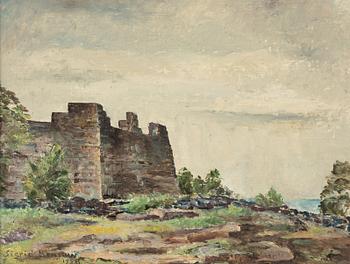
The old mill
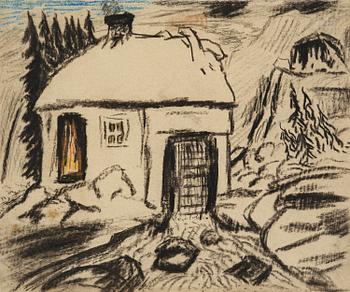
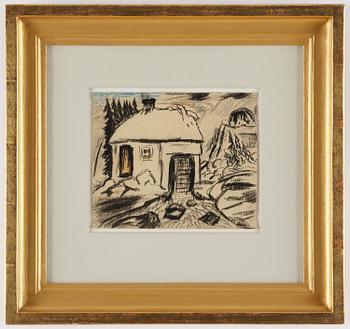
Crayon on paper 17 x 20.5 cm.
Provenance
Bukowski Auktioner, International Spring Auction 516, 29-31 May 2000, lot 70.
More information
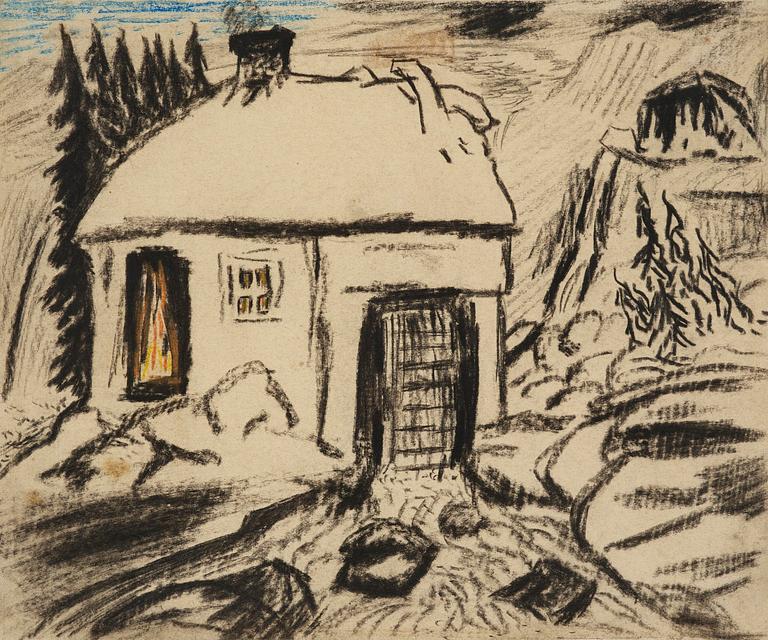
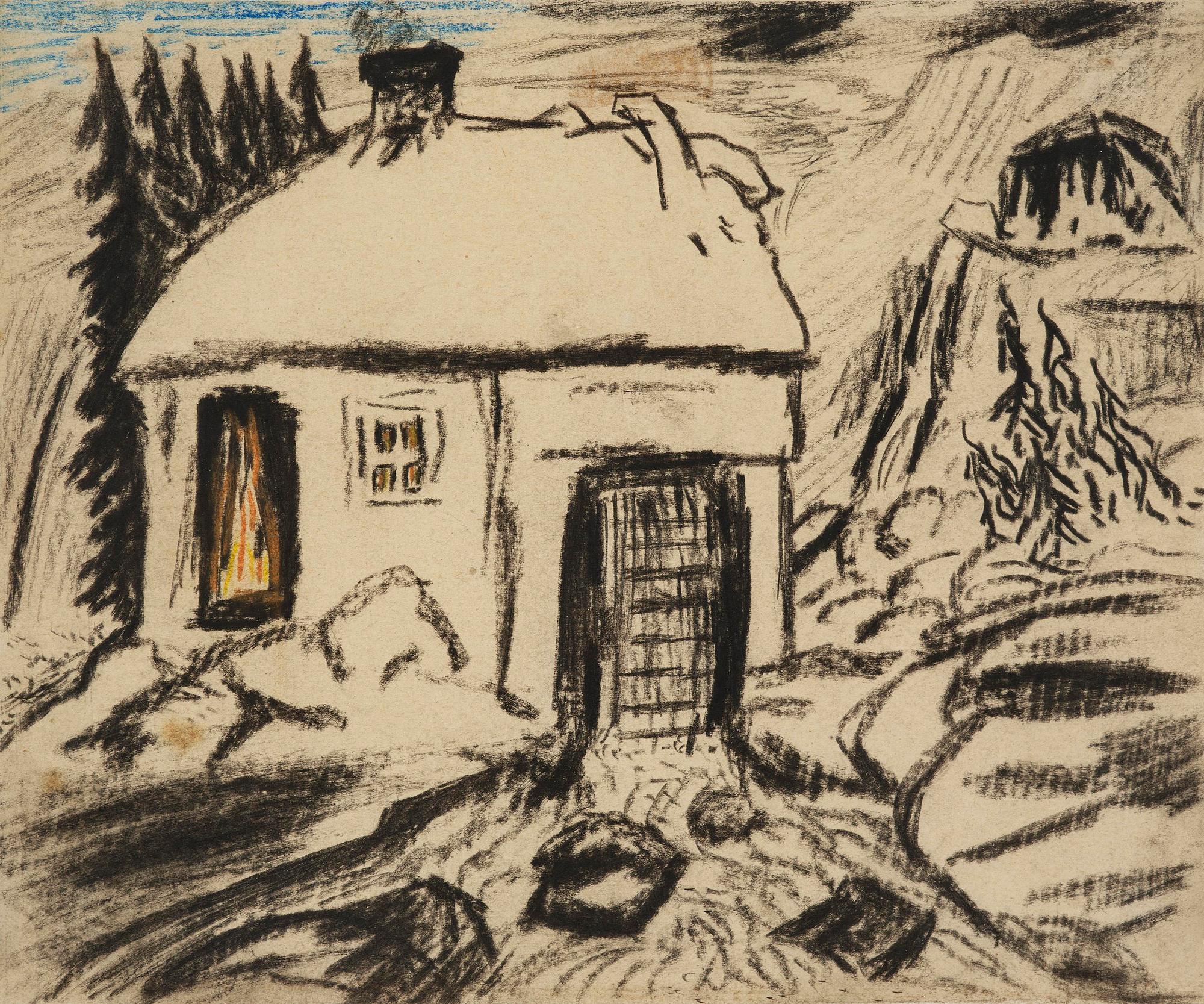
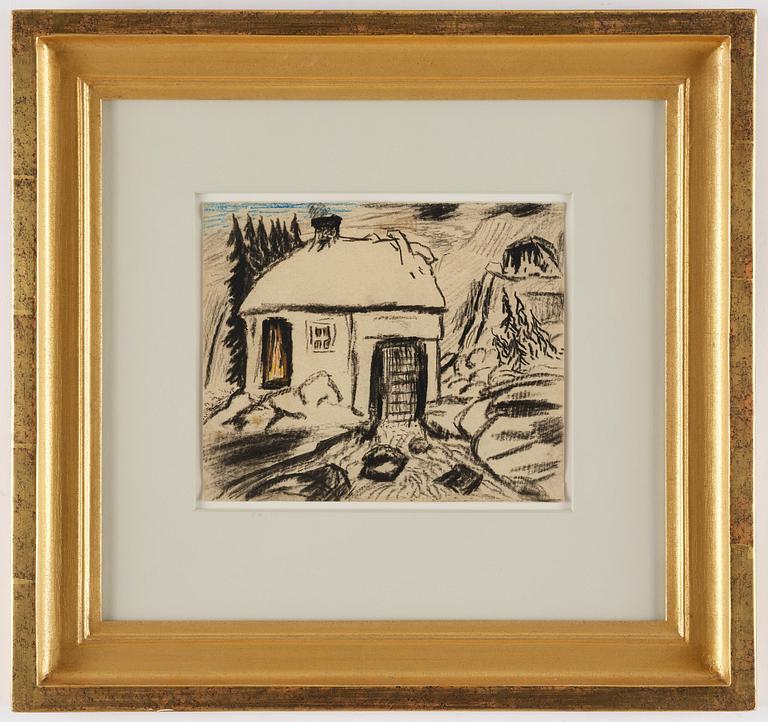
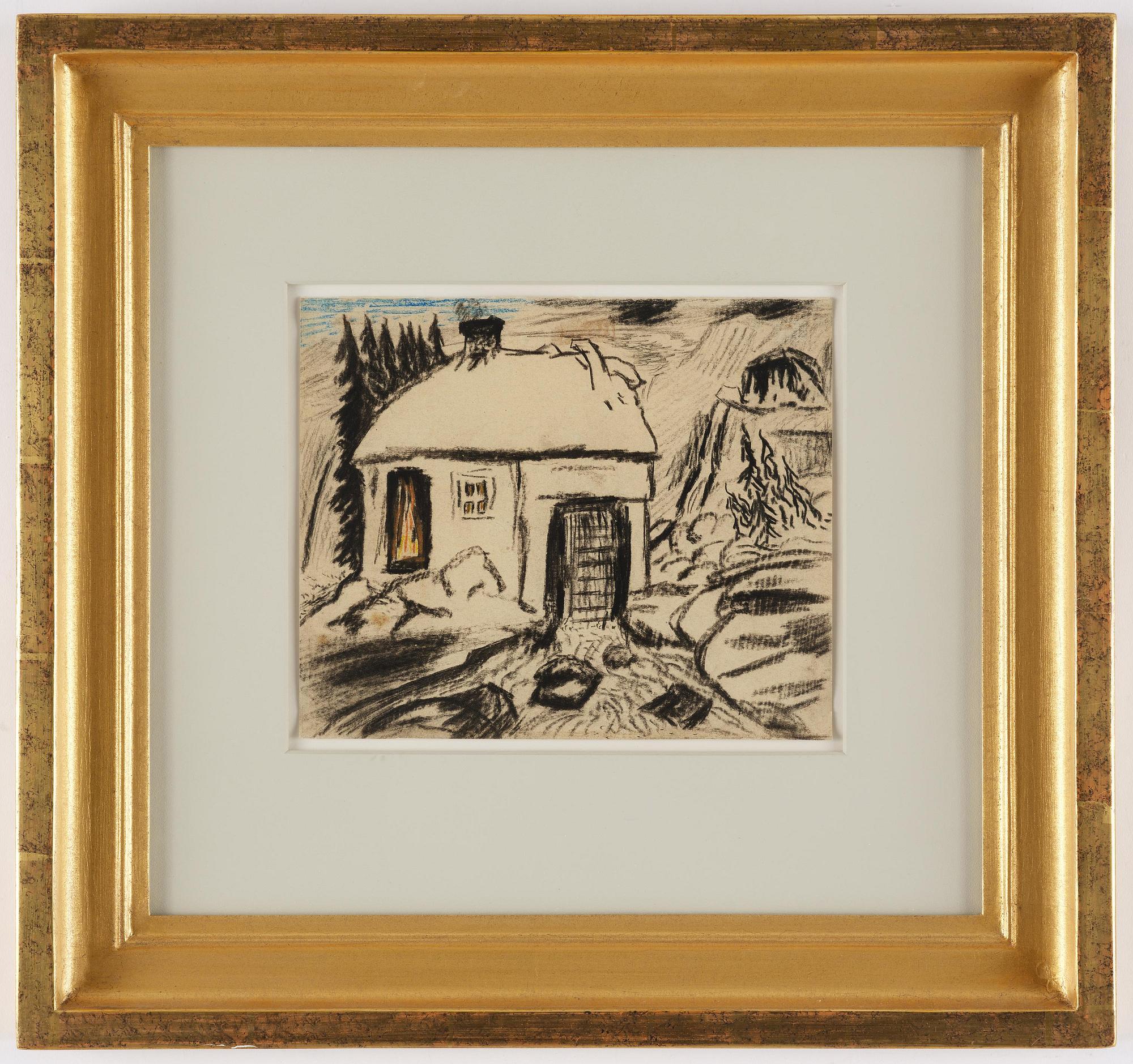
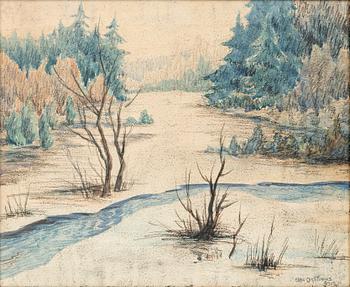
In "The old mill" by Carl Fredrik Hill, the focus is on the mill building with its large waterwheel, which cuts through the very structure of the house and is placed in the center of the image. On either side of the waterwheel, the flowing water is visible; in the background, it is depicted as a narrow, steep waterfall, while in the foreground it has widened into a turbulent stream that rushes over rocks and stones, directly towards the viewer.
The old mill building also appears to be used as a dwelling. Through the openings on the long side of the house, a warm glow of firelight shines, and black smoke rises from the chimney into the blue sky. Behind the house, seven tall, slender sprouces grow closely together. The straight growth of the trees forms a protective wall between the house and the background, where one can discern a mountain and possibly another waterfall. To the right of the house, another, taller mountain rises with several ledges. On one of the ledges, the entrance to a dark cave is visible.
It is an interesting drawing with several symbol-laden motifs; the trees, the cave, the mill, the mountain, the stones, and the waterfall.
More about Carl Fredrik Hill
Carl Fredrik Hill was a Swedish artist born in Lund. Hill is considered one of Sweden's formost landscape painters. His fate and artistry are perhaps the strangest but most interesting in Swedish art history. Born in an academic home in Lund, despite his father's protests, he managed to begin studies at the Art Academy in Stockholm and then traveled to France, where he came in contact with Corot's landscape painting. He found his inspiration in Barbizon and later on the River Oise, in Luc-sur-Mer and Bois-le-Roi. He painted frantically with the hope of being accepted into the Salon de Paris. Already during his student years, he struggled with an incipient mental illness and at the age of 28 he was taken to the mental hospital in Passy. During the hospital stay he began his rich production of drawings and then continued with the production after his return to Lund, where he was cared for by his family for the rest of his life. In thousands drawings, a fantasy world of figures scenes appears. Today, Hill's river landscape and flowering fruit trees from the years in France, together with the visionary drawings from the period of illness in Lund, have received great recognition. His art depicts a loneliness and longing that is easy to get caught up in. He is mainly represented at the Malmö Museum and at the National Museum in Stockholm.
Read moreFor condition report contact specialist