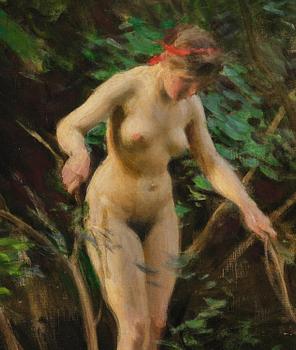
Anders Zorn (Sweden, 1860-1920) "Bräcklig spång"
"Bräcklig spång"
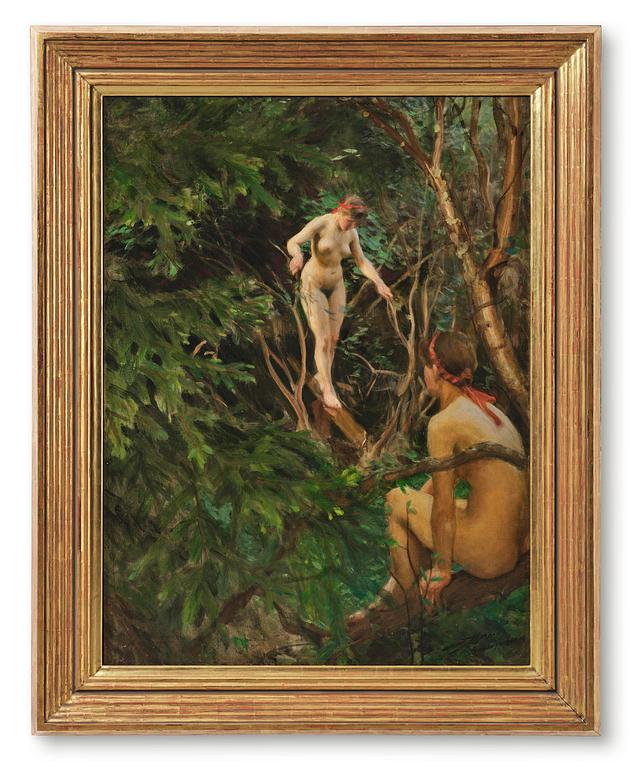
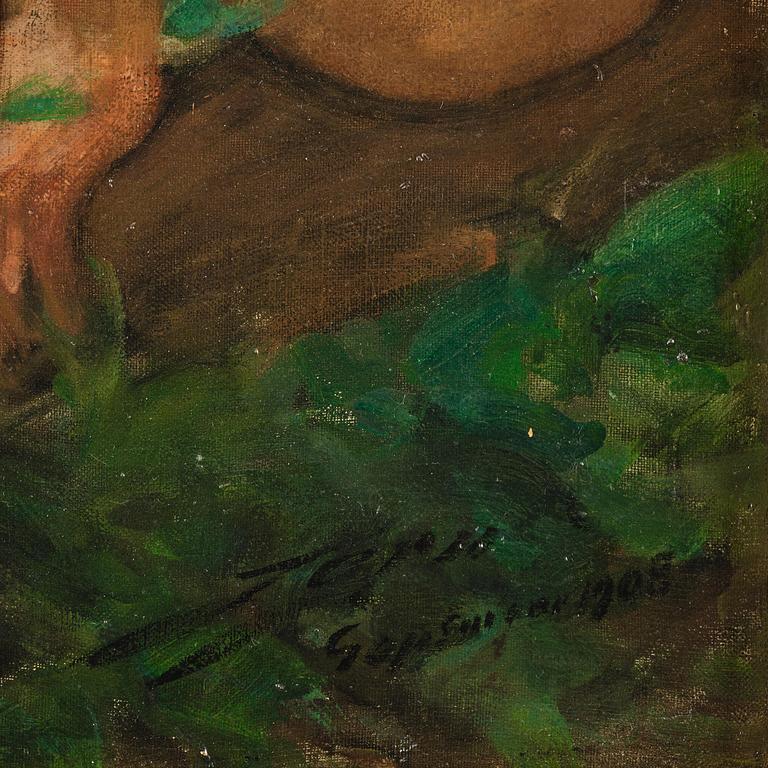
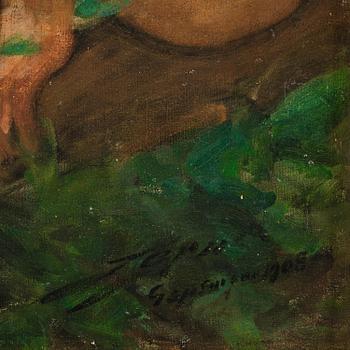
Signed Zorn and dated Gopsmor 1908. Oil on canvas 121.5 x 91 cm.
Provenance
Fritzes kungliga hovbokhandel, Stockholm.
Publisher Simon Söderstam (1882-1952), Stockholm, acquired from the above circa 1947.
Robert Andersson, Vassmolösa, Kalmar.
Art dealer Börjesson, Gothenburg.
Tage Pettersson, Anderstorp.
Builder John Journath, Norrköping.
Beijers Auktioner, Stockholm, spring auction 40, 25-27 April 1990, lot 352.
Bukowski Auktioner, auction 516, Internationella Vårauktionen, 29-31 May 2000, lot 249.
Exhibitions
VIII Esposizione d'Arte della città di Venezia, 22 April-31 October 1909, cat. no 16 "Ragazze che giocano".
Galerie Heineman, München, "Anders Zorn-Ausstellung", 1909, cat. no 16 "AmSteg".
Emil Richter, Königlicher Hofkunsthändler, Dresden, January 1910, cat. no 16 "AmSteg".
Art exhibition in Hudiksvall, 1913, cat. no 2.
Literature
Franz Servaes, "Anders Zorn", 1910, p. 48, illustrated pl. 77.
Ernst Malmberg, ”Larsson-Liljefors-Zorn. En återblick”, 1919, p. 117.
Tor Hedberg, "Anders Zorn 1894-1920", 1924, p. 92, illustrated p. 96.
Gerda Boëthius, "Zorn - tecknaren, målaren, etsaren, skulptören", 1949, p. 481-482, illustrated in colour, plate 33, registered in the year 1908, p. 552.
Anders Zorn, ”Självbiografiska anteckningar”, published and commented on by Hans Henrik Brummer, 1982, mentionned p. 150.
Inger Fredriksson, ”Anders Zorn – Mannen, Mästaren, Myten”, 1984, p. 38, illustrated p. 39.
Cecilia Lengefeld, "Zorn. Resor, konst och kommers i Tyskland", 2000, registered under the exhibitions in Munich 1909 and Dresden 1910.
Anders Zorn, "Självbiografiska anteckningar", 2004, published by Birgitta Sandström, p. 243 and 275.
More information
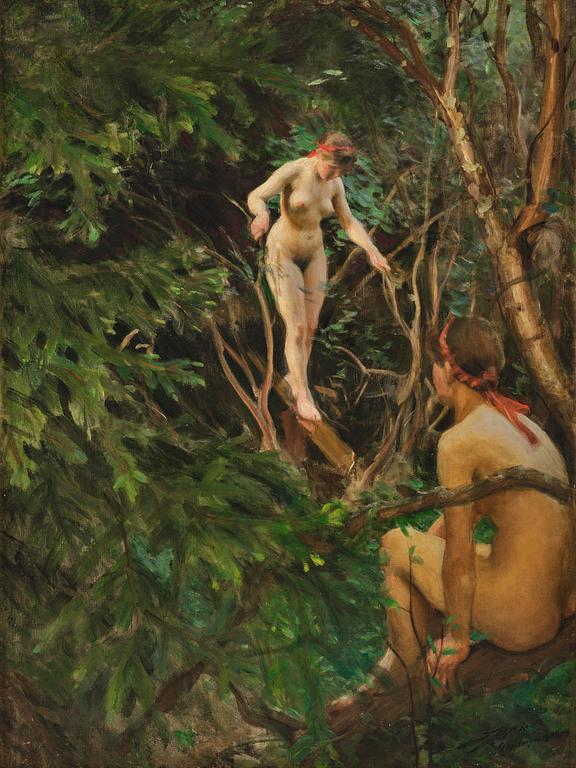
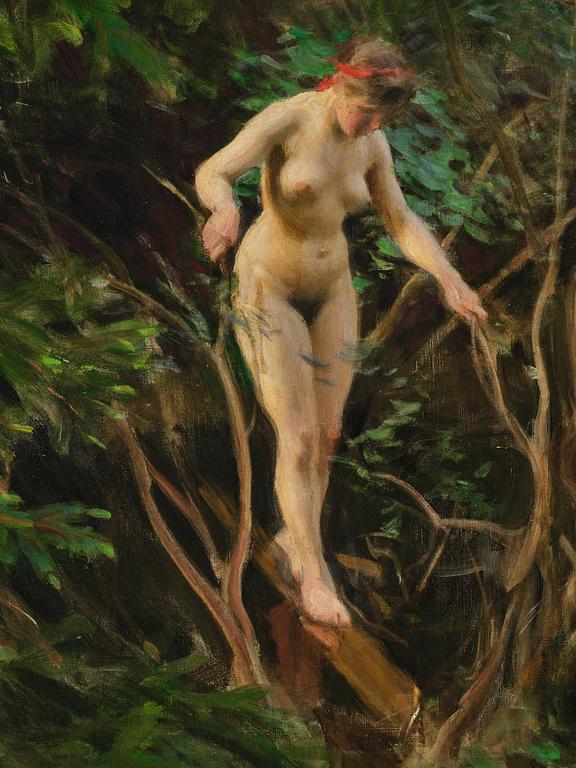
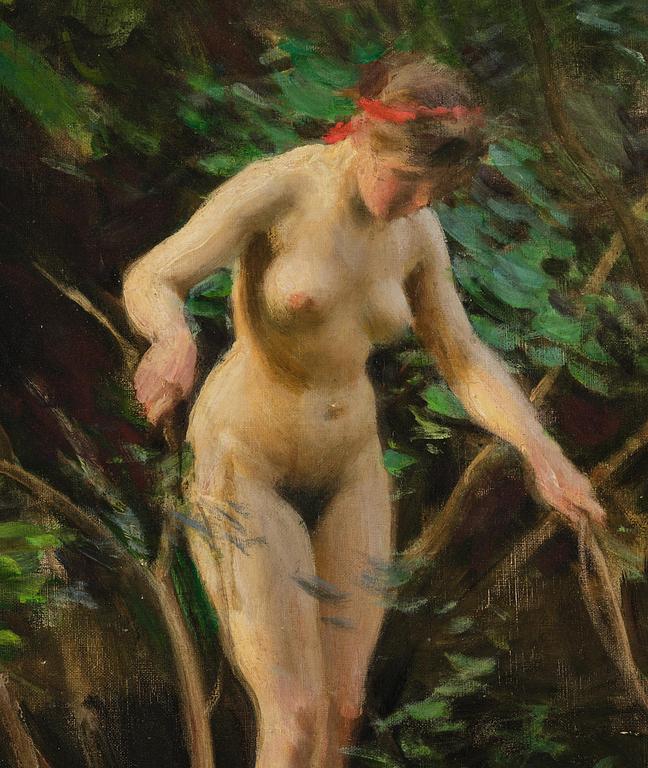
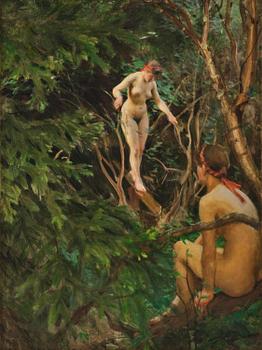
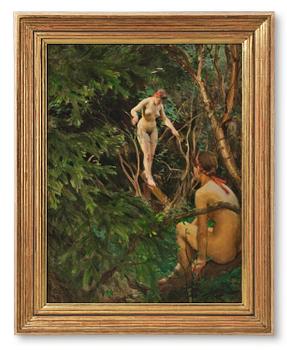
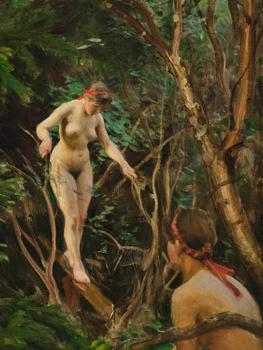
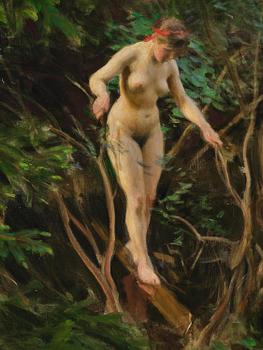
In "Bräcklig spång" from 1908, Anders Zorn depicts two young women in a forest clearing at Gopsmor. The scene is framed by greenery, with dense spruce branches almost obscuring the view. The light, the so-called “Gopsmor light”, falls upon the young woman who is carefully balancing her way across a narrow footbridge. The movement is captured with great skill, and as viewers we can sense the model’s concentration as she makes her way, step by step, across the dark stream. Her face lies in shadow as she stretches out her arms towards a few fragile branches for support. The skillful Zorn allows the light to play across the young model’s skin, which seems to shimmer as she moves. The composition is built around a diagonal that, via the footbridge, leads towards the second woman, positioned in the foreground like a quiet forest spirit. Like exclamation marks amid the greenery, the red wool ribbons in the darlecarlian girls’ hair catch the eye.
When it came to locations for Anders Zorn’s nudes in greenery motif, Gopsmor and the Stockholm archipelago were at times rivals. For a long time, Zorn had searched for a place where he could work in complete peace. He envisioned a small log cabin by the riverbank, where he could see the water and hear the stream passing. He found such a place at Gopsberget in Dalarna, where tall pines and magnificent spruces formed the setting for his “open-air studio.” A small clear stream and the Dalälven River nearby completed his dream of an ideal secluded location.
Gerda Boëthius has described the genius of his choice of location: “It is not merely that nature offers such rich variety within a relatively limited area; its entire composition is such that it provides an endless variation of lighting, daylight effects and colours. The surface of the river can display every colour from yellowish brown to clear blue, while reflections from the water affect the colours and light in the forest and meadows.”
Life at Gopsmor was primitive and the food simple. Although some of Zorn’s guests at Gopsmor found the conditions somewhat too spartan, there can be no mistaking the beneficial effect that his stays at Gopsmor had on Zorn’s creativity and inspiration. Zorn always worked industriously at Gopsmor; it was as though an extra zeal and joy in his work came over him as soon as he had managed to make his way out to the secluded studio. It is therefore hardly surprising that several of the artist’s best-known paintings were created there.
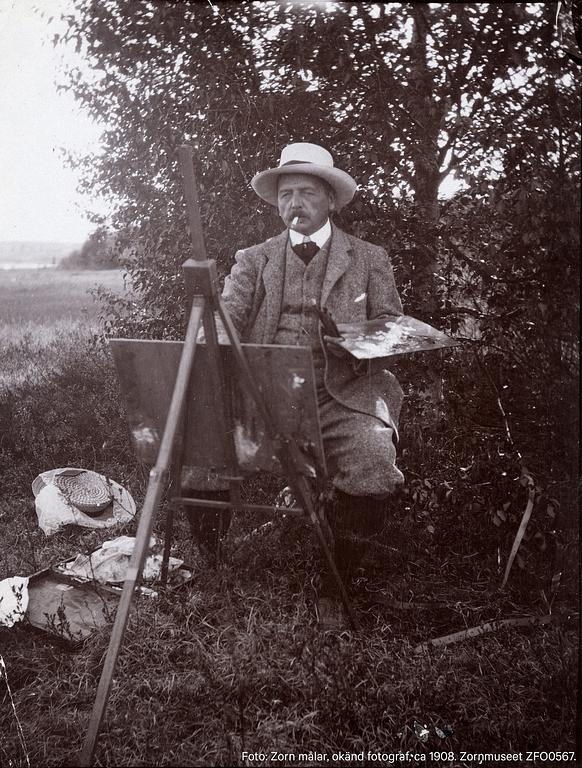
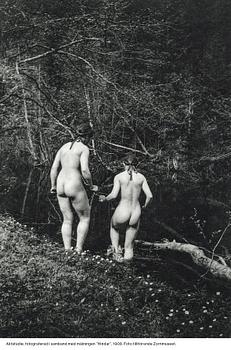
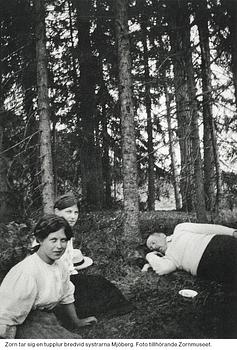
Zorn often worked with a camera and photographs as preparatory material for his paintings. In "Bräcklig spång", the focus and shimmering light fall on the model at the centre of the composition. The foreground, with its dense spruce branches, is painted in a more subdued tone, while the seated model seems to merge with nature. The models are the Mjöberg sisters, who also posed for Zorn’s painting "Hindarna" from the same year, 1908. Photographs from the work on "Hindarna" have been preserved. The sisters also posed for the bronze fountain sculpture "Morgonbadet" from 1908–1909, which can be found in the garden of Zorngården as well as in Rosenbadsparken in Stockholm.
Gerda Boëthius described the paintings "Bräcklig spång" and "Hindarna", both from 1908, as major works in the artist’s oeuvre from this period. “He put his soul into every brushstroke when he painted the spires of the tree trunks, the branches, and the beautiful, soft bodies of the girls” ("ZORN. Tecknaren, Målaren, Etsaren, Skulptören", 1949).
In "Bräcklig spång", Zorn fully exploits every nuance available on his artistic palette, conveying the overall grandeur of the scene in a fleeting moment. In his beloved home region of Dalarna, the artist found a timeless motif that allowed him to explore different painterly aspects with great success. Through an intricate and well-balanced interplay of lines, and with lush greenery and light-filled plein-air painting as its foundation, Zorn presents the young women from Dalarna in a quiet tribute to the freedom of youth and the breathtaking beauty of nature.
More about Anders Zorn
Anders Zorn, born in Mora in 1860, showed artistic talent from a young age. In 1875, he traveled to Stockholm and became a student at the then Slöjdskolan (now Tekniska högskolan) in Stockholm, and shortly after, he joined the Royal Academy of Fine Arts. Initially, Zorn had aspirations of becoming a sculptor, but soon watercolor painting took over, becoming his primary medium until 1887. At the student exhibition in 1880, Zorn had his breakthrough with the watercolor painting "I sorg." The following year, he gained international acclaim as a portrait painter. His watercolor painting reached its pinnacle during this period, and his most famous work from this time is "Vårt dagliga bröd” from 1886. Shortly thereafter, Zorn transitioned to oil painting, which was met with immediate success. Zorn's reputation mainly rested on his portrait art, and he portrayed many notable figures, including presidents. For instance, he created an etching of Theodore Roosevelt. His etchings significantly contributed to his success. In the late 1880s, Zorn began working in the genre that would increasingly become his trademark: nude figures in outdoor settings. He had long been fascinated by the movement of water and the reflections of light on its surface. Now, he added the complexity of placing a model near or in the water, aiming to depict a synthesis between nature and humanity. In 1896, Zorn and his wife moved back to Sweden and settled in Zorngården in Mora. This move sparked a renewed interest in his homeland, which would be reflected in his future paintings. Among the artist's scenes from the Mora region, portraying its local customs and ancient traditions, "Midsommardansen" holds the highest value according to Zorn himself. Today, the painting can be found at the National Museum.
Read moreFor condition report contact specialist

What will the transport cost?
Shipping can only be arranged by contacting specialdelivery@bukowskis.com.