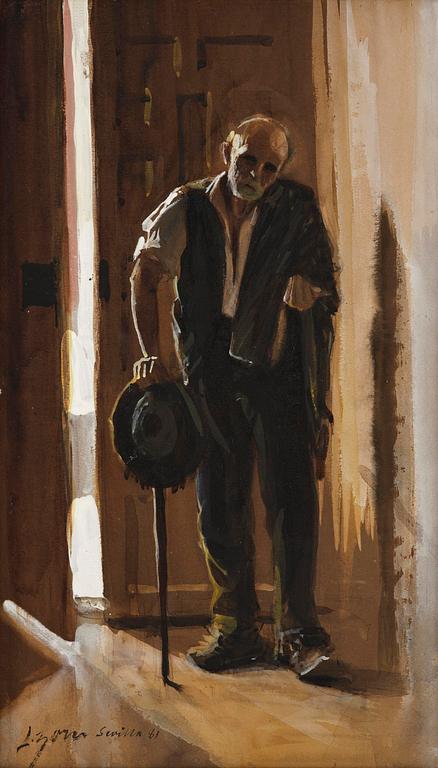
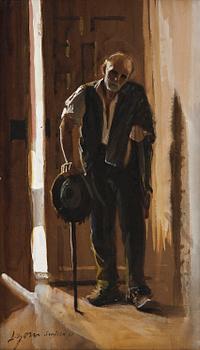
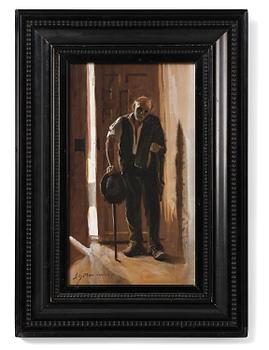
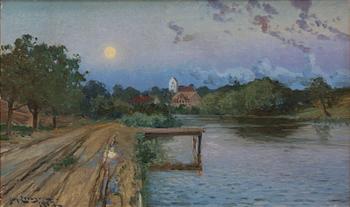
Anders Zorn (Sweden, 1860-1920) Beggar in Seville
Beggar in Seville
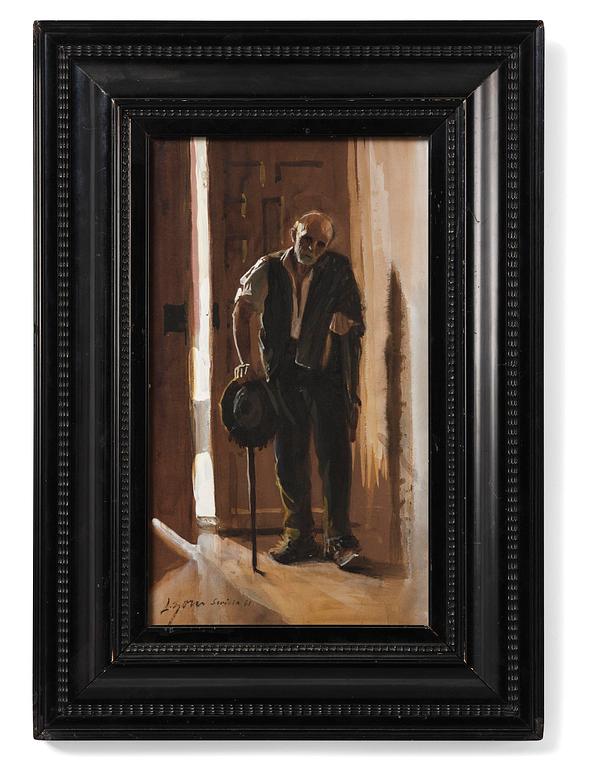
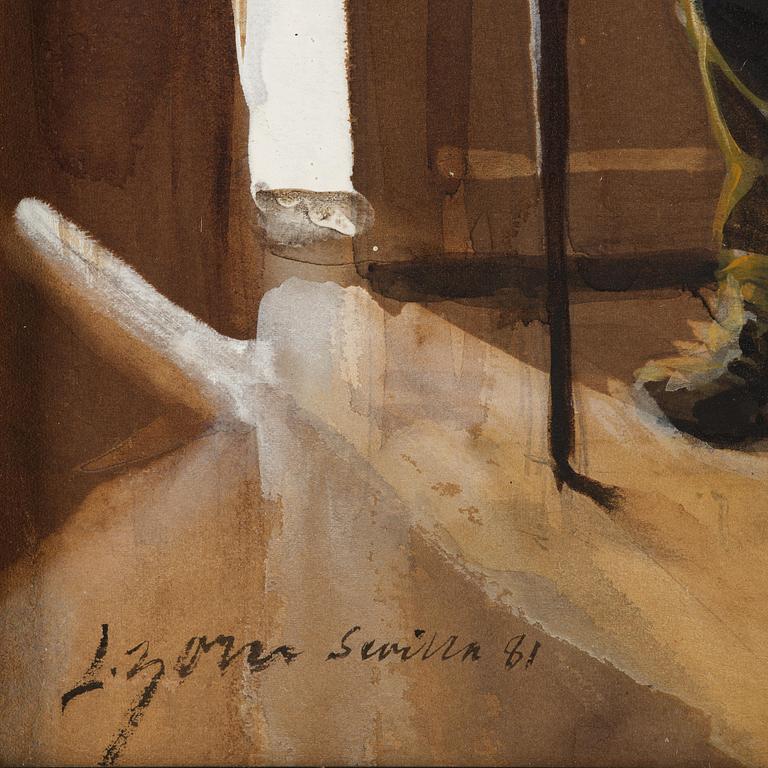
Signed L. Zorn and dated Seville 1881. Watercolour heightened with white on paper, 38,5 x 22,5 cm.
Provenance
Consul Erik Brodin (1872–1931), Stockholm.
Managing Director Carl-Axel Fockler, Halmstad.
Bukowski Auktioner, Höstauktionen 380, 8–11 November 1967, lot 277.
Stockholms Auktionsverk, Klassiska, 8 December 2016, lot 3093.
Private collection.
Exhibitions
Nationalmuseum, Stockholm, "Zorn - en svensk superstjärna", 18 February - 29 August 2021, cat. no. 16.
Literature
Gerda Boëthius, "Zorn - Tecknaren - Målaren - Etsaren - Skulptören", 1949, under year 1881 p. 538, mentionned pp. 79, 96, 98, 99, 101, 121, 181, 224, illustrated fig. 24.
Gerda Boëtius, "Zorn - Människan och konstnären", 1959, p. 51, 53, 58, 90, illustrated pl. 5.
Gerda Boëthius, "Zorn - Svensk och världsvandrare", 1959, illustrated pl. 5.
Hans Henrik Brummer, "Zorn MCMLXXXIX", 1989, p. 43, illustrated fig. 8 p. 43.
Hans Henrik Brummer, "Anders Zorn - till ögats fröjd och nationens förgyllning", 1994, p. 59.
Hans Henrik Brummer, "Ernst Josephson - Målare och diktare", 2001, p. 110.
Johan Cederlund, "Zorn i Spanien", 2009, illustrated p. 31.
Carl-Johan Olsson (ed.), "Zorn - en svensk superstjärna", 2021, p. 13, illustrated p. 161.
More information
The year was 1881, and the twenty-one-year-old Anders Zorn, or Leonhard Zorn as he styled himself at the time, had resolved to travel to Spain. His choice of destination can be explained in part by the profound impression made upon him by the works of the artist Egron Lundgren. In En målares anteckningar (1873), Lundgren recounted his travels in Spain, and at the memorial exhibition held in his honor at the Royal Academy of Fine Arts in Stockholm in 1876, Zorn and other visitors had also encountered his picturesque scenes from the country: flamenco dancers, bullfighters, and charming women with languid black eyes beneath their mantillas.
At this time, Spain was enveloped in an aura of mystery. It offered something foreign and exotic that set it apart from the rest of Europe and attracted numerous artists. Moreover, there was a strong market for “Spanish” subjects, no insignificant consideration for a young artist seeking to establish a career.
Zorn travelled via London and Paris. In the French capital he encountered his fellow artists Ernst Josephson and Hugo Birger. Since Josephson had long cherished plans to visit Spain himself, the two decided to join forces. “A few days later we were on our way to the long-awaited country of our dreams, a land we had imagined so many times,” Zorn later recalled in his autobiographical notes.
The journey south was undertaken by train. Upon arriving in Madrid, Josephson took Zorn to the Prado Museum to study the works of Velázquez. It was the first time Zorn stood before the paintings of the great Spanish master, yet they made little immediate impression on him. “I was still very green,” he later remarked.
From Madrid the friends continued on to Seville. There Zorn quickly felt at home. He delighted in his surroundings and worked with great enthusiasm. “Things are going splendidly,” he wrote in a letter to his future brother-in-law Hugo Geber. “It is warm here, sunny, full of delightful girls and picturesque beggars, a paradise for painters. One would be mad to remain in Paris doing nothing but looking at what others have already achieved.”
Zorn enjoyed the company of his companion, who was ten years his senior, and Josephson held him in equally high regard: “Zorn is a good lad.” Artistically, however, the two friends pursued different subjects, largely because of their differing points of departure. Zorn had come to Spain with Egron Lundgren’s images firmly in mind, whereas Josephson was deeply influenced by the painting of Velázquez and Goya; the merely picturesque held little appeal for him. “Josephson went out almost every day to Triana to paint Gypsies,” Zorn observed. It was there, in this suburb of Seville, that Josephson painted his celebrated Spanska smeder (Nationalmuseum) in the autumn of 1881. Zorn himself spent his days in the courtyard, or patio, attached to their lodging, where he could work undisturbed. Like Josephson, he selected his models from among the city’s Roma population, but Zorn painted only young women. His portfolio was filled with watercolours depicting dark-complexioned girls in quiet poses, usually set against neutral backgrounds. Working wet-in-wet, he employed subtle tonal harmonies that corresponded to the dreamy expressions of his sitters.
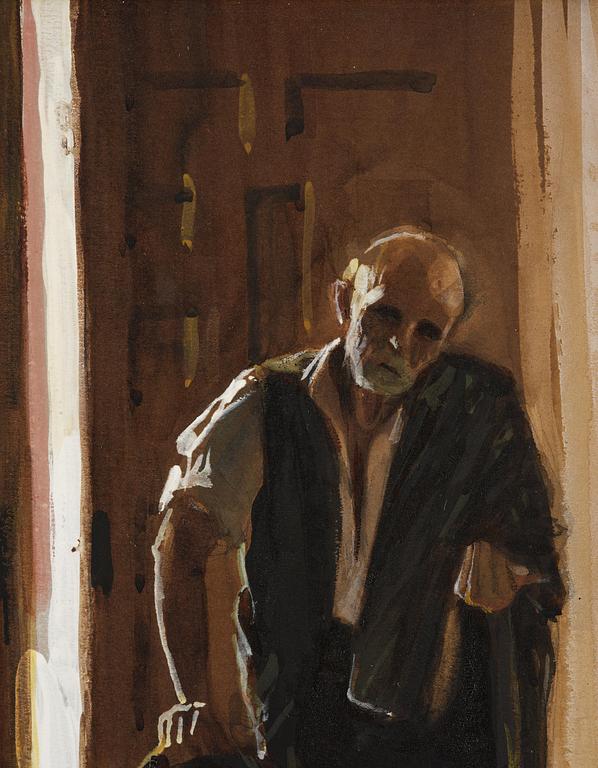
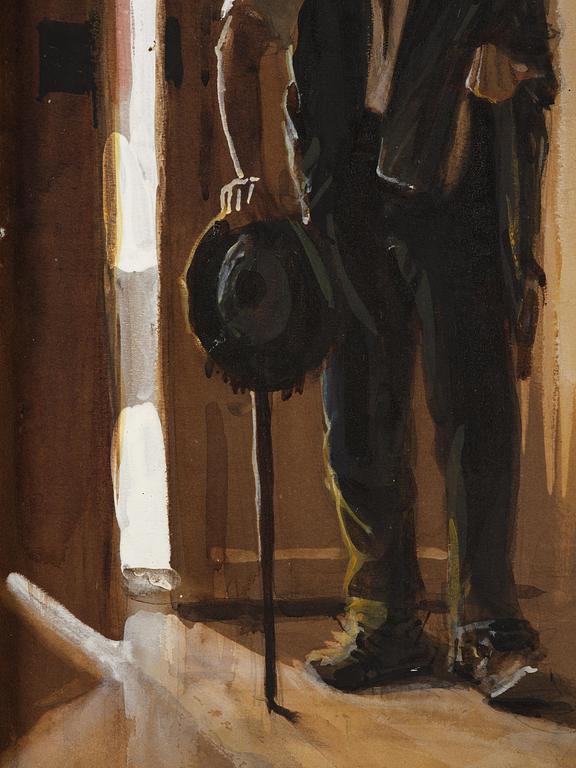
On one occasion, Josephson and Zorn each produced a version of the same subject: an elderly beggar entering a house. It is Zorn’s version, "Tiggare i Sevilla", that Bukowskis now offers for sale. The choice of subject was probably inspired by Josephson. Earlier that year, at the Paris Salon, where Josephson himself had exhibited successfully, Jules Bastien-Lepage’s painting "Le Mendiant" had attracted considerable attention. It depicts an impoverished old man receiving a piece of bread from a young girl outside a house. Now, the two Swedish artists sat side by side in a house in Seville, each creating his own interpretation of a comparable scene. The impoverished man before them extends his hand while light streams into the room through the half-open door.
“He paints in the manner of Egron Lundgren,” a contemporary critic wrote of Zorn, “but with even greater boldness.” This “boldness” resided in Zorn’s sketch-like manner of execution. At a time when great value was still attached to the polished finish of a work of art, his brushwork was sometimes considered excessively summary. Even his future wife Emma could feel that his Spanish watercolours lacked a certain refinement. Today, however, it is precisely Zorn’s technical brilliance that strikes us most forcefully.
Johan Cederlund, Zornmuseet
More about Anders Zorn
Anders Zorn, born in Mora in 1860, showed artistic talent from a young age. In 1875, he traveled to Stockholm and became a student at the then Slöjdskolan (now Tekniska högskolan) in Stockholm, and shortly after, he joined the Royal Academy of Fine Arts. Initially, Zorn had aspirations of becoming a sculptor, but soon watercolor painting took over, becoming his primary medium until 1887. At the student exhibition in 1880, Zorn had his breakthrough with the watercolor painting "I sorg." The following year, he gained international acclaim as a portrait painter. His watercolor painting reached its pinnacle during this period, and his most famous work from this time is "Vårt dagliga bröd” from 1886. Shortly thereafter, Zorn transitioned to oil painting, which was met with immediate success. Zorn's reputation mainly rested on his portrait art, and he portrayed many notable figures, including presidents. For instance, he created an etching of Theodore Roosevelt. His etchings significantly contributed to his success. In the late 1880s, Zorn began working in the genre that would increasingly become his trademark: nude figures in outdoor settings. He had long been fascinated by the movement of water and the reflections of light on its surface. Now, he added the complexity of placing a model near or in the water, aiming to depict a synthesis between nature and humanity. In 1896, Zorn and his wife moved back to Sweden and settled in Zorngården in Mora. This move sparked a renewed interest in his homeland, which would be reflected in his future paintings. Among the artist's scenes from the Mora region, portraying its local customs and ancient traditions, "Midsommardansen" holds the highest value according to Zorn himself. Today, the painting can be found at the National Museum.
Read moreFor condition report contact specialist

What will the transport cost?
Shipping can only be arranged by contacting specialdelivery@bukowskis.com.