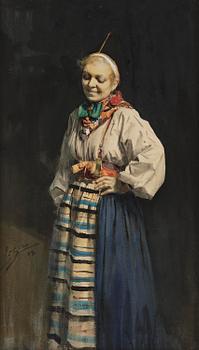
Anders Zorn (Sweden, 1860-1920) Rättvikskulla (Darlecarlian girl from Rättvik)
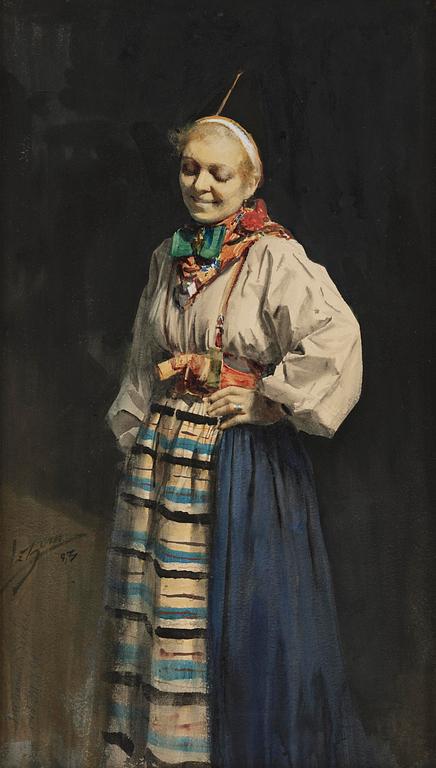
Rättvikskulla (Darlecarlian girl from Rättvik)
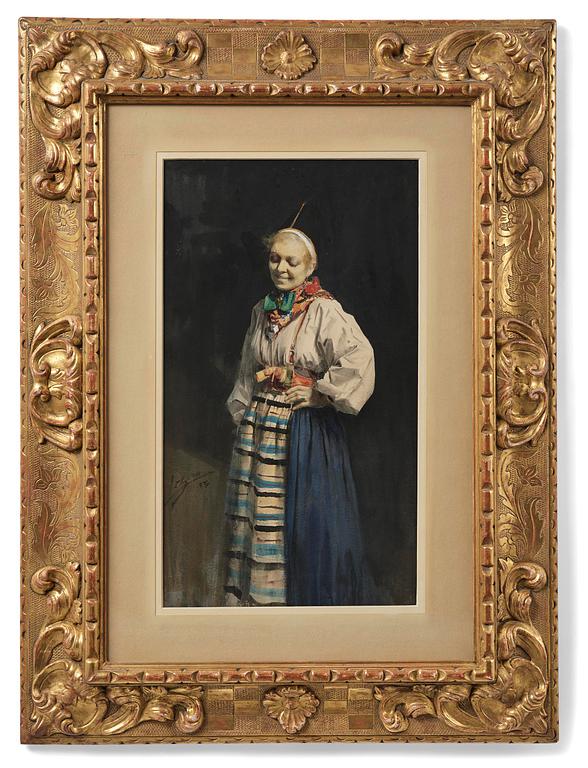
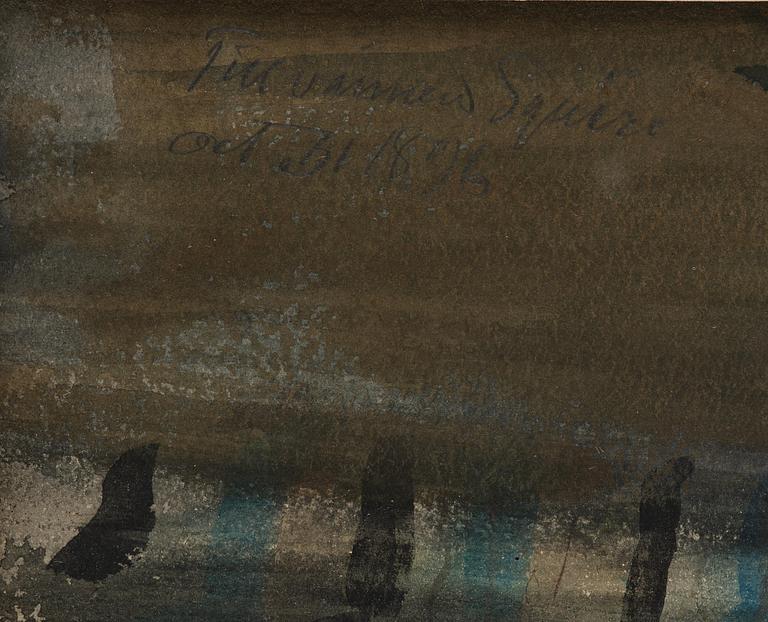
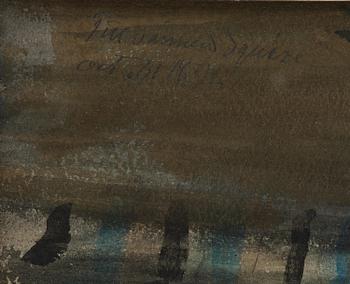
Signed L. Zorn and dated 83. Watercolour on paper laid down on board, 67 x 39 cm. Gift inscription in pencil in the lower left corner: “To my friend Squire Oct 31 1896”.
Provenance
Originally in the collection of George Squires, London.
Private collection, Sweden.
Literature
Ernst Malmberg, "Larsson-Liljefors-Zorn. En återblick", 1919, possibly mentionned p. 88.
More information
Anders Zorn spent the first half of 1883 in London, where he painted “portraits of young ladies and lived the life of a snob”. Zorn had also discovered that “America is a profitable market”, while preparing a journey to Japan. As if this were not enough, Zorn also took the opportunity to visit the Salon in Paris, from where, on 26 May, he reported to Hugo Geber in London: “Hasselberg’s 'Snörklockan' (Snowdrop) was the best sculpture I saw, and one of the best I have ever seen.” Impressively, in July Zorn even found time for a journey to Amsterdam, from where he wrote to Emma on 29 July that he was paying a visit to “the old boys Rembrandt and Frans Hals”.
The cosmopolitan Zorn then returned home to Sweden, where during August and September he stayed in Dalarna – Mora, Leksand and Skattungbyn. From Skattungbyn, Zorn wrote to Emma on 10 September: “I am thoroughly enjoying myself” [...] “I arrange dances every other night, dress up as an Orsa lad and dance the Orsa polka so wildly that I usually sweep the floor clean and end up dancing alone”.
Zorn’s artistic output bears witness to the fact that he also found time for painting. The subject matter of Zorn’s watercolours from this period can be linked to works by painters such as Höckert, Zoll and Nordenberg. When Zorn assumed the role of chronicler of the life of the people of Dalarna, however, his approach was characterised by the artist’s incisive handling as a watercolourist.
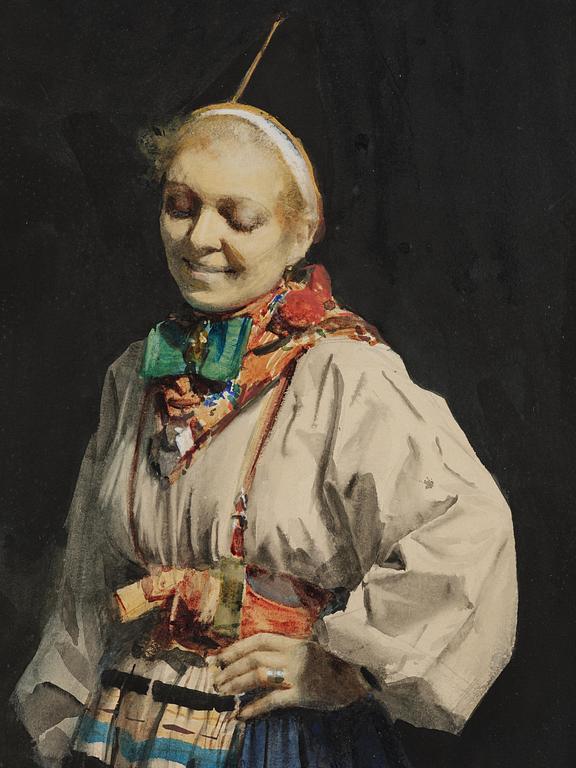
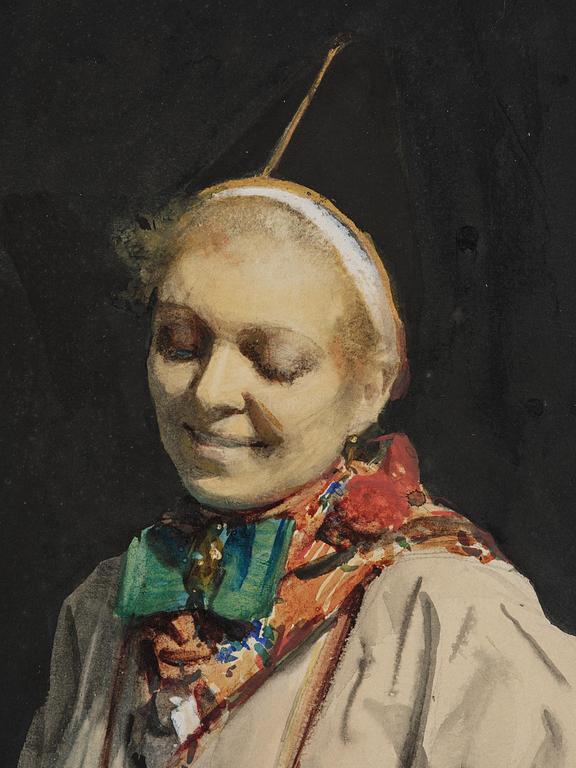
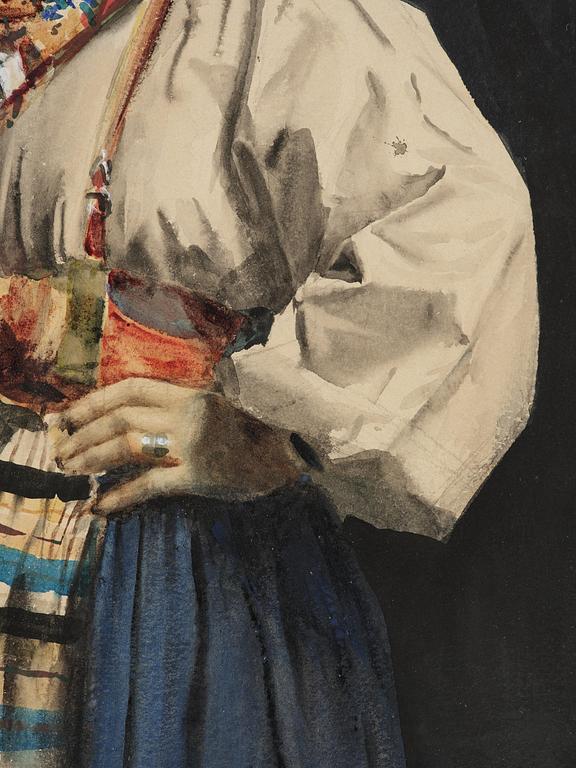
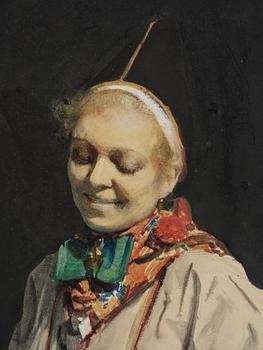
"Rättvikskulla" is characterised by finely nuanced tonal painting, in which the splendid colour accents of the costume are set off against the dark background in a refined manner. Zorn’s assured brushwork has produced an elegant composition in which the elaborately dressed girl shyly gazes down at the ground, her confidently rendered hand resting lightly on her hip, where it touches her striped apron.
More about Anders Zorn
Anders Zorn, born in Mora in 1860, showed artistic talent from a young age. In 1875, he traveled to Stockholm and became a student at the then Slöjdskolan (now Tekniska högskolan) in Stockholm, and shortly after, he joined the Royal Academy of Fine Arts. Initially, Zorn had aspirations of becoming a sculptor, but soon watercolor painting took over, becoming his primary medium until 1887. At the student exhibition in 1880, Zorn had his breakthrough with the watercolor painting "I sorg." The following year, he gained international acclaim as a portrait painter. His watercolor painting reached its pinnacle during this period, and his most famous work from this time is "Vårt dagliga bröd” from 1886. Shortly thereafter, Zorn transitioned to oil painting, which was met with immediate success. Zorn's reputation mainly rested on his portrait art, and he portrayed many notable figures, including presidents. For instance, he created an etching of Theodore Roosevelt. His etchings significantly contributed to his success. In the late 1880s, Zorn began working in the genre that would increasingly become his trademark: nude figures in outdoor settings. He had long been fascinated by the movement of water and the reflections of light on its surface. Now, he added the complexity of placing a model near or in the water, aiming to depict a synthesis between nature and humanity. In 1896, Zorn and his wife moved back to Sweden and settled in Zorngården in Mora. This move sparked a renewed interest in his homeland, which would be reflected in his future paintings. Among the artist's scenes from the Mora region, portraying its local customs and ancient traditions, "Midsommardansen" holds the highest value according to Zorn himself. Today, the painting can be found at the National Museum.
Read moreFor condition report contact specialist

What will the transport cost?
Shipping can only be arranged by contacting specialdelivery@bukowskis.com.