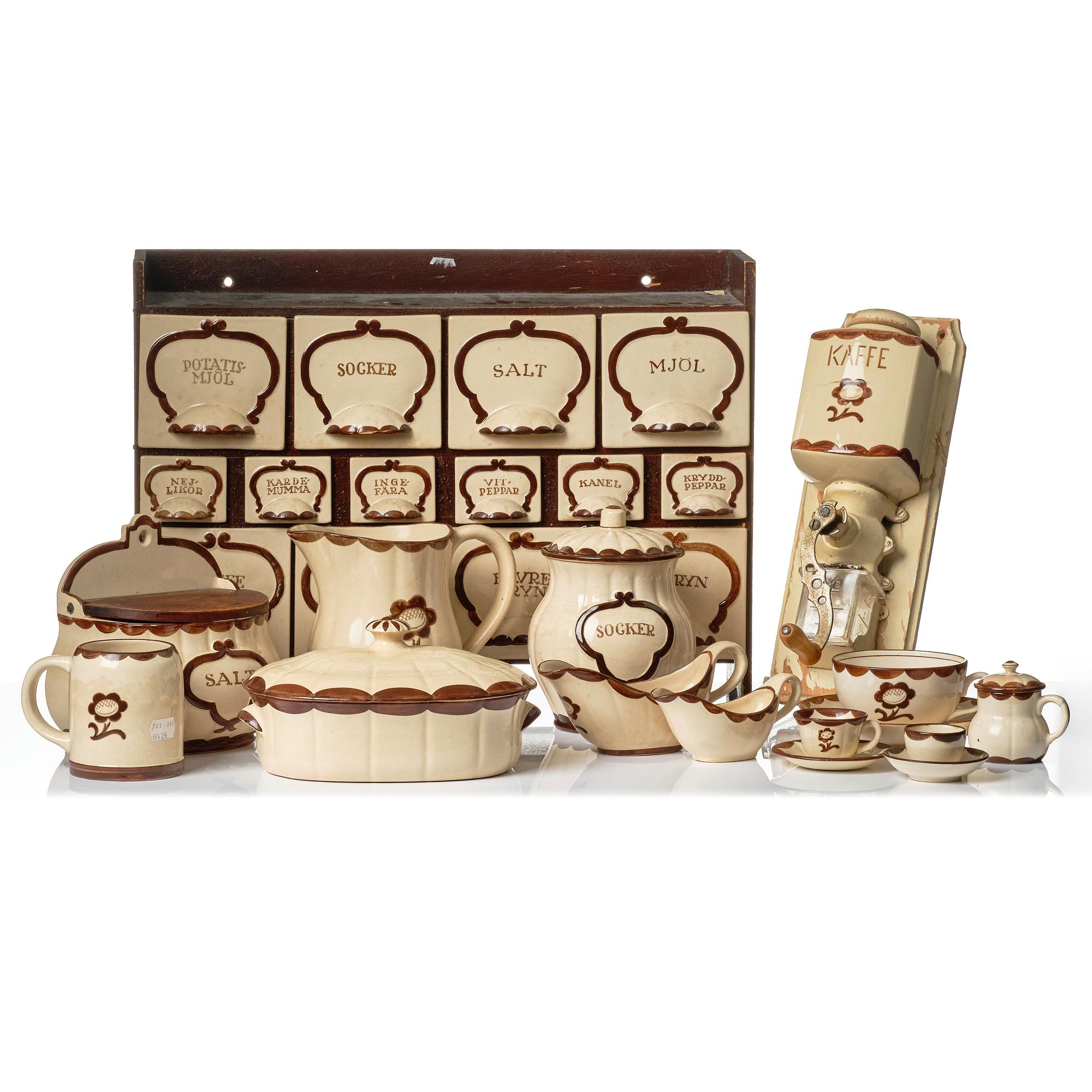
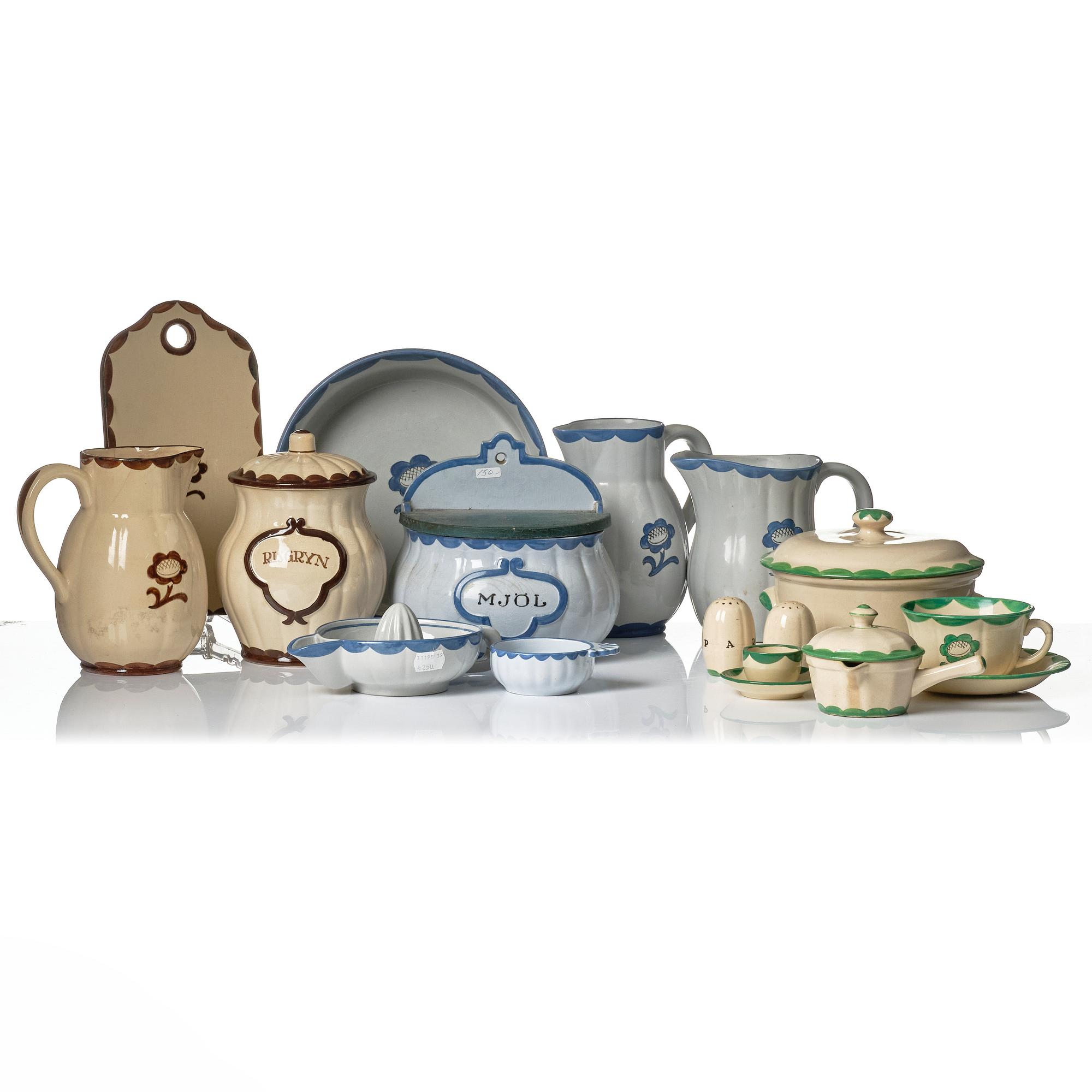
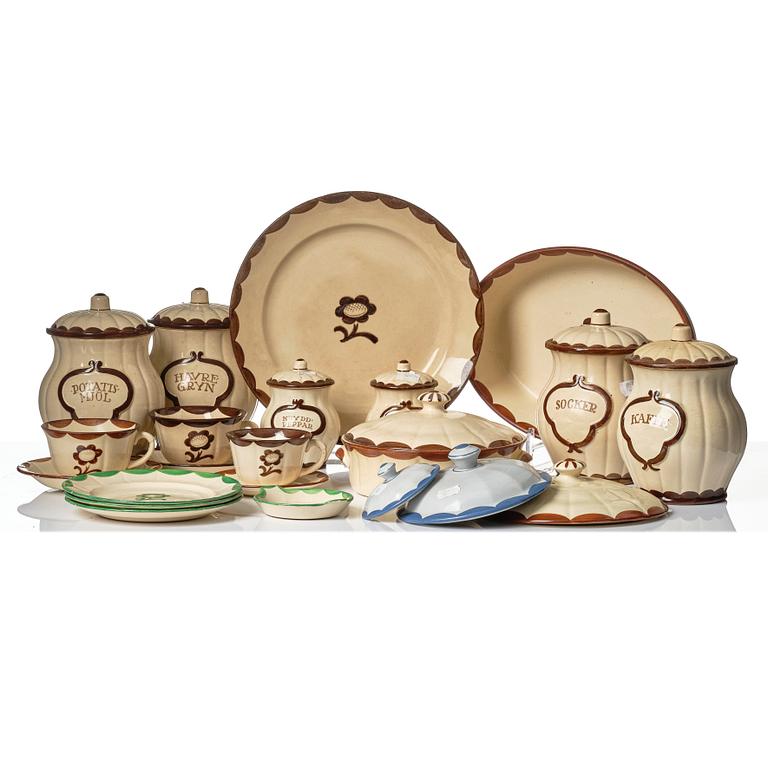
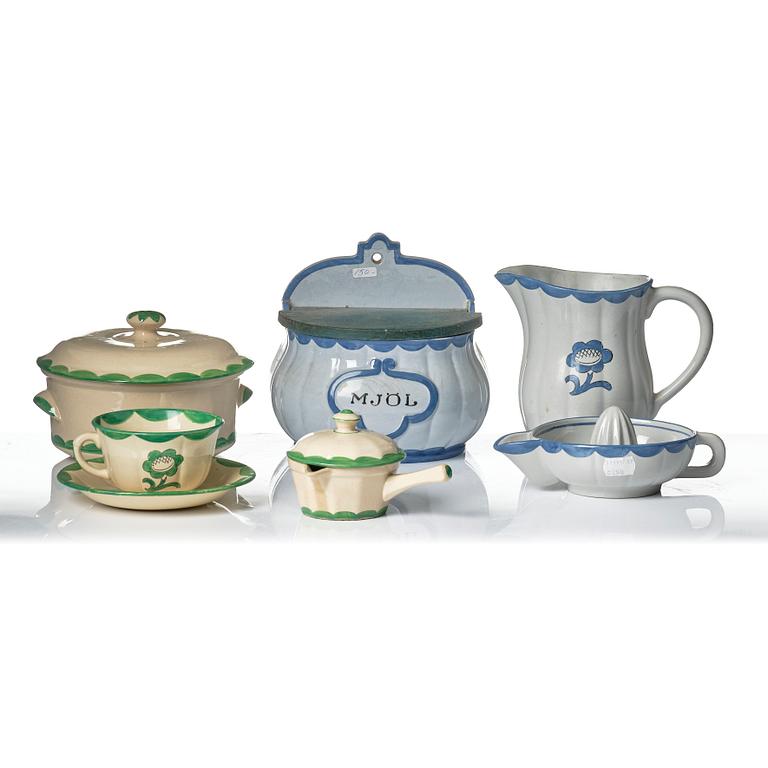
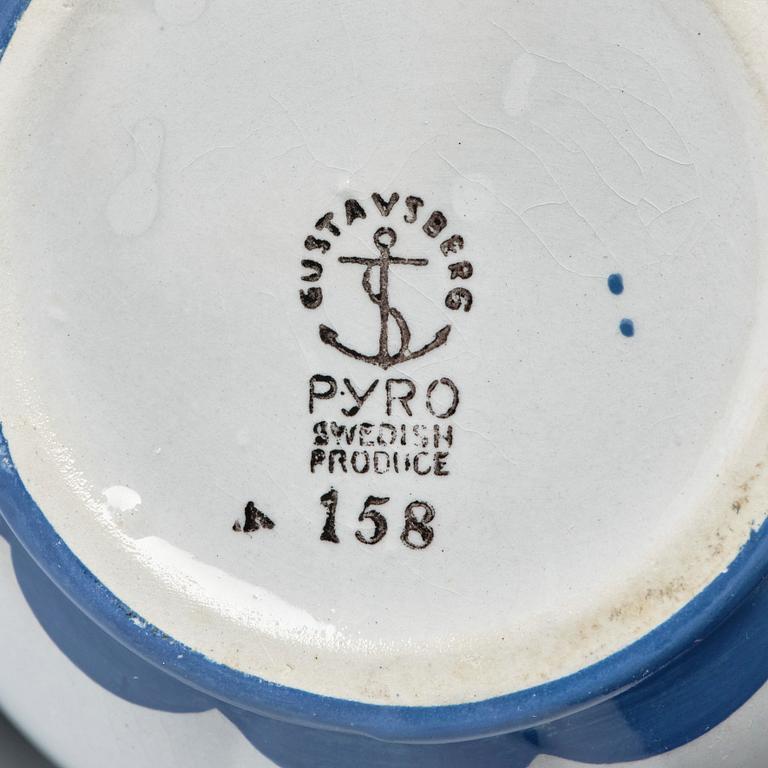
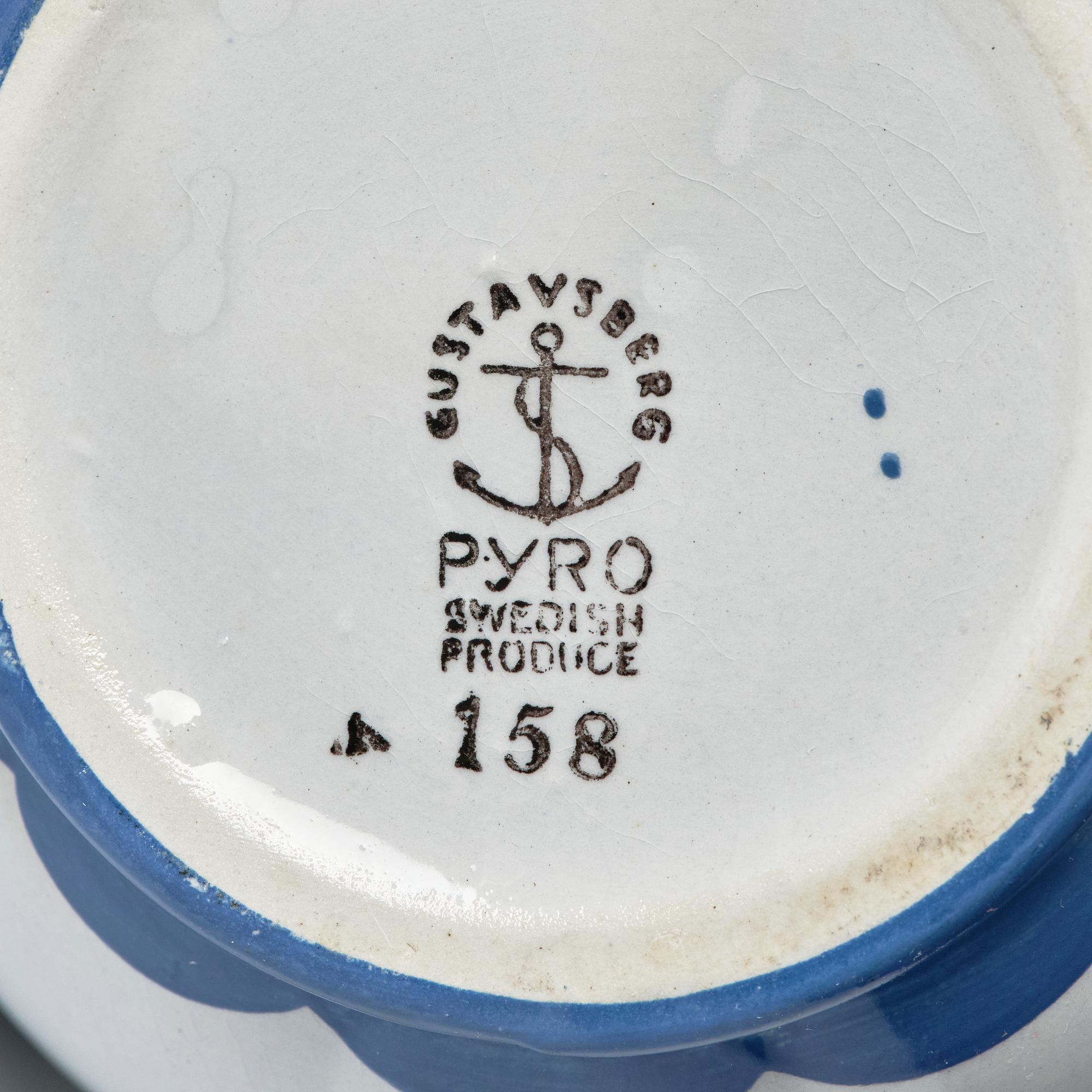
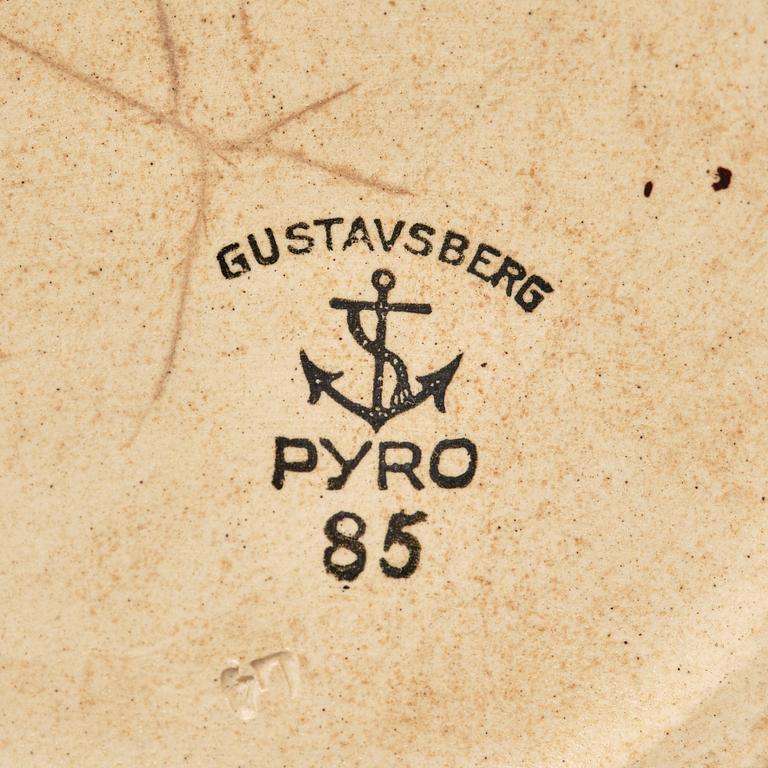
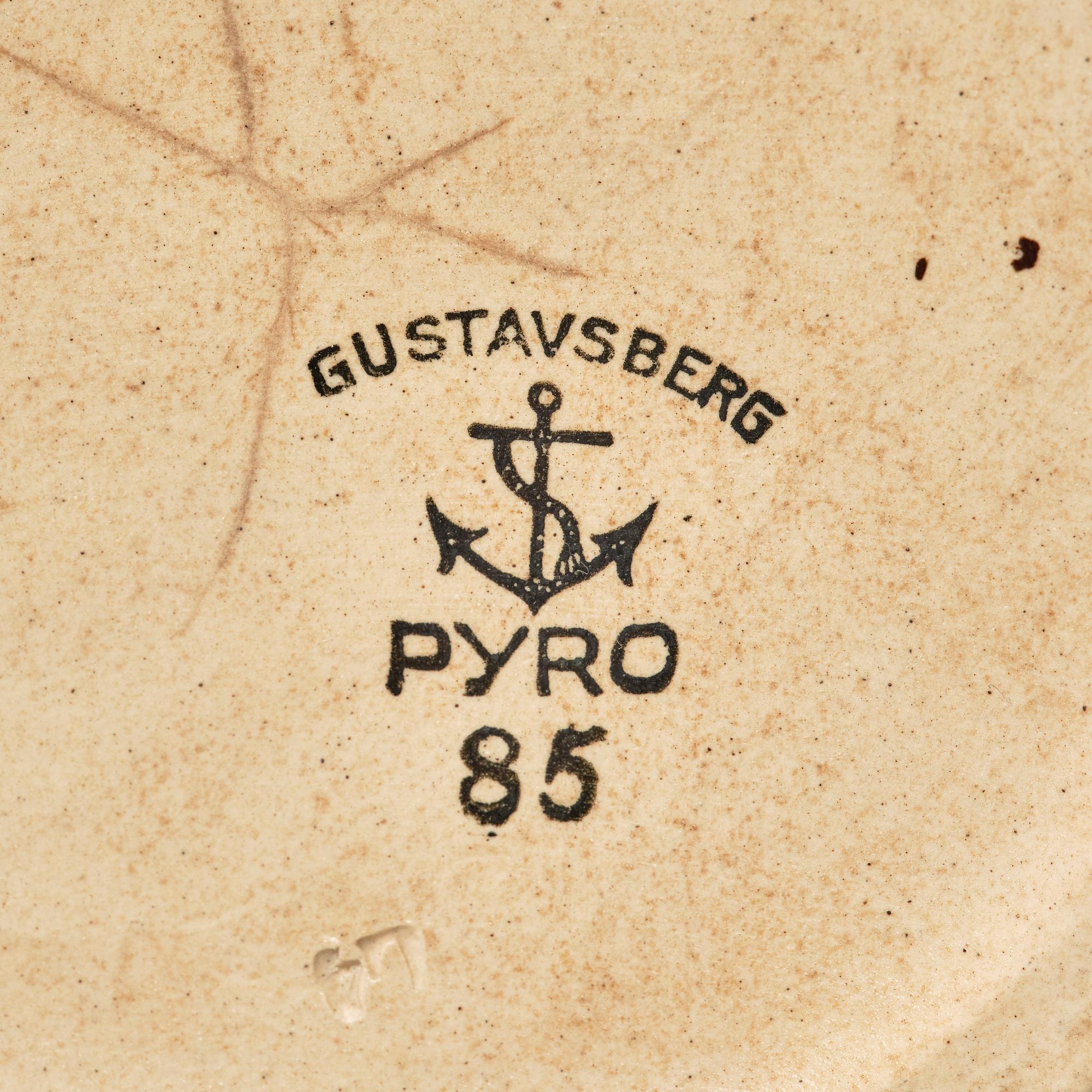
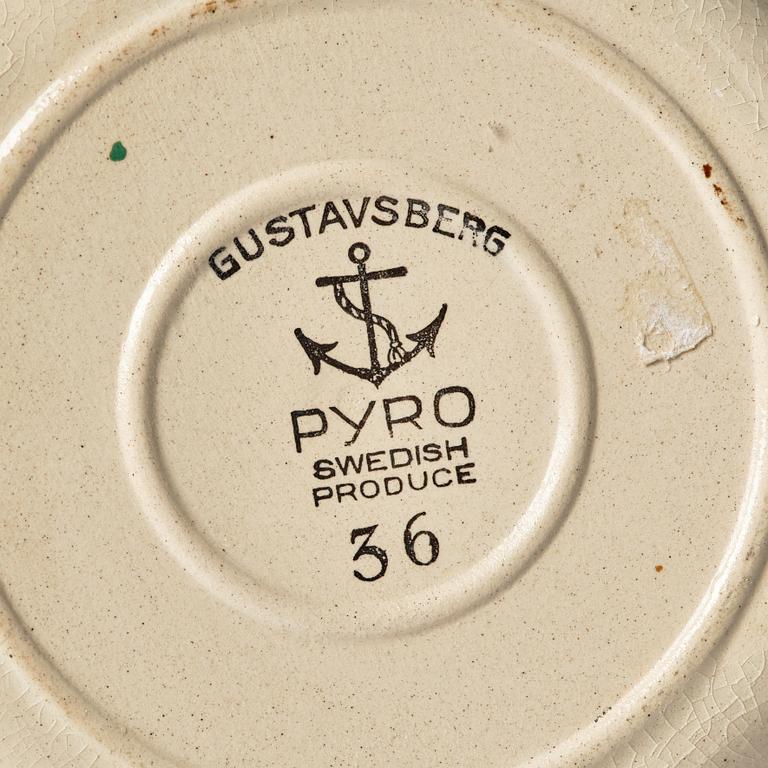
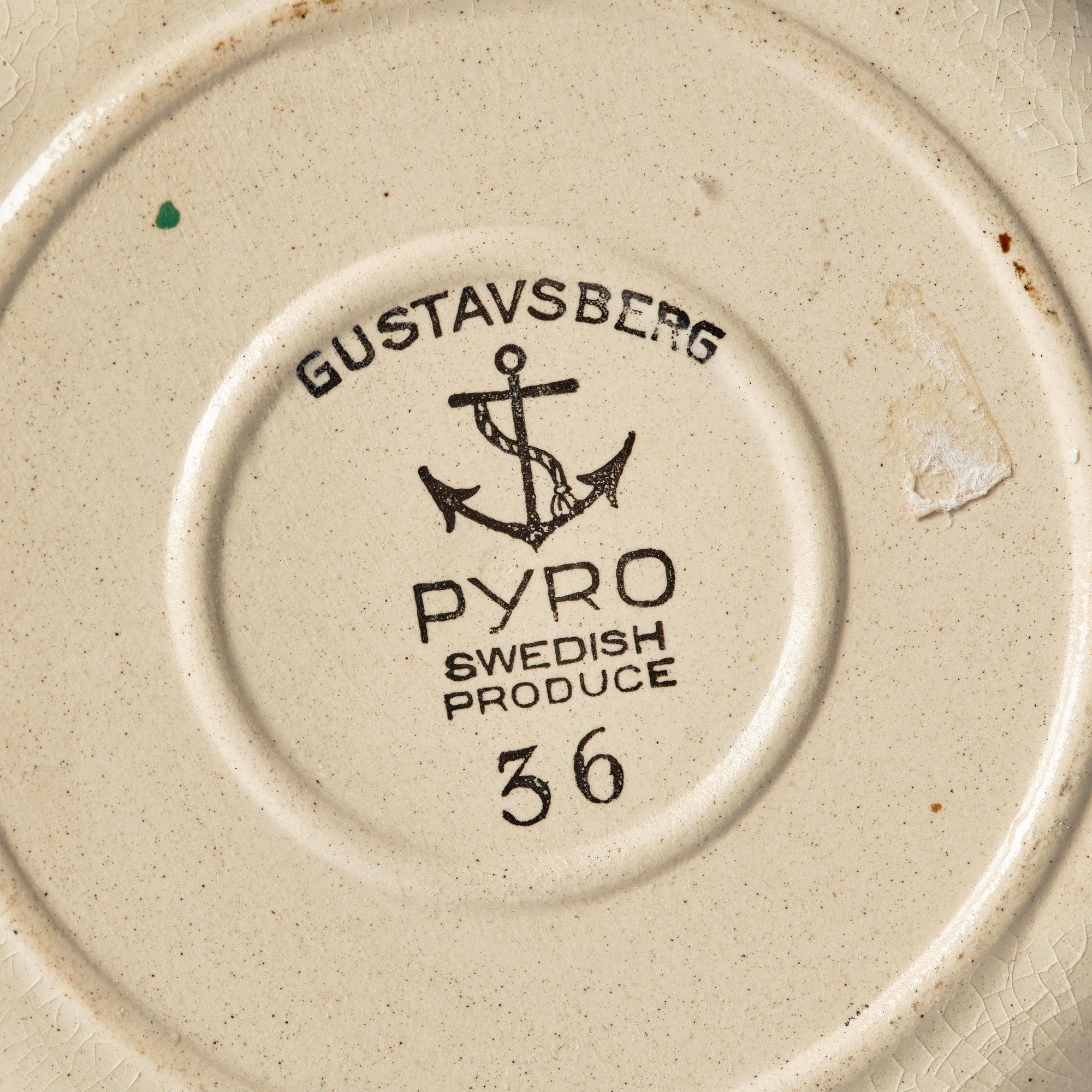
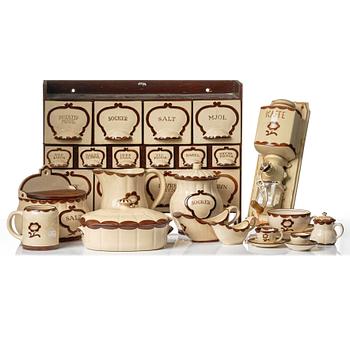
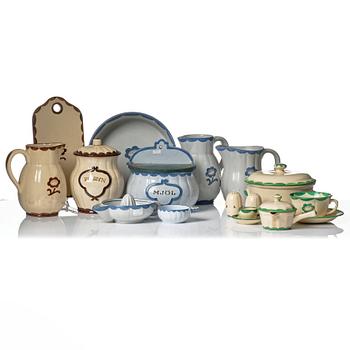
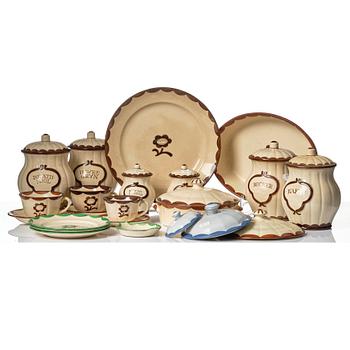
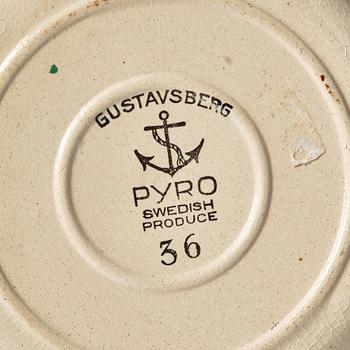
43-pieces of a 'Pyro' service including coffee grinder and spice rack, Gustavsberg, Sweden, 1930 and 1955.
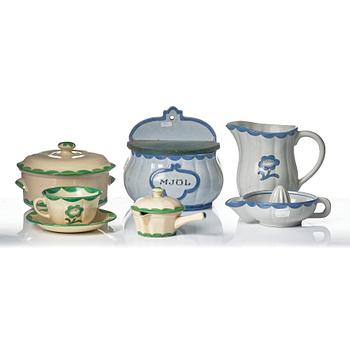
Painted decoration of flowers in brown, green and blue.
Decoration in brown:
Coffee grinder mounted with container of pressed glass, height 35, width 12 cm.
Spice rack of brown-painted wood with 14 containers, width 51.5, depth 17, height 37 cm.
Cutting board, length 26 cm.
Oval pot with lid, length 24 cm.
Round pot with lid, diameter 20 cm.
Oval dish/casserole, length 28 cm.
Plate, diameter 28 cm.
2 jugs, height 17 cm.
2 small spice jars with lids (allspice and cardamom), height 12 cm.
6 larger jars with lids (sugar, rice, potato flour, oatmeal, coffee), height 18.5 cm.
Wall-mounted spice jar (salt), width 19, height 18 cm.
Mug, height 10 cm.
2 sauce boats, length 14.5-19 cm.
Mustard pot with lid, height 8 cm.
Egg cup on plate, diameter 8.5 cm.
Small coffee cup with saucer, saucer diameter 9.5 cm.
Coffee cup with saucer, saucer diameter 13.5 cm.
Coffee cup with saucer, saucer diameter 15.5 cm.
Tea cup with saucer, saucer diameter 16 cm.
Decoration in blue:
Wall-mounted spice jar (flour), width 19, height 18 cm.
Bowl, diameter 8 cm.
Citrus juicer, diameter 13 cm.
2 jugs, height 15-17 cm.
Round dish/casserole, diameter 23 cm.
Decoration in green:
Pot with lid, diameter 17 cm.
Small sauce pan with lid, diameter 9 cm + handle 5 cm.
3 side plates, diameter 18.5 cm.
Coffee cup with saucer, saucer diameter 15.5 cm.
Egg cup on plate, plate diameter 8 cm.
Small dish with two handles, width 12 cm.
Salt & pepper shakers, height 6 cm.
Usage wear. Craczing. Chips. The coffee grinder is not tested and has some paint loss. The container of the spice rack marked "Potatismjölr" is repaired. An extra coffee pot, an odd plate, and an odd lid in brown are included. Two odd lids in blue are included.
Provenance
A Swedish private collection.
More information
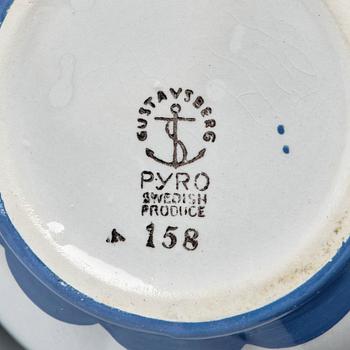
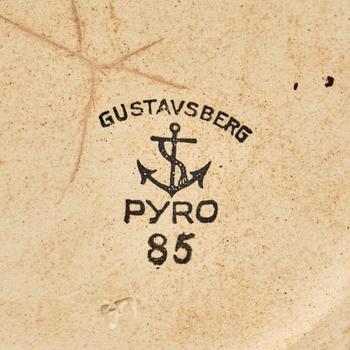
'Pyro' was the first oven-safe dinnerware set produced by Gustavsberg, and Wilhelm Kåge presented it at the Stockholm Exhibition in 1930. The dinnerware, made from a fireproof clay imported from England, quickly became a sales success and soon came in green (1934) and blue (1940). Over time, it was also produced in creamware.
More about Wilhelm Kåge
Wilhelm Kåge was a Swedish artist and ceramicist. Kåge is known for his ceramics for the Gustavsberg porcelain factory, where he was the artistic director from 1917 to 1949. Kåge studied from 1910 under Carl Wilhelmson at the Valand Academy of Art in Gothenburg and later under Johan Rohde in Copenhagen, where he became acquainted with Gösta Adrian-Nilsson (GAN) and grew closer to modern art. He studied graphic art in Munich and began his artistic career by designing posters for theatres and exhibitions, among other things. His connection with Gustavsberg was facilitated through the Swedish Society of Crafts and Design, as Gustavsberg needed new products for the Home Exhibition at Liljevalchs in 1917. He went on to design around thirty different dinnerware sets, as well as art pottery, colourful faience, stoneware, and various series of art pottery such as Carrara, Surrea, and Våga. In 1942, Kåge, together with Stig Lindberg, established the Gustavsberg Studio, which became a kind of aesthetic laboratory for art pottery.
At the Stockholm Exhibition in 1930, Kåge presented Gustavsberg's future sales success "Argenta," a series of art pottery primarily glazed in green but also in red, blue, brown, and celadon green, and decorated with various silver designs based on Kåge's sketches. Argenta became very popular and was produced well into the 1970s. The powerful stonewares "Farsta" were also presented at the Stockholm Exhibition and they became the ones closest to Kåge's heart and with which he continued to experiment throughout his life. The pieces improved over the years, and the most impressive and many of the most sought-after items were created by Kåge during the 1950s.
Image rights
The artworks in this database are protected by copyright and may not be reproduced without the permission of the rights holders. The artworks are reproduced in this database with a license from Bildupphovsrätt.
Others have also viewed