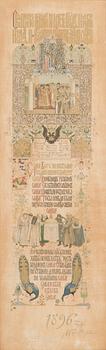
Pablo Picasso, Incomplete portfolios of "Carmen", 1949 and "Le Carmen des Carmen", 1964.
Incomplete portfolios of "Carmen" and "Le Carmen des Carmen".
"Le Carmen des Carmen": Éditeur Français Réunis, 1964. Portfolio with loose papers. Numbered XIX of XXX. Signed both Aragon and Picasso in the colophon at the front. Picasso's signature in red chalk.
This portfolio is missing 4 etchings and 1 original lithograph by Picasso. Linen cloth box not included.
"Carmen": 1949. Incomplete. Numbered 160. Edition of 320. Signed Picasso in pencil. Portfolio with loose papers. Includes 19 of 38 etchings. Original cover with wear and damage.
Incomplete. Wear. Damage. Not fully inspected.
More about Pablo Picasso
Pablo Picasso (1881-1973), Spanish painter, printmaker, sculptor, and ceramist. Active in France since 1900. He is, alongside Matisse, the most dominant artist of the 20th century. After passing through a blue period, a pink period with circus scenes and harlequins, he created his first cubist painting, "Les Demoiselles d'Avignon," in 1907 under the influence of African sculptures. Together with Braque, he further developed cubism by breaking down surfaces, which were then represented in various simultaneous aspects. In 1912, he left nature and recreated a new reality, only to return to acrobats in 1916. During the 1920s, he approached surrealism and worked with whimsical forms while also producing drawings and etchings in line style. During the Spanish Civil War, he was violently stirred, and it is now that his great protest in the painting Guernica comes to fruition. In the late 1940s, he settled by the Mediterranean and produced nymphs, centaurs, and fauns, as well as paraphrases of the works of old masters, and painted powerful terracotta ceramics in Vallauris. His abundant graphic production follows the same development as his painting.
Pablo Picasso was not only an artist but also a skilled ceramist. During his lifetime, he created hundreds of ceramic works, such as jugs, vases, and plates. Picasso's passion for ceramics began when he visited the annual ceramics exhibition in Vallauris in southern France in 1946 and was introduced to the craft by the artist couple Suzanne and Georges Ramié, who owned the Madoura pottery. During the following years which he spent in Vallauris, Picasso met his second wife, Jacqueline Roque, whom he depicted on the ceramic pieces. He also decorated the ceramics with abstract animals and bullfighters in a cubist style.
Read moreCovered by droit de suite
Image rights
The artworks in this database are protected by copyright and may not be reproduced without the permission of the rights holders. The artworks are reproduced in this database with a license from Bildupphovsrätt.

Others have also viewed