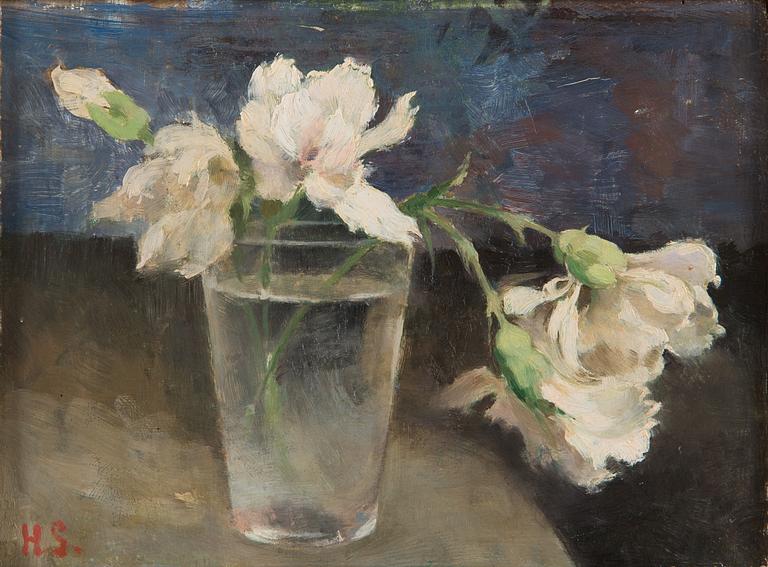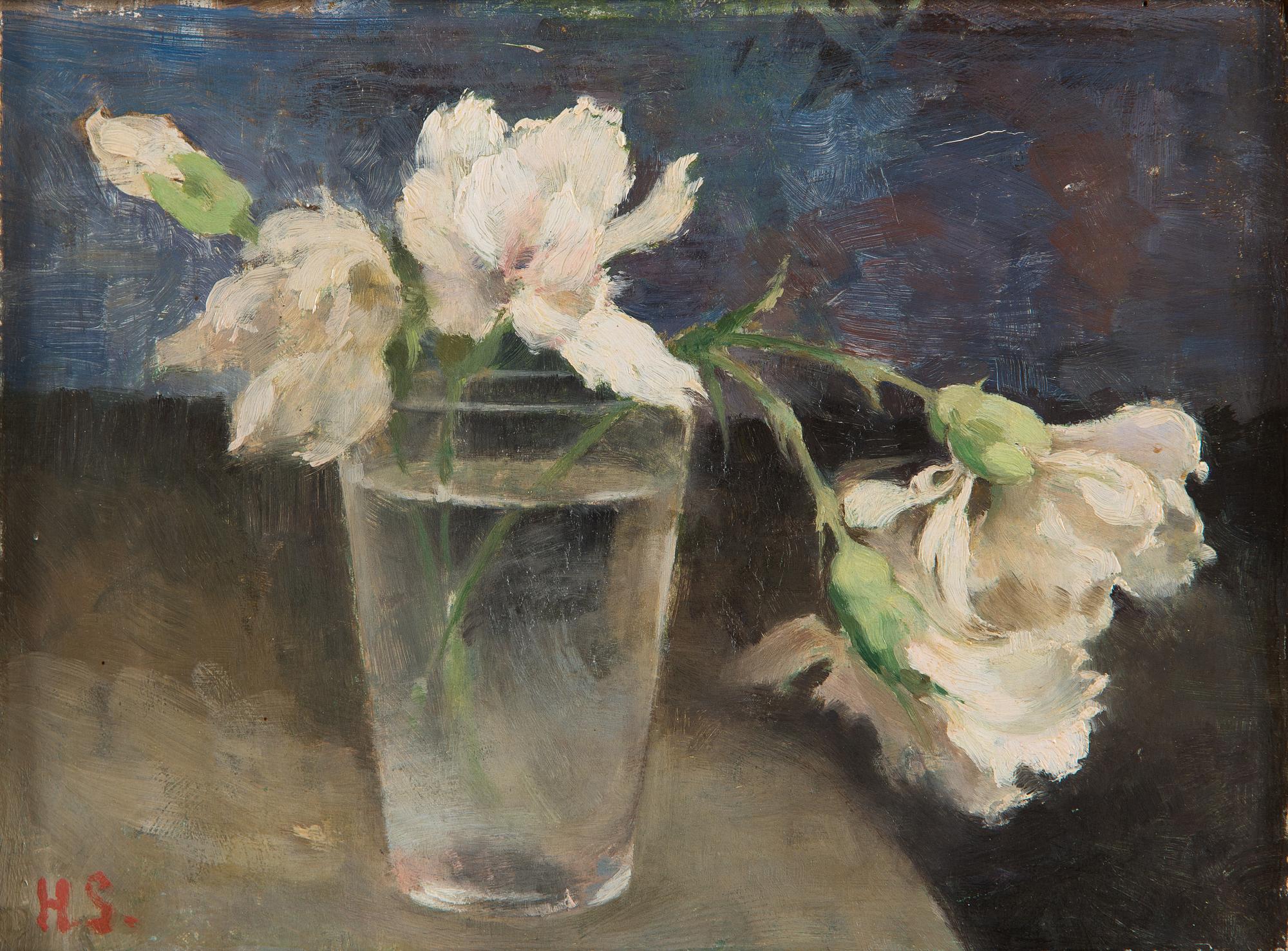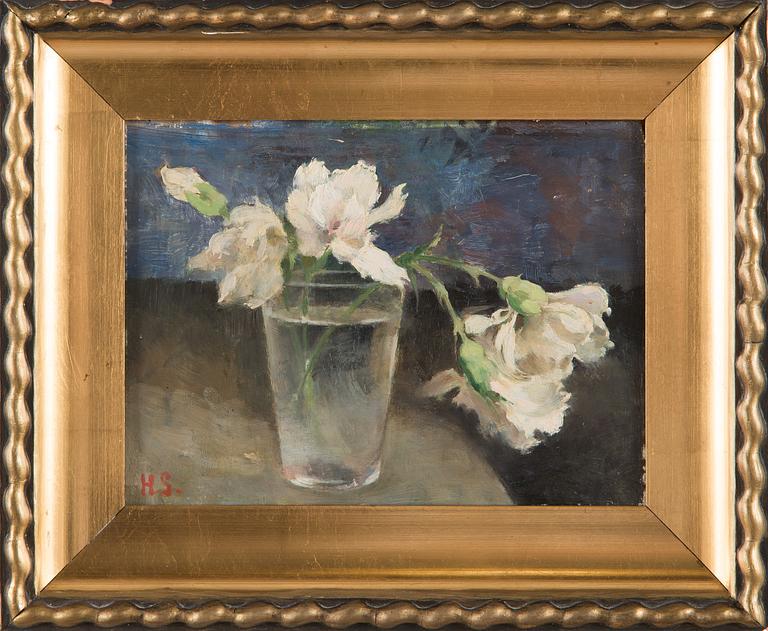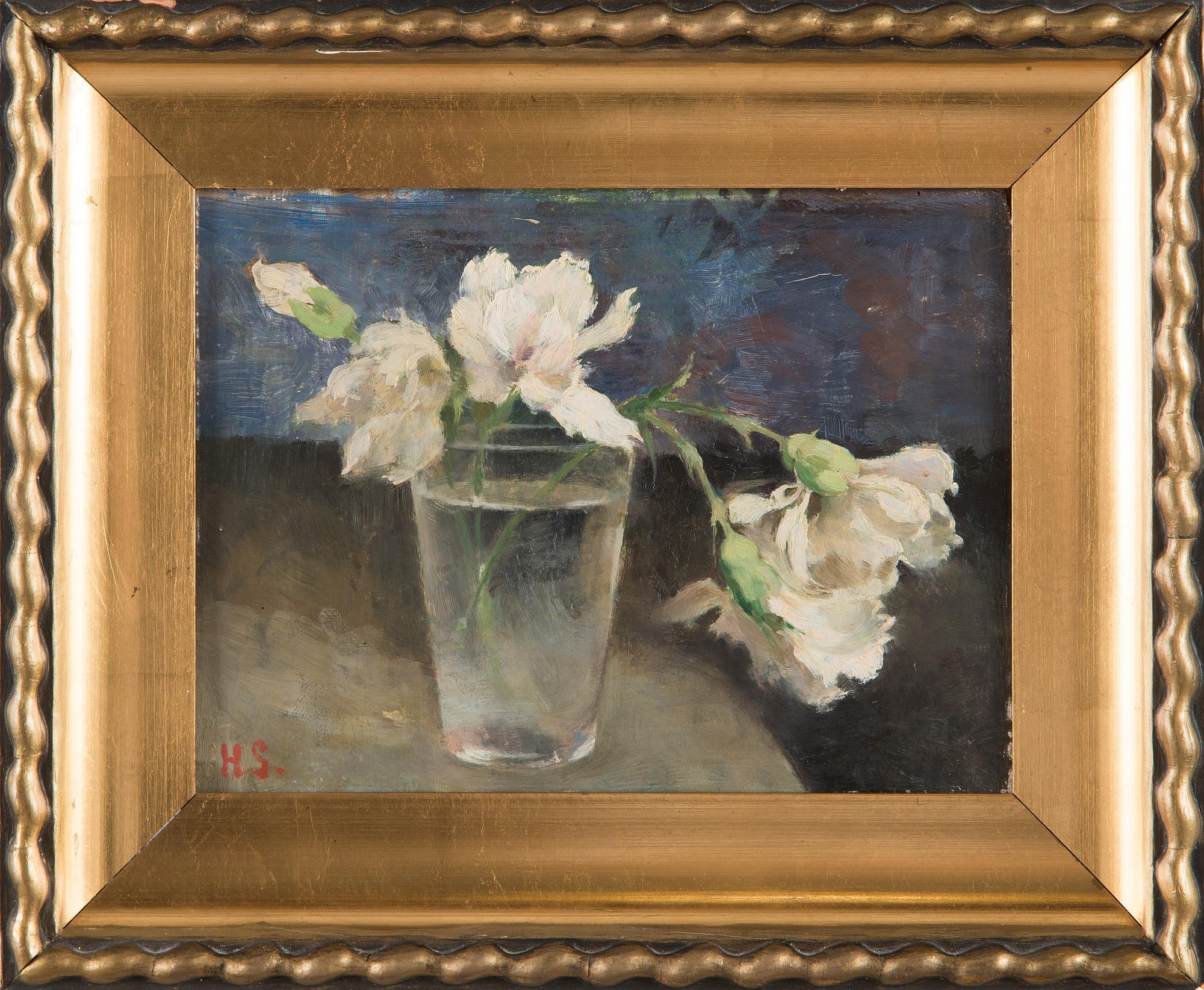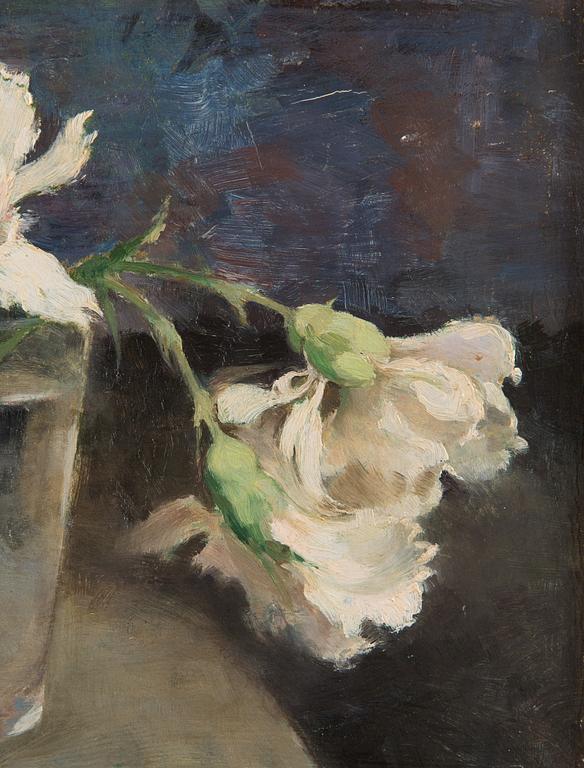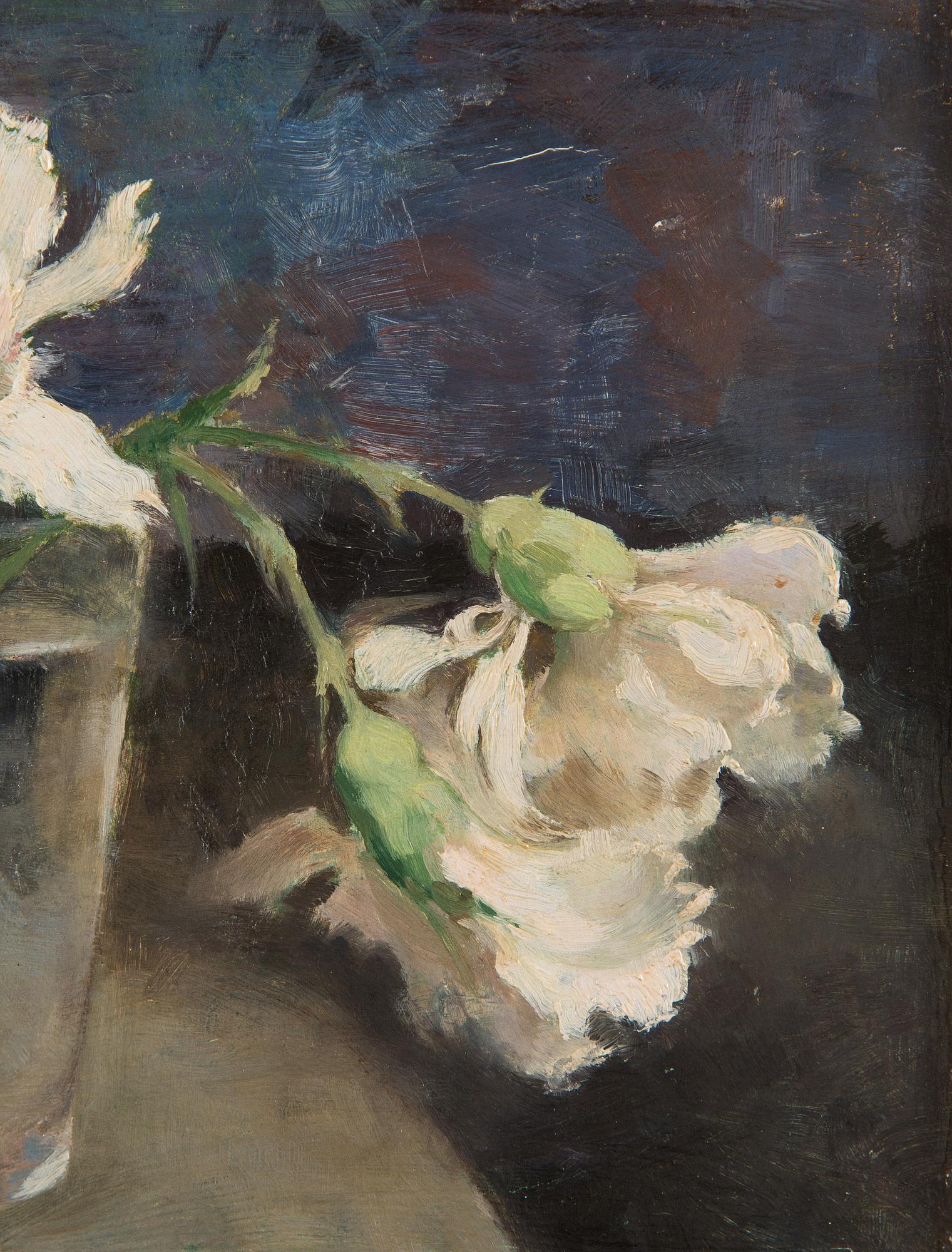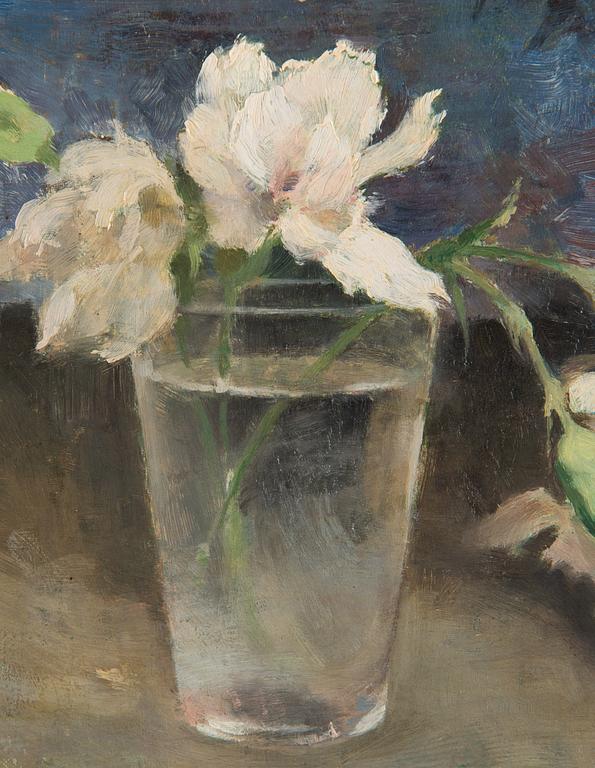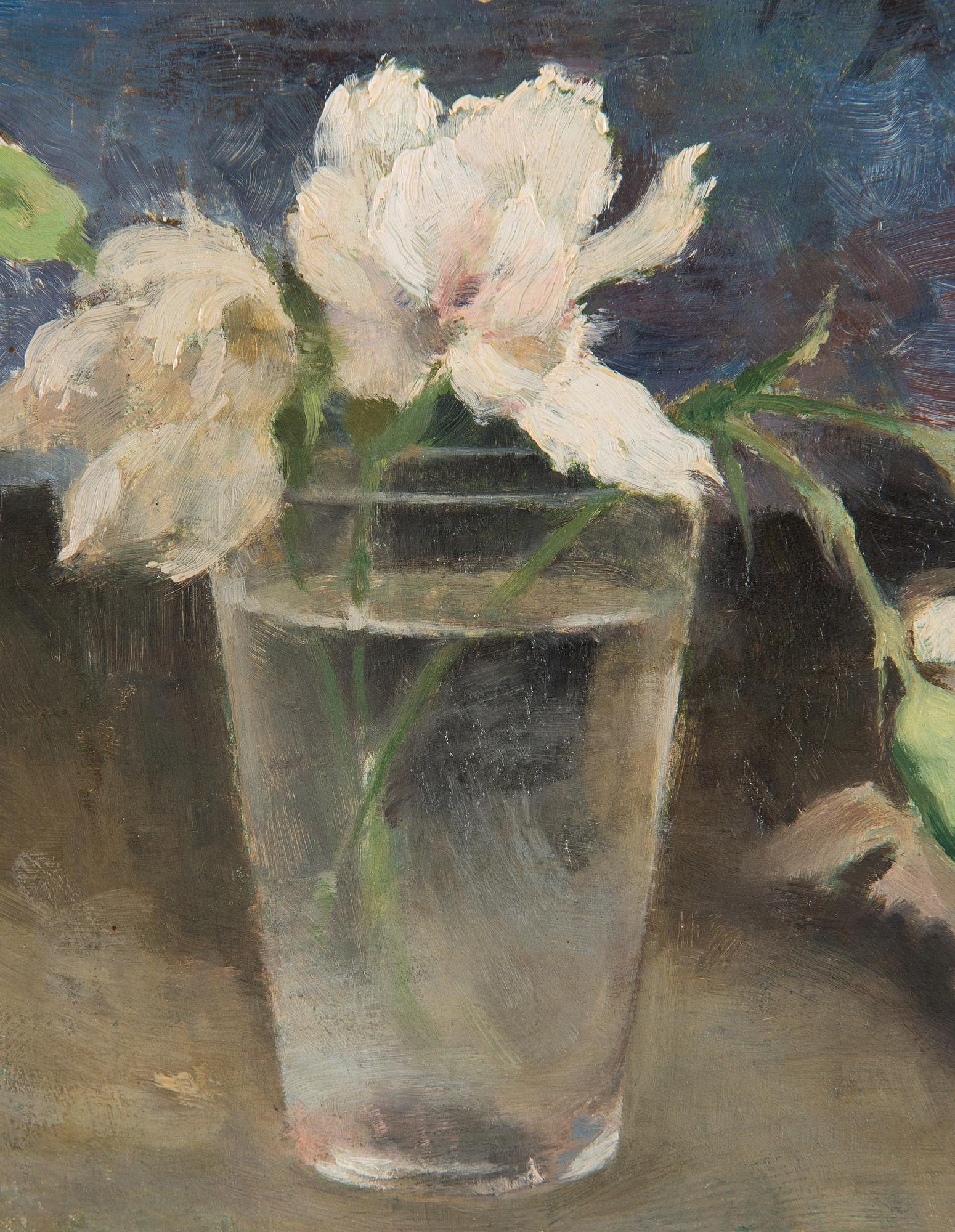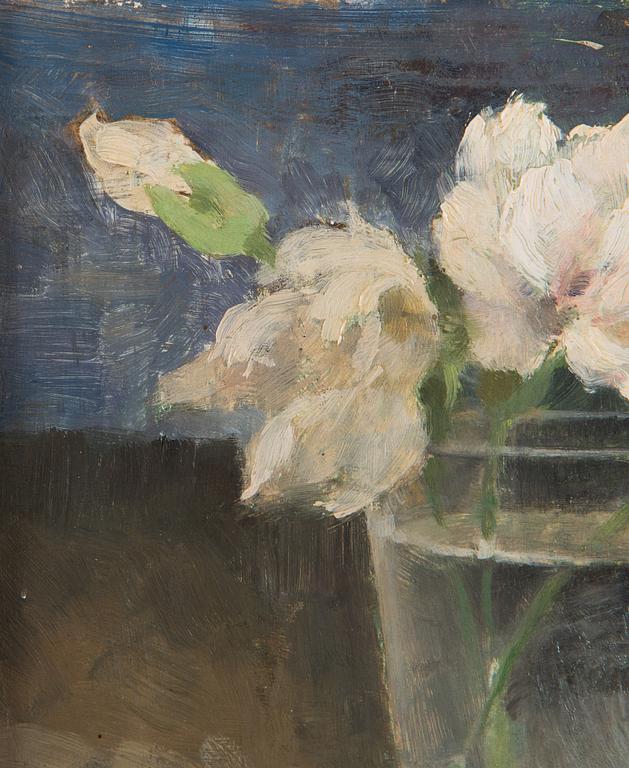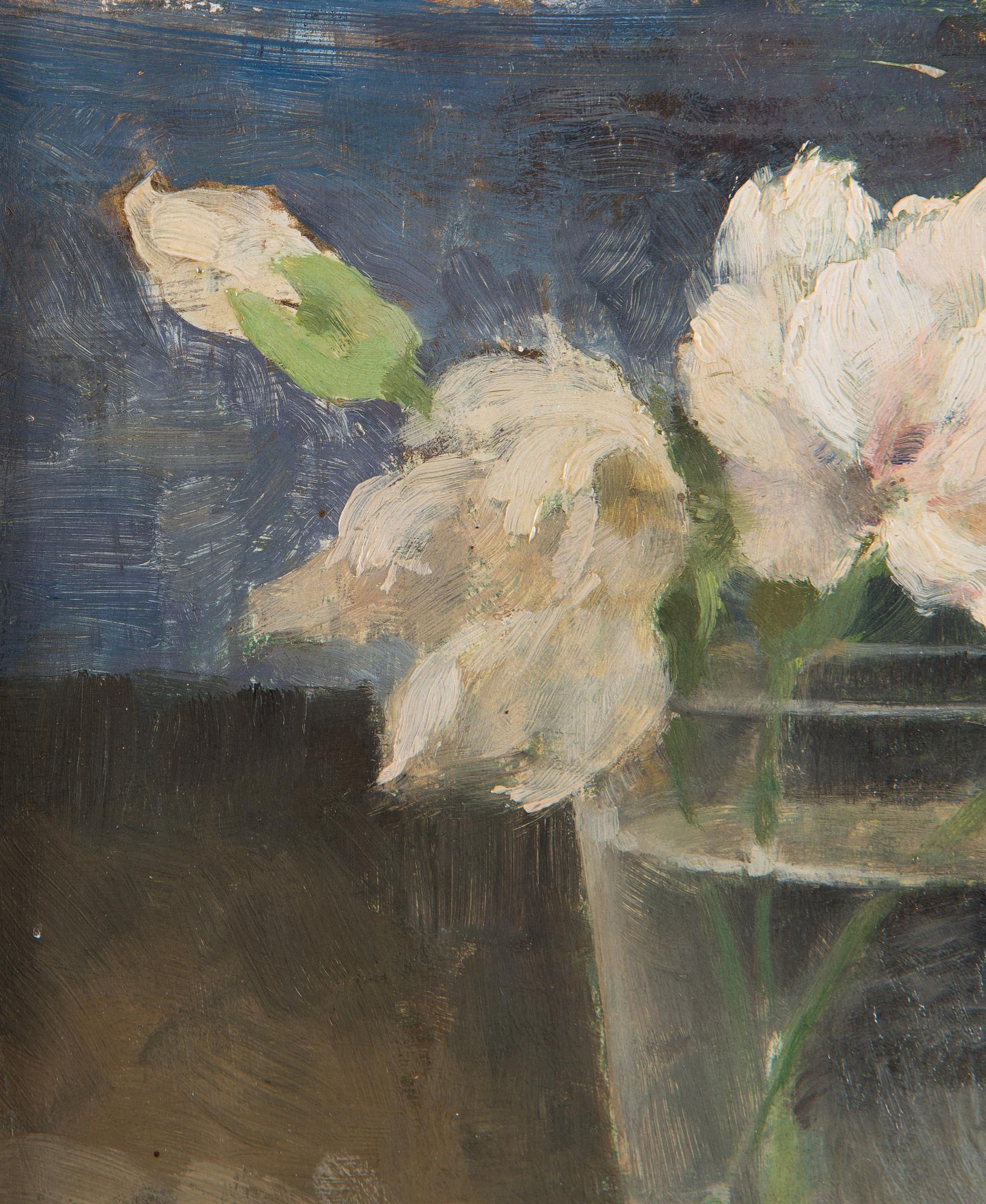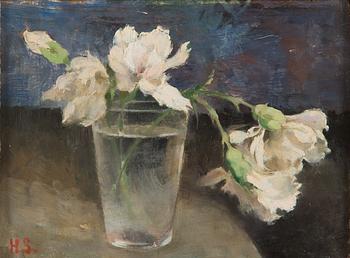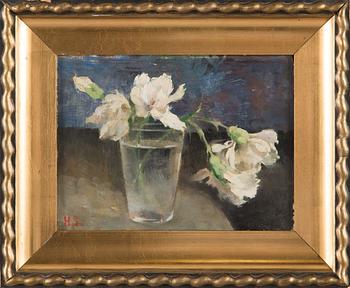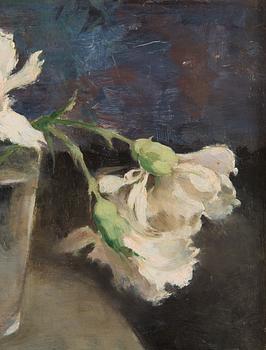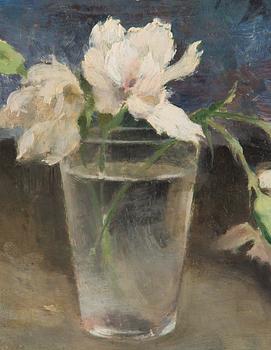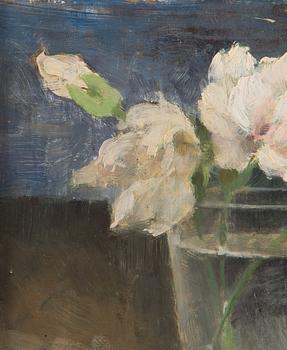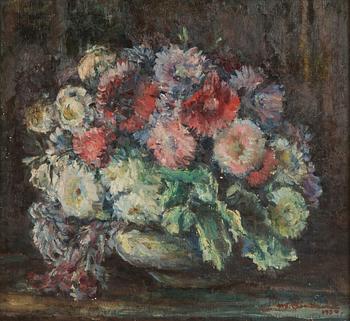
Carnations in a Glass of Water.
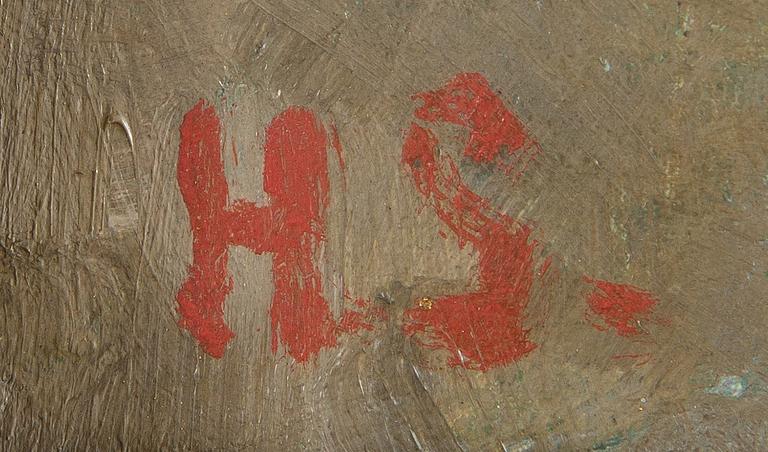
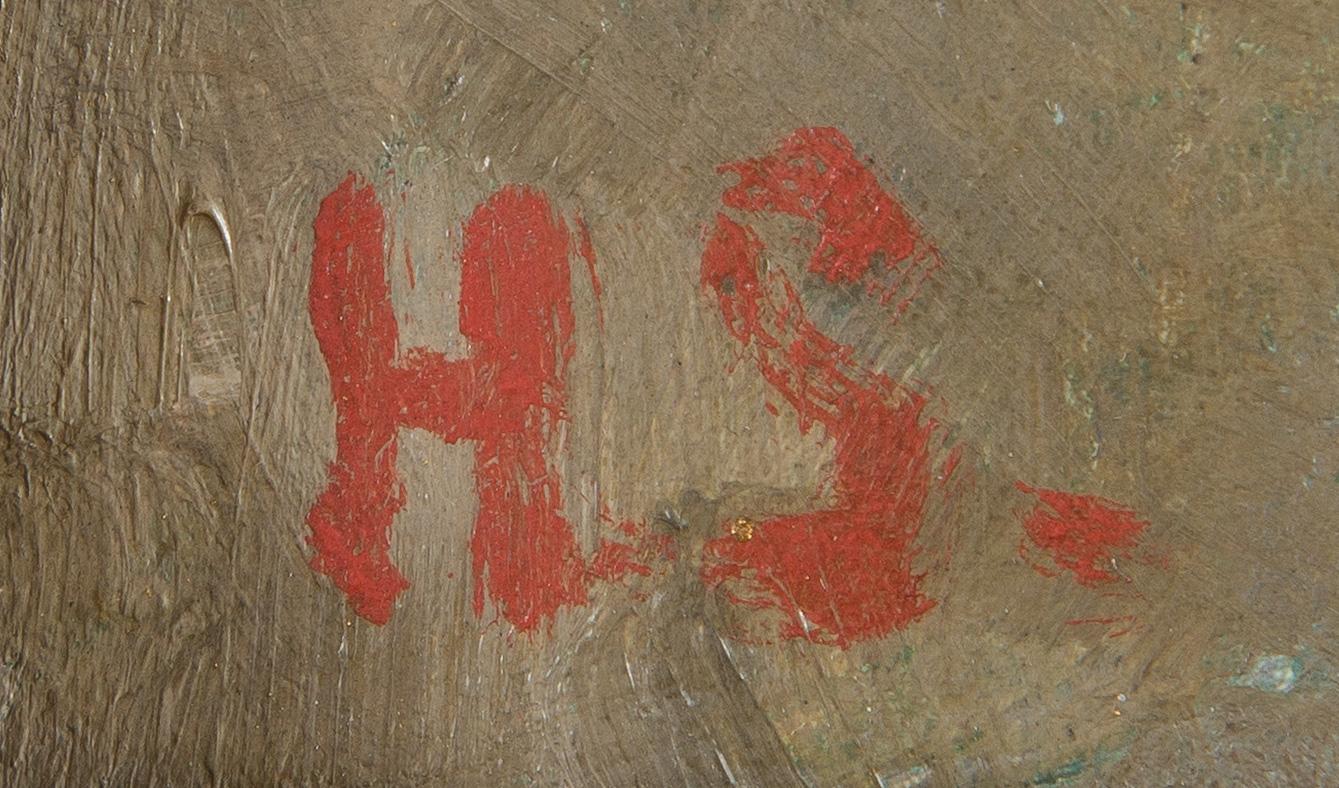
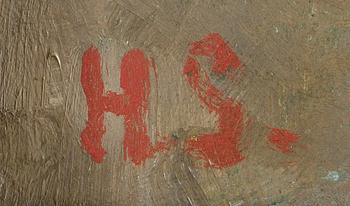
Signed H.S. Executed c.1888. Oil on mahogany, 20x26.5 cm.
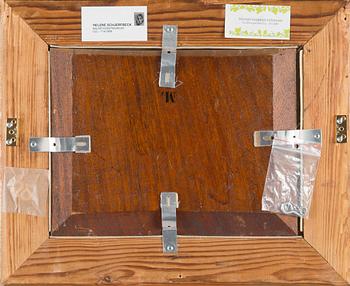
Wear due to age and use. Wear along edges. Small scratch.
Provenance
Gift from the artist to Martha Neiglick-Platonoff, whose mother, Helene Calonius, was Helene Schjerfbeck's cousin; thereafter by descent within the family.
Exhibitions
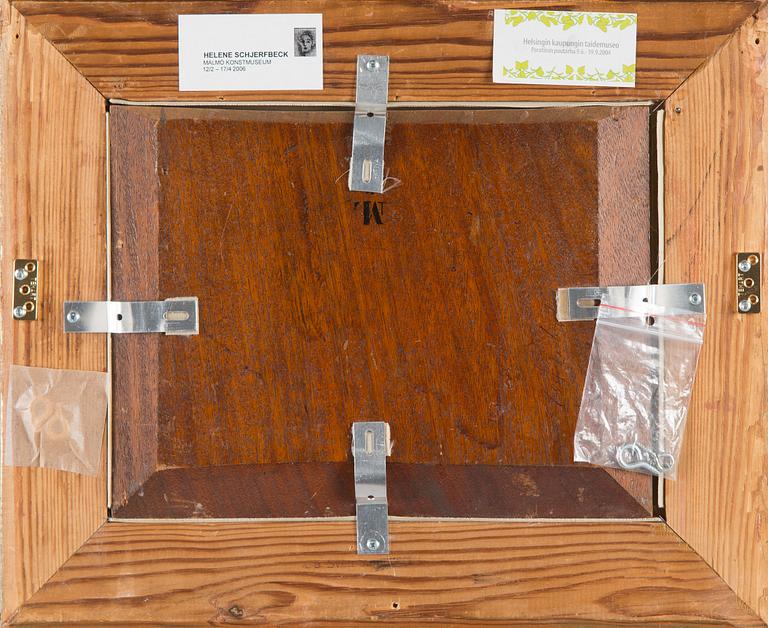
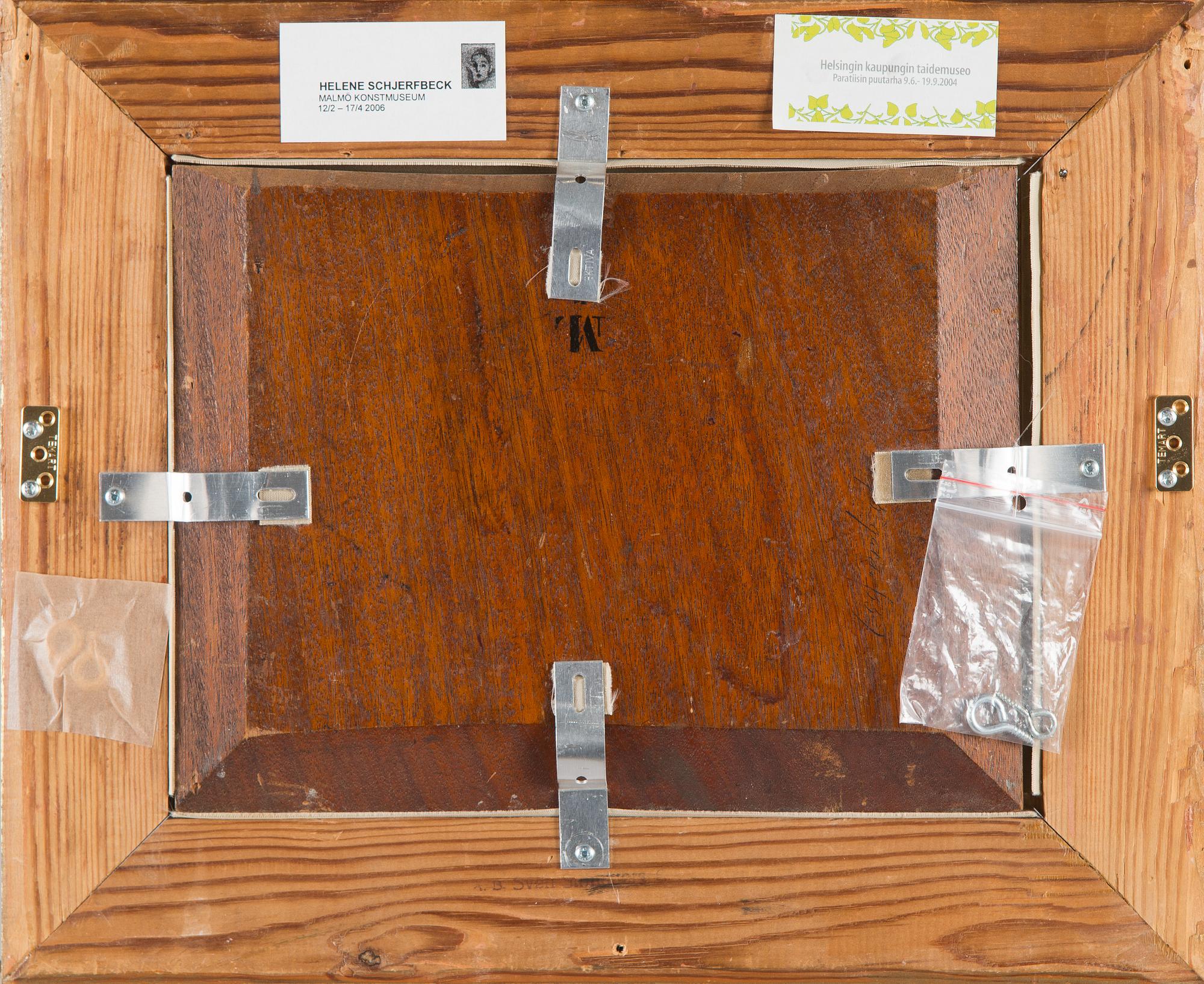
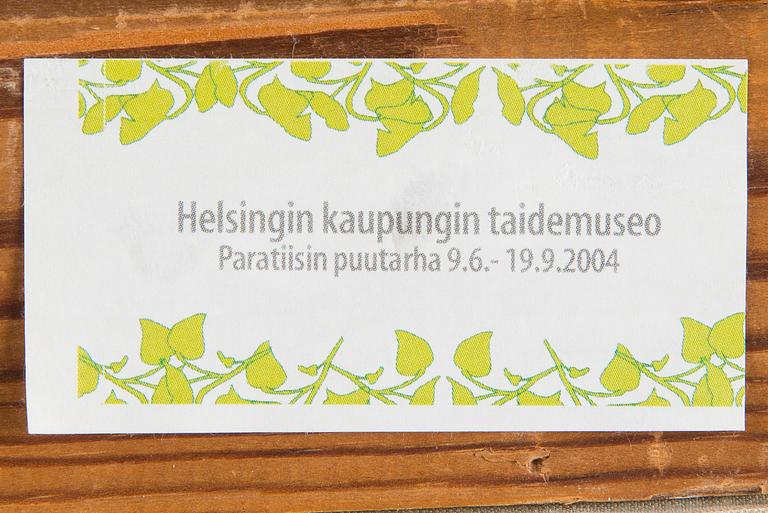
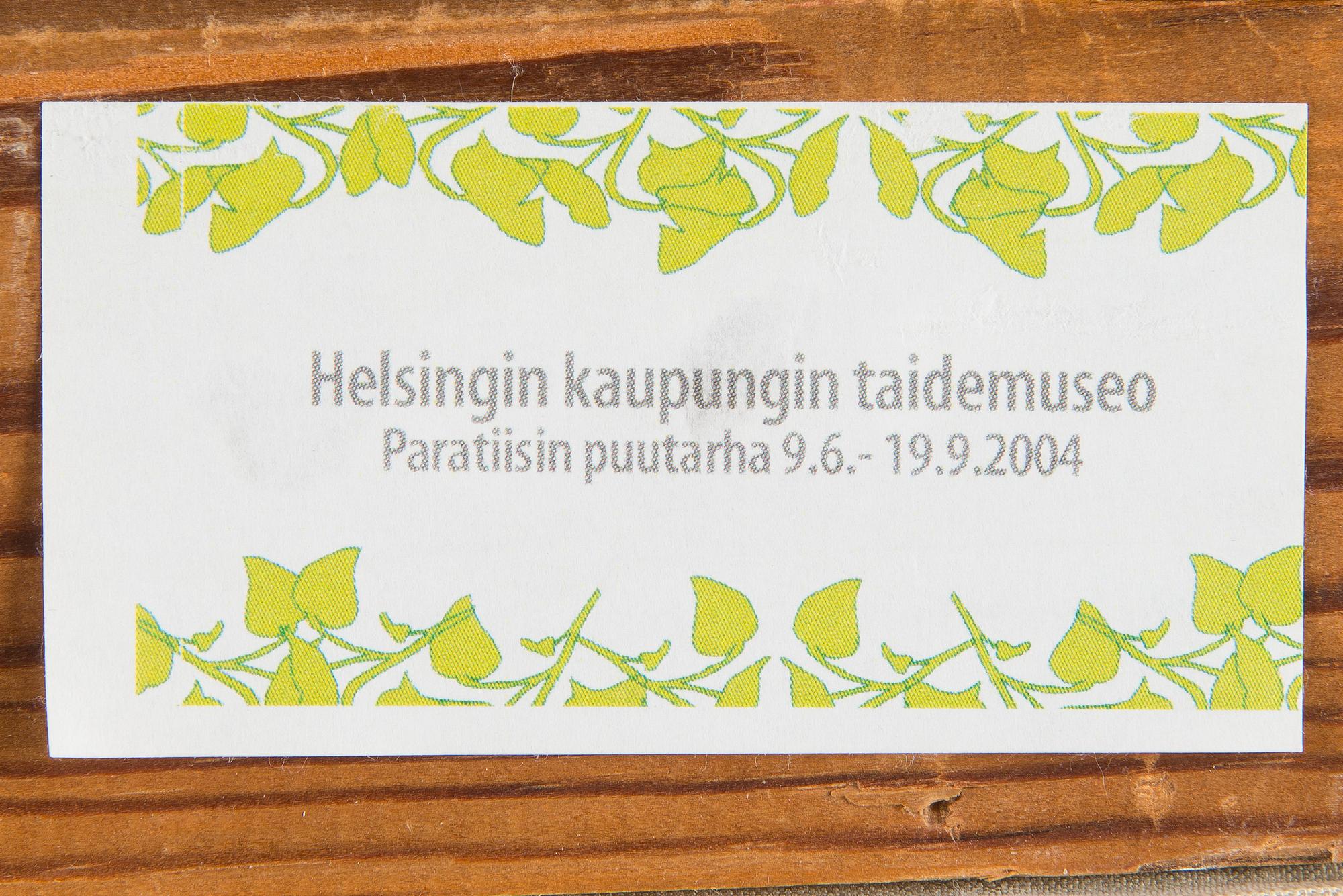
"Garden of Paradise," Helsinki Art Museum, 9 June - 19 September 2004.
"Helene Schjerfbeck", Tikanoja Art Museum, Vaasa, 16 October 2005 - 29 January 2006.
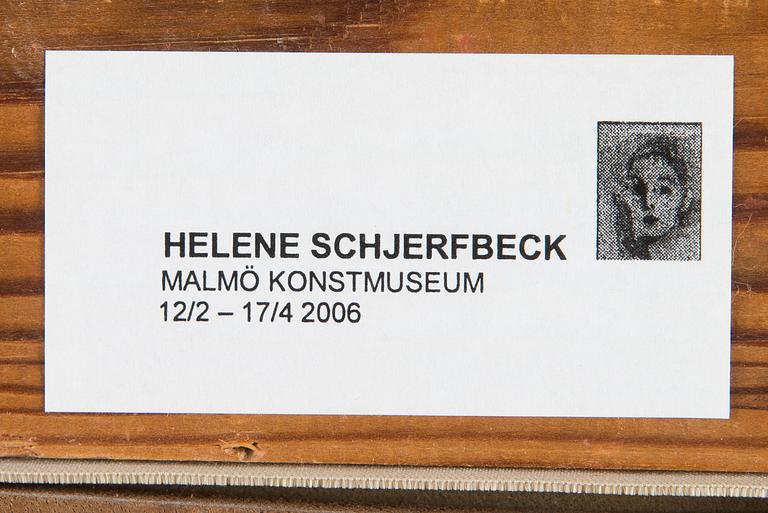
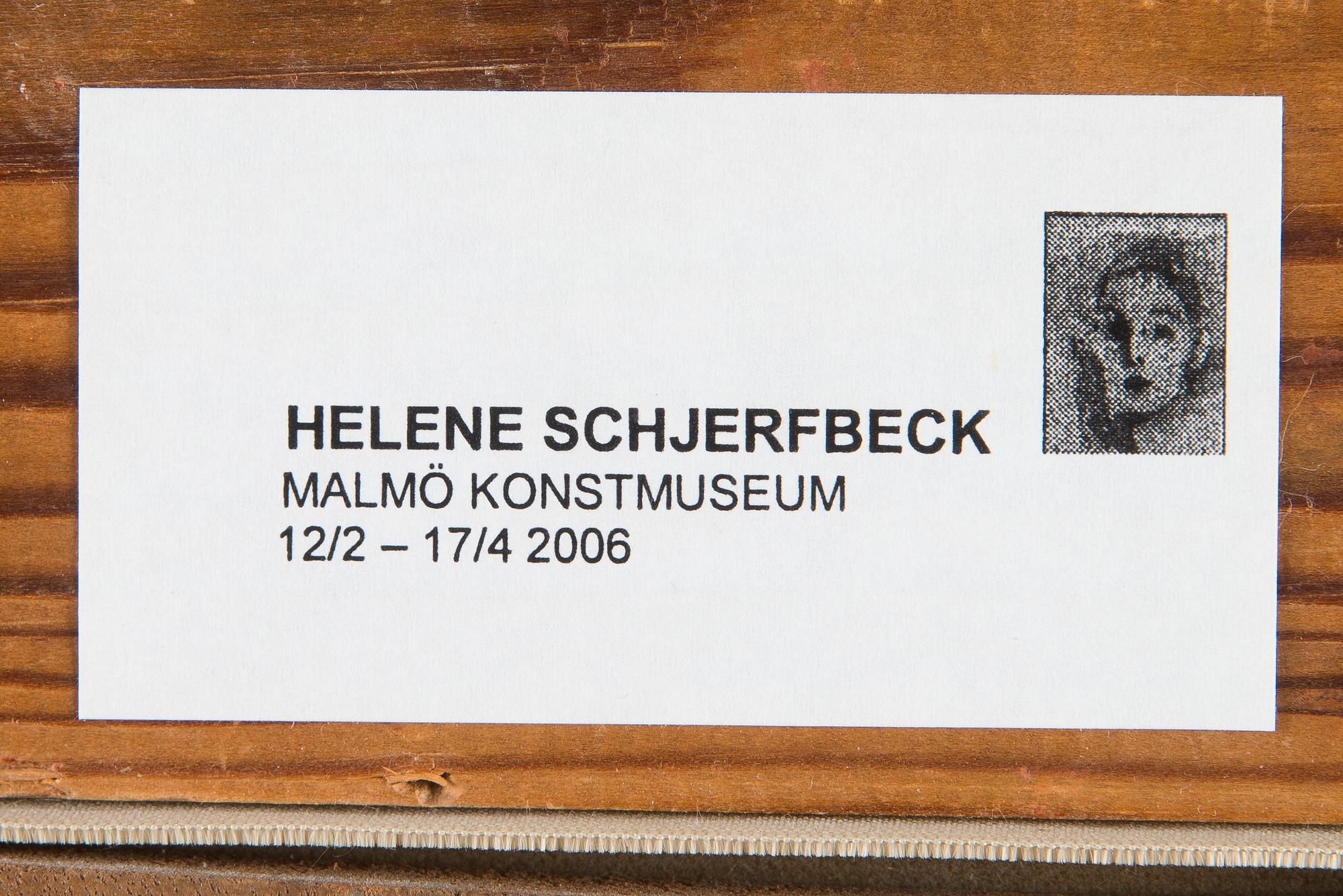
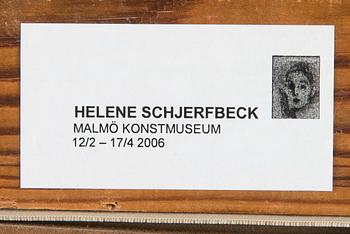
"Helene Schjerfbeck," Malmö Art Museum, 12 February - 17 April 2006.
"Helene Schjerfbeck-Life and Art", Raaseporin museo, Tammisaari, 2014-2024.
Literature
H. Ahtela, "Helene Schjerfbeck, Helsinki 1966, no. 204
"Helene Schjerfbeck", ed. Leena Ahtola-Moorhouse, Ateneum, 1992, no 119, illustrated on p.134.
"Helene Schjerfbeck-150 years", ed. Leena Ahtola-Moorhouse, Ateneum art museum, 2012, no 163, illustrated on p.135.
More information
During the latter part of the 1880s, Helene Schjerfbeck spent time on several occasions in Paris and also in St Ives on the English coast. Here she adopted the techniques and principles of French plein air painting, but also brought a bold and free approach to her work which, combined with her great technical mastery, gave the impression that her paintings had been created with effortless ease. This was not viewed as entirely positive, and she faced criticism even from her fellow artists. In a letter to H. Ahtela (Einar Reuter), she vents her frustration at her colleagues’ lack of acceptance of her artistic style: “I was never modern like them, among them.” In this context, ‘modern’ refers to naturalistic plein air painting.
Schjerfbeck, however, rarely allowed herself to be swayed by the criticism of those around her, and it can be said that the 1880s laid the foundations for her unique style, characterised by broad, soft brushstrokes, a play with colour contrasts and a distinctive sensitivity. In 1888, the work “The Convalescent” was created, an interior scene depicting a sad, sickly girl calmly gazing at a twig with a few budding buds. The following year, the painting was awarded the first-class bronze medal at the Paris World’s Fair, and it remains one of Helene Schjerfbeck’s most famous works.
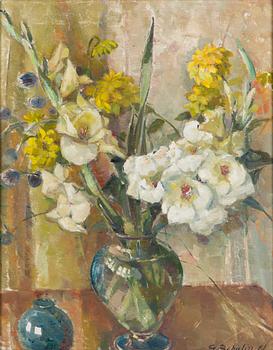
Flowers and children were central motifs for Schjerfbeck in her work from the 1880s. The availability of child models was quite good, but they were at the same time relatively demanding subjects and difficult to arrange. Like Maria Wiik, Schjerfbeck was able to emphasise fragile and distinctly feminine emotional states in her paintings featuring children, which can also be seen as a certain limitation. In contrast, in her floral motifs she was able to express both the vitality of nature and its nuances, whilst at the same time reflecting her own state of mind at that moment.
From childhood, Schjerfbeck had felt a strong connection to nature and admired the beauty of plants and their magnificent colours. Floral motifs and other forms of still life were themes to which she constantly returned throughout her career, and they provided a welcome and much-loved pastime when she had time to spare from her portrait and landscape work.
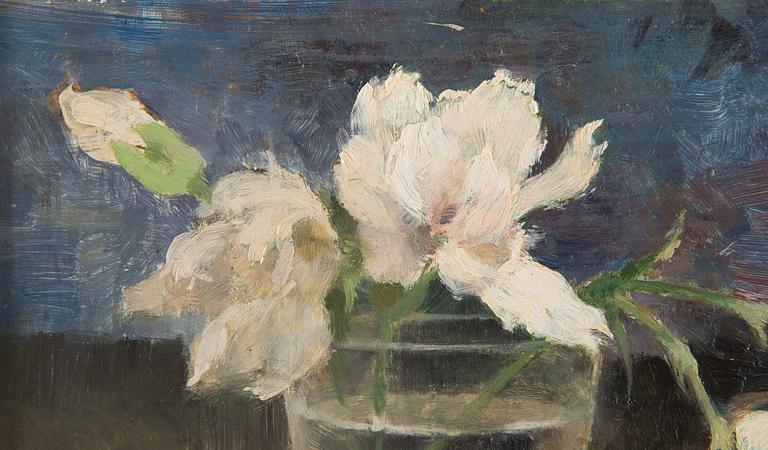
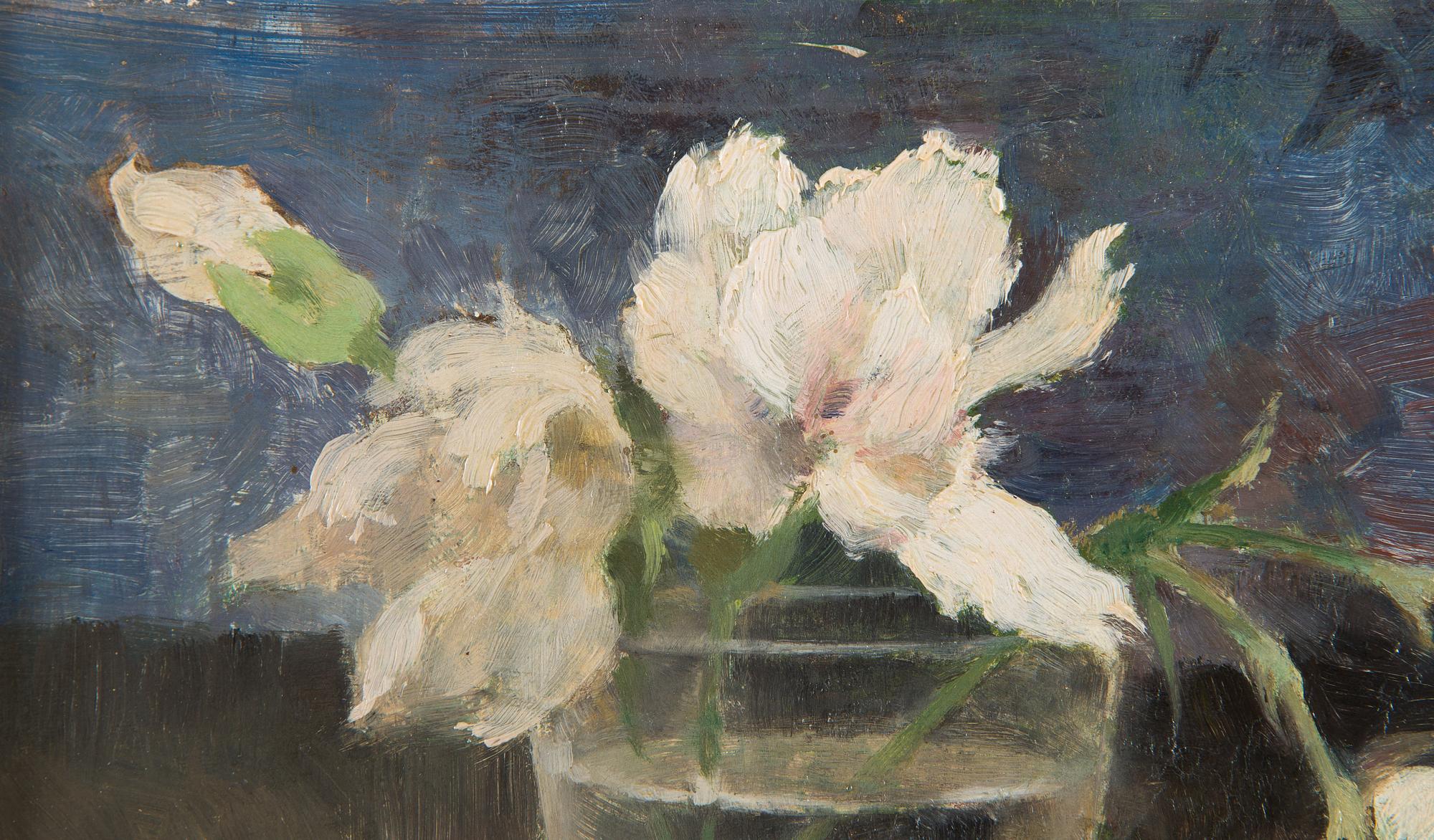
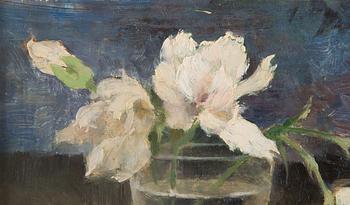
The work now on sale is a fine example of the expressiveness Schjerfbeck achieved in her flower paintings. The carnations in the water glass give a lively impression and seem to be embroiled in a conflict. The carnation in the centre stands defiantly, whilst two are bent far over the rim of the glass and look as though they wish to leave. The drama is heightened by the dark and richly nuanced background, which lends depth whilst simultaneously highlighting the interplay between the flowers. It is fascinating to imagine the emotions and thoughts that flowed through the artist as she created the painting.