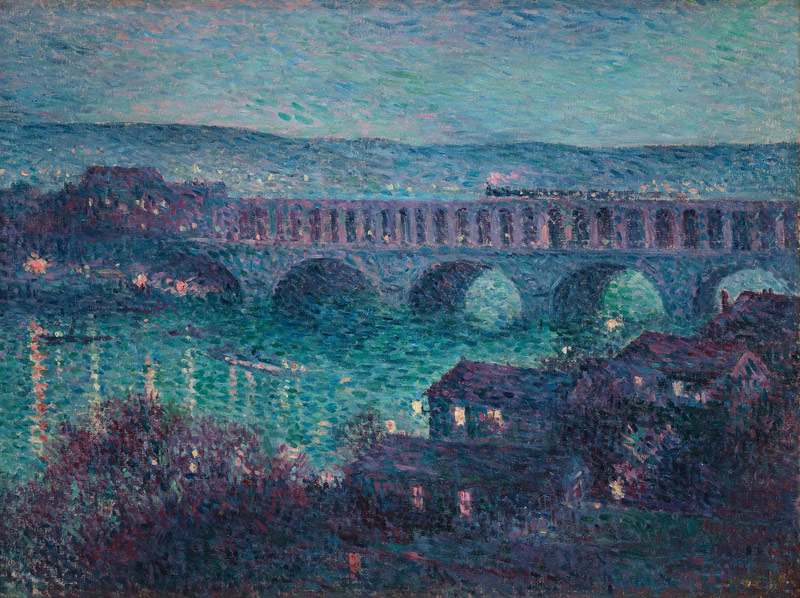
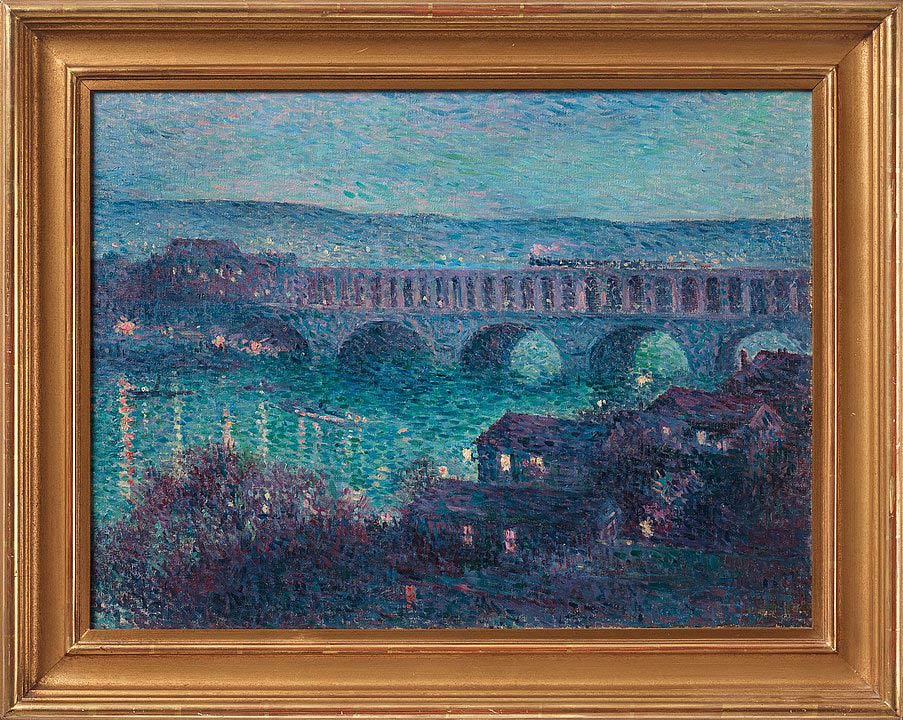
Maximilien Luce — ”Le viaduc d'Auteuil (Le Pont)”
Important Winter Sale presents
Maximilien Luce — ”Le viaduc d'Auteuil (Le Pont)”
The exhibition, which would later come to be known as the first Impressionist show, was held in the famous Parisian photographer Félix Nadar’s studio in 1874. The artists joining the exhibition were looking for an alternative to the official ‘Salon’ – a development that Sweden also experienced with the so-called ‘Opponentrörelsen’ in 1885. It is hard not to consider the 1874 exhibition in Paris as a decisive moment in art history when a new way of painting was launched on a large scale. The reception by both critics and the French public was mixed. The changes taking place in French art were more clearly noticeable than in other parts of Europe, where the official art scene remained governed by powers still anchored in an idealistic belief in art’s higher purpose. One of the artists that, for the longest time, would carry the banner of the Impressionists was Maximilien Luce.
The changes in art during the late 19th century mirrored societal transformation, and the notion of modernity encompassed the idea of time as something fleeting, with progress waiting just around the corner. The evolving society became a constant source of ideas for artists living in urban environments. In Paris, in particular, the transformation went hand in hand with Impressionism during its early development. Urbanity and change were the backdrop for artists such as Renoir, Caillebotte, Manet, and also Luce.
Under Emperor Napoleon III the capital city of Paris underwent major renovations between 1853 and 1870. Baron Haussmann, after whom the city’s replanning is named, set about tearing down old buildings in order to create a more open space and a cleaner, brighter and safer city. Another contributing factor was that the city still displayed damage from its occupation during the Franco-Prussian war (1870-1871). After the war, the number of inhabitants in the city had increased exponentially, which gave artists an enormous amount of material for their scenes of city life. The wide boulevards, public gardens, theatres and grand buildings became symbols of the future and of modernity.
Amongst the Impressionists some came to especially devote themselves to certain parts of the city: Degas and Caillebotte focussed on labourers, singers and dancers, whilst their female colleagues, who lacked the liberty of moving freely in public, ended up depicting the bourgeois home. What the Impressionists’ paintings of Paris have in common is the mix of social classes – in the streets, in the park or in the shops. Within the melting pot of progress, people and their belief in the future that was Paris at this time, politics came to play an increasingly more important role.
In his younger years, Luce had worked as a printer. Emerging before his eyes was a modern Paris, and one of the most dynamic eras in the history of culture began. Suddenly the focus shifted from ‘what’ to ‘how’, and it was this question that Luce explored in his artistic practice. From having been a printer, Luce came to fully invest himself in his painting around 1880, eagerly cheered on by his good friend Camille Pissarro – one of the founding figures of Impressionism. The two friends wanted to evolve painting and strongly believed in the future of the medium and the kind of society they wanted to build. Both were actively engaged in the anarchist movement, and Luce’s subjects often demonstrate solidarity with the city’s less fortunate residents. With his background as a printer and illustrator, Luce ended up doing several illustration jobs for a number of political magazines circulating in Paris at the end of the 19th and the beginning of the 20th century.
Luce exhibited at ‘Les Indépendants’ almost every year from 1887 to 1941 – this confirms his critical importance to the art at the time. In contrast to the Pointillists, with their clearly defined colour application, Luce and the Neo-Impressionists would theorise colour in a more integrated way so that the subjects were increasingly considered as a whole. Luce’s constant desire to develop and contextualise painting made him an early adopter of Fauvism, where he again emphasized the unique status of colour and, as such, found his way back to his original style.
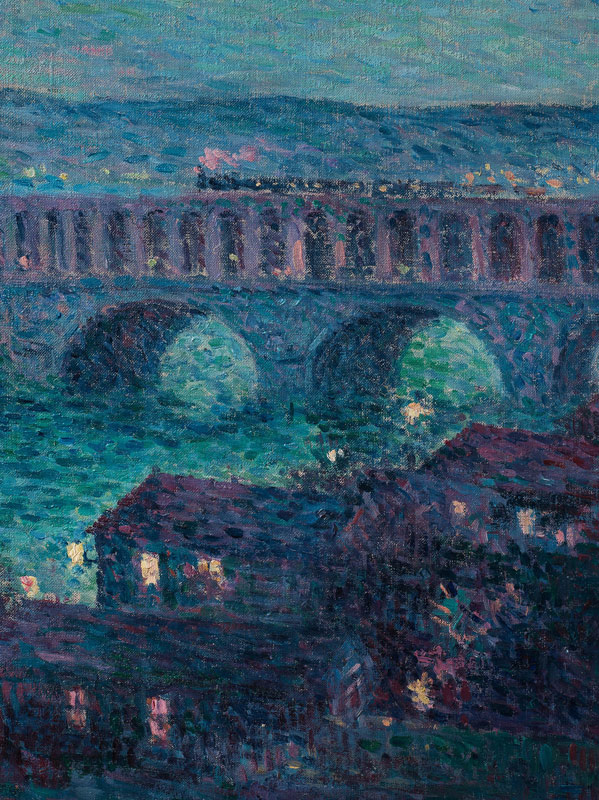
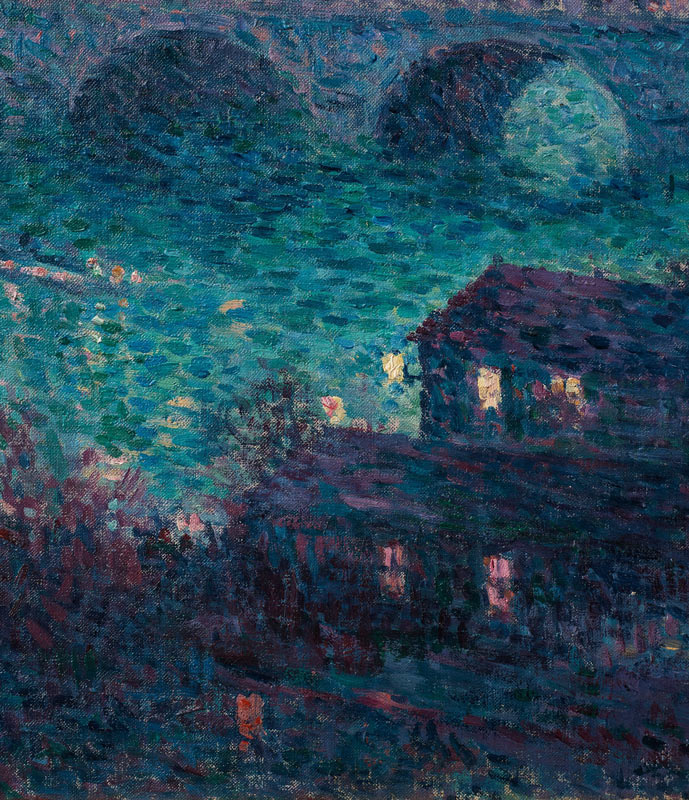
In the lot in the auction, Le viaduc d’Auteuil, we are witnessing one of the artist’s best works. In connection with a major 2011 retrospective exhibition of Luce’s work at Musée d’Orsay in Paris, the artist’s paintings experienced a renaissance and his important role amongst the Impressionists was highlighted. In the preface to the exhibition catalogue, his use of light is described as a ‘violent effect’ that shines a light on a view of art, on the city and on light itself – everything that the artist held dear. The technique that Luce employed was short, interrupted brushstrokes that transmitted the essence of a shape, together with pure and undiluted colours. Apart from this radical brush technique, the exceptional position that colour held must also be mentioned.
Within academic art, shadowing using white, grey and black was advocated, whilst the Impressionists chose to create the illusion of shadows in colour. Today these light colours seem hardly radical, but in the 1870s, the public were used to the more sober colours common in academic art. Another technical aspect of Impressionism was how many artists chose not to varnish their works and, in effect, tone down their colouring. During the mid-1800s, synthetic pigment was developed, which made colours more intense and resulted in even livelier nuances of blue, green and yellows than the painters had ever used before. The colour palette in this lot is bursting with colour without being intimidating or upsetting to the eye. Instead of a quiet and consistently blue palette, Luce plays with turquoise mixed with warm purple tones, giving the composition a peaceful impression.
The bridge depicted, the aqueduct by Auteuil, maintained traffic to and from the town, which had not been possible prior to its construction in 1863. Additionally, it came to play an important part in the ever-more significant development of the railway. In the painting, a train is careering across the bridge, which can be interpreted as an allegory for modernity and the society in transformation that the artist lived in. Le viaduc d’Auteuil was bought through Svensk-Franska Konstgalleriet in Stockholm. It was previously part of an important Swedish private collection for many years. The work has on several occasions been exhibited as an example of excellent French Neo-Impressionism, including in 1941 at the National Museum’s exhibition "Frankrike genom konstnärsögon" and in 1954 at Liljevalchs’s exhibition "Cézanne till Picasso. Fransk konst i svensk ägo".
The work is sold at the Important Winter Sale. Estimate 3 000 000 - 4 000 000 SEK.
Viewing: December 1 – 6th, Berzelii Park, Stockholm.
Open: Mon–Fri 11 AM – 18 PM, Sat – Sun 11 AM – 16 PM.
Auction: December 7 – 9th, Arsenalsgatan 2, Stockholm.
To the work
Explore the cataloge
Requests & condition reports Contact specialist