Modern Art & Design presents Bror Hjorth | May 20–22
"Påskafton på turisthotellet"
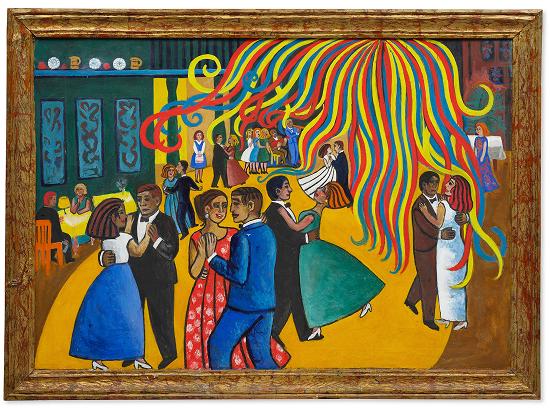
Nu erbjuds ett sällsynt tillfälle att förvärva ett av Bror Hjorths mest centrala verk, tillkommen när konstnären stod på höjden av sin karriär och strålande i sin gränslösa färgprakt.
It’s positively brimming with life in the dining hall of the historic tourist hotel in Rättvik. The floorboards creak as dancing couples sweep across the room to cheerful tunes, colourful ribbons dangle from the ceiling, and the effervescent atmosphere is unmistakable. Bror Hjorth’s monumental depiction of the Easter Eve ball in Rättvik in 1946 was especially dear to him, and he kept the painting in his possession throughout his life.
Bror Hjorth’s importance to the emerging modernism in Sweden truly gathered pace during his time in Paris in the 1920s. It was there, at a distance from Sweden, that he not only developed his artistry but also found a deeper grounding within himself. “My real life, the one with art, began upon my arrival in Paris in 1921,” writes Bror Hjorth in My Life with Art. In Paris he became a pupil of Antoine Bourdelle at the sculpture school on Rue de la Grande Chaumière, while also establishing his own studio in Clamart. There he worked intensively, experimenting with the robust language of Cubism and striving to capture what lay beyond the visible—the inner core of form. His encounter with Auguste Rodin made a powerful impression through its expressive force, while Vincent van Gogh, Paul Cézanne, and Paul Gauguin opened his eyes to the possibilities of colour. Gauguin’s paintings from Tahiti proved particularly decisive; they set in motion an inner transformation that altered his way of seeing his own creative work, but above all stirred a longing for home.
Estimate: 2 000 000 - 4 000 000 SEK
Weekdays 11 AM – 6 PM
Weekends 11 AM – 4 PM
“Through Gauguin I also, quite unpretentiously, found an exotic land for myself without the slightest effort. […] My country, my home, my parents, the clear blue sky, the dark spruces and pines, the lakes and hills, the light nights. Everything blossomed within me. […] I had no need to seek my subjects elsewhere.”
The exotic became a mirror that turned his gaze back towards home, to the landscapes of his childhood and the Swedish nature he carried within him. “Through Gauguin I also, quite unpretentiously, found an exotic land for myself without the slightest effort. […] My country, my home, my parents, the clear blue sky, the dark spruces and pines, the lakes and hills, the light nights. Everything blossomed within me. […] I had no need to seek my subjects elsewhere.”
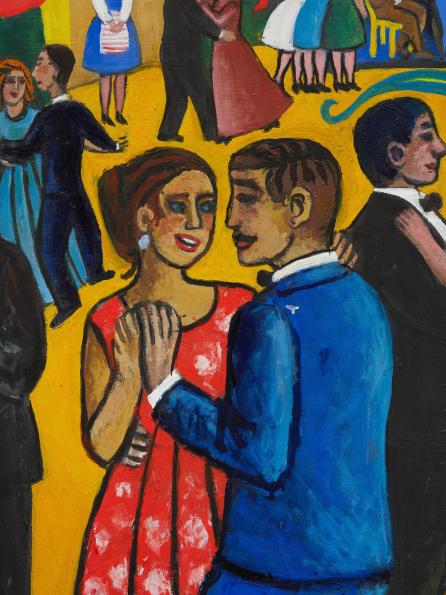
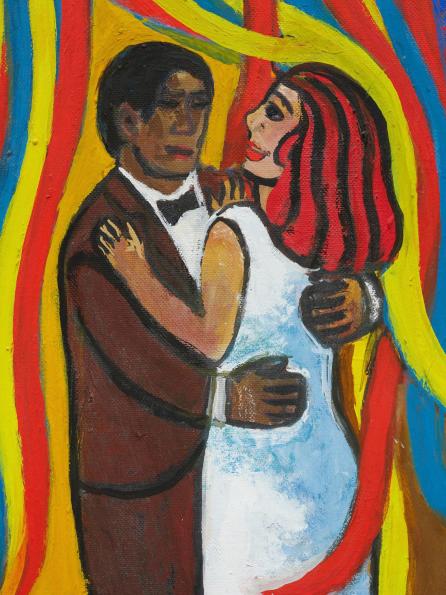
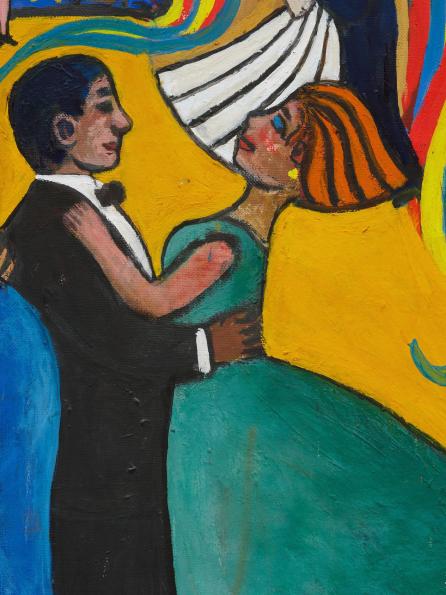
Thus Bror Hjorth turned his gaze towards Sweden and the places where he felt at home. In the early 1940s, the Hjorth family’s finances improved considerably following successful sales, making it possible to build a spacious villa and studio in Kåbo on the south-western outskirts of Uppsala. In the summer of 1943, Bror, his wife Tove, and their son Ole moved into the leafy residential district. His motifs were now drawn almost exclusively from the home, the surroundings of Uppsala, and the family’s holiday travels to Rättvik, Leksand, Varberg, Öland, and Arild. The handsome tourist hotel in Rättvik, commissioned by Wilhelmina Skogh, was completed in 1894 and built alongside the railway line. At Easter 1946, a grand ball was held in the hotel’s dining room, and the experience was immortalised by Bror Hjorth in the painting’s astonishing richness of colour. To the left appears the artist’s wife, Tove Hjorth, dancing in a blue skirt and white blouse. Their son Ole, dressed in a brown suit and black bow tie, leads his companion between the colourful ribbons hanging from the ceiling. The tourist hotel was demolished in the 1960s, but black-and-white photographs of the dining room still reveal the characteristic wall decorations and the shelf with plates and tankards, recognisable in Hjorth’s painting.
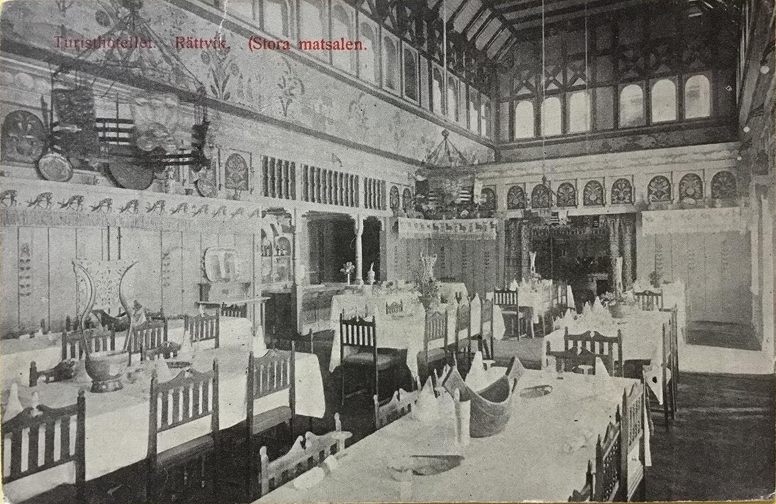
The motif was first executed as a smaller sketch before being transferred to a considerably larger and more detailed final version. The year after its creation, Bror Hjorth exhibited at the Swedish-French Art Gallery in Stockholm, where the present work was shown as the first catalogue entry. Hjorth kept the painting in his private collection, and during the 1960s he returned to it with renewed energy. The final years of his life were marked by an immense creative drive and a fondness for heightened colours and sharp contrasts. Many of his earlier works were reworked and given new life, including Easter Eve at the Tourist Hotel, which after 1966 emerged, if possible, in an even greater splendour of colour. In a photograph from Hjorth’s studio at this time, the painting can be seen standing on an easel, likely newly completed once again. Bror and Margaretha, the artist’s second wife, embrace affectionately amidst his vividly coloured paintings and sculptures.
Bror Hjorth’s artistic practice carries a particular luminosity. In Easter Eve at the Tourist Hotel, he truly excels, and the painting becomes a tribute to what lay closest to his heart—music, people, and an inexhaustible joy for life.
Bror Hjorth at Modern Art & Design
Enquiries and Condition Reports