Modern Art & Design presents Victor Vasarely | November 18–19
The art of Hungarian artist Victor Vasarely is perhaps more relevant today than ever before.
The visual effects he created by hand in the mid-twentieth century anticipated the aesthetics of contemporary computer games, digital art and graphic design. His vivid colours, flowing geometric compositions and striking black-and-white patterns continue to captivate viewers, demonstrating the timeless appeal of his artistic vision.
Born in Hungary in 1906, Vasarely became one of the leading pioneers of Op Art, an artistic movement that explores optical illusions through geometric forms, colour and contrast. He studied under László Moholy-Nagy, whose teaching introduced him to the ideas of the Bauhaus. The works of artists and architects such as Wassily Kandinsky, Walter Gropius, Le Corbusier and Piet Mondrian also influenced his development. After moving to Paris in 1930, Vasarely worked successfully as a graphic designer, systematically investigating the visual and emotional possibilities of graphic techniques. Over the following decades, Vasarely developed a distinctive approach to geometric abstraction, creating compositions in which carefully arranged shapes and colours produced powerful optical effects.
Estimate: 3 000 000–5 000 000 SEK
Estimate: 2 000 000–2 500 000 SEK
Weekdays 11 AM – 6 PM
Weekends 11 AM – 4 PM
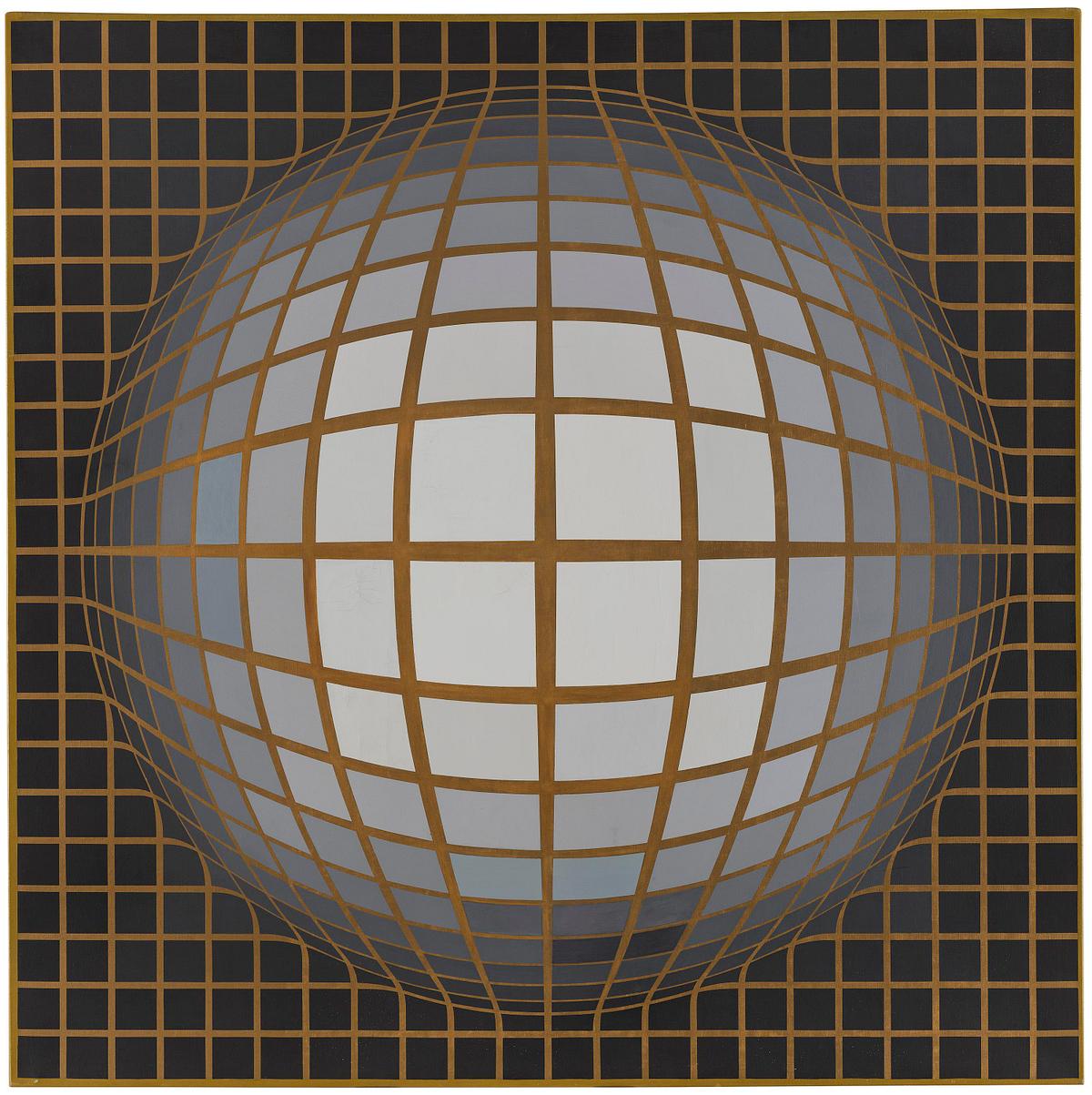
In the composition RE-NAB-II-B, Victor Vasarely creates the illusion of three-dimensional space on a two-dimensional surface. Against a dark background, a golden grid curves around a large, pale blue-grey circular form at the centre. The geometric lines create the illusion of a rounded volume either projecting out from or receding into the surrounding space.
The illusion is heightened by the contrast between the regular structure of the grid and its apparent deformation. At first, the grid appears ordered and symmetrical, but as the lines curve around the central form, the structure becomes visually unstable. The viewer may perceive the form as a sphere, a bulge or an opening into another space. This ambiguity causes the eye to alternate between perceiving the image as a flat pattern of lines and as a three-dimensional object.
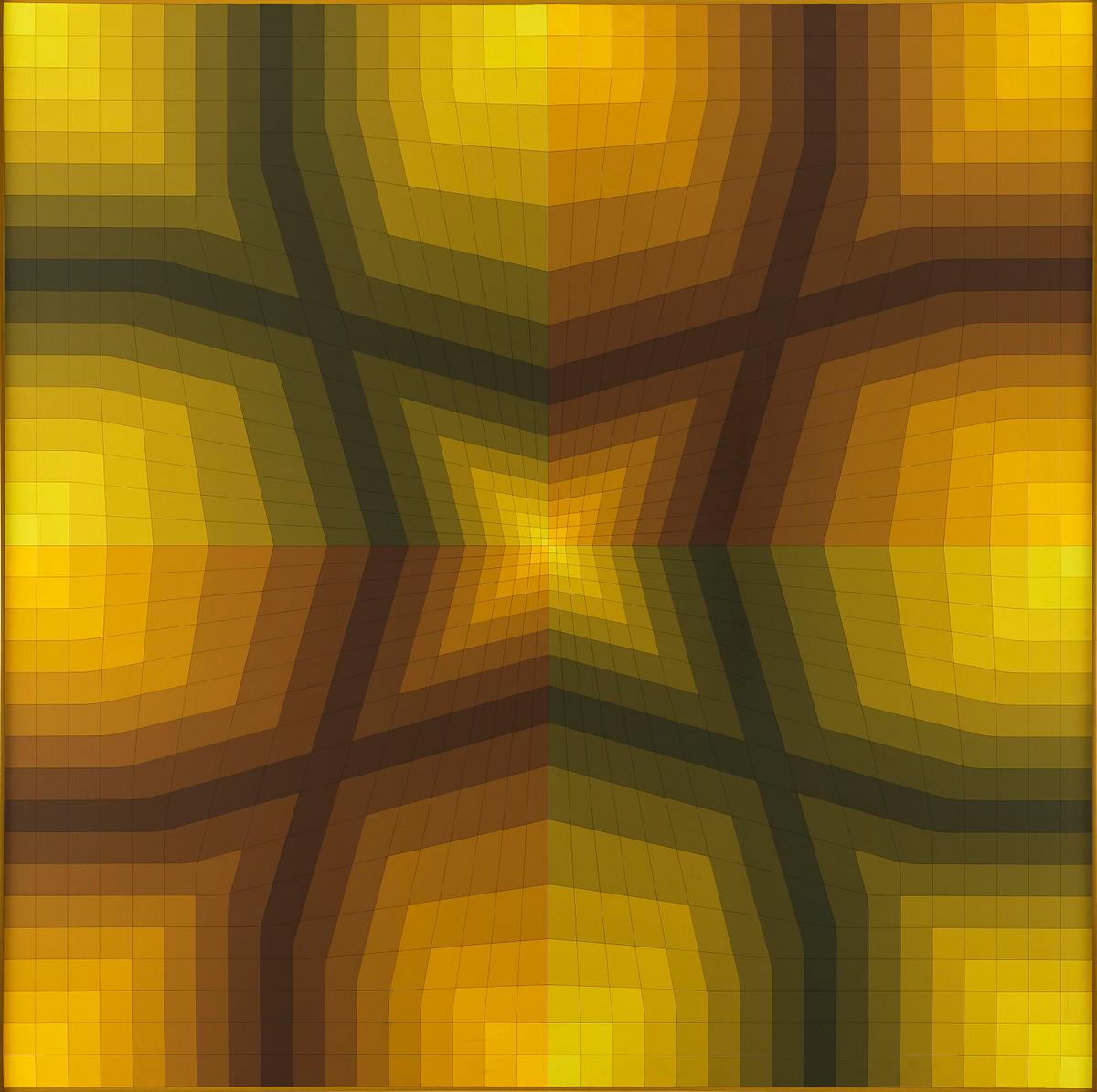
Created in 1986, "ONNCA" exemplifies the mature expression of Vasarely’s artistic ideas. The painting features an ordered geometric grid that appears to swell and project beyond the picture plane, creating an illusion of convex and concave forms. Warm colours, particularly yellow, seem to advance towards the viewer, while the surrounding geometric structure enhances the impression of depth and movement.
By placing these colours around the centres of the grid, Vasarely manipulates visual perception, transforming a flat surface into an apparently three-dimensional space. The result is a composition that seems almost sculptural, despite being constructed entirely through colour and geometry.
In "ONNCA", Vasarely brings together his lifelong explorations of optical illusion, spatial perception and the dynamic relationship between colour and form. The painting is more than a visual experiment; it demonstrates how carefully controlled geometric arrangements can challenge the viewer’s perception of reality. Its apparent movement and spatial depth anticipate many of the visual strategies used in contemporary digital imagery. Nearly four decades after its creation, "ONNCA" remains a compelling example of Vasarely’s ability to transform mathematical precision into a vivid and immersive artistic experience.
Victor Vasarely at Modern Art & Design
Enquiries and Condition Reports