New Season, New Masterpieces – Keith Haring, "Untitled"
Offered for sale in Contemporary Art & Design
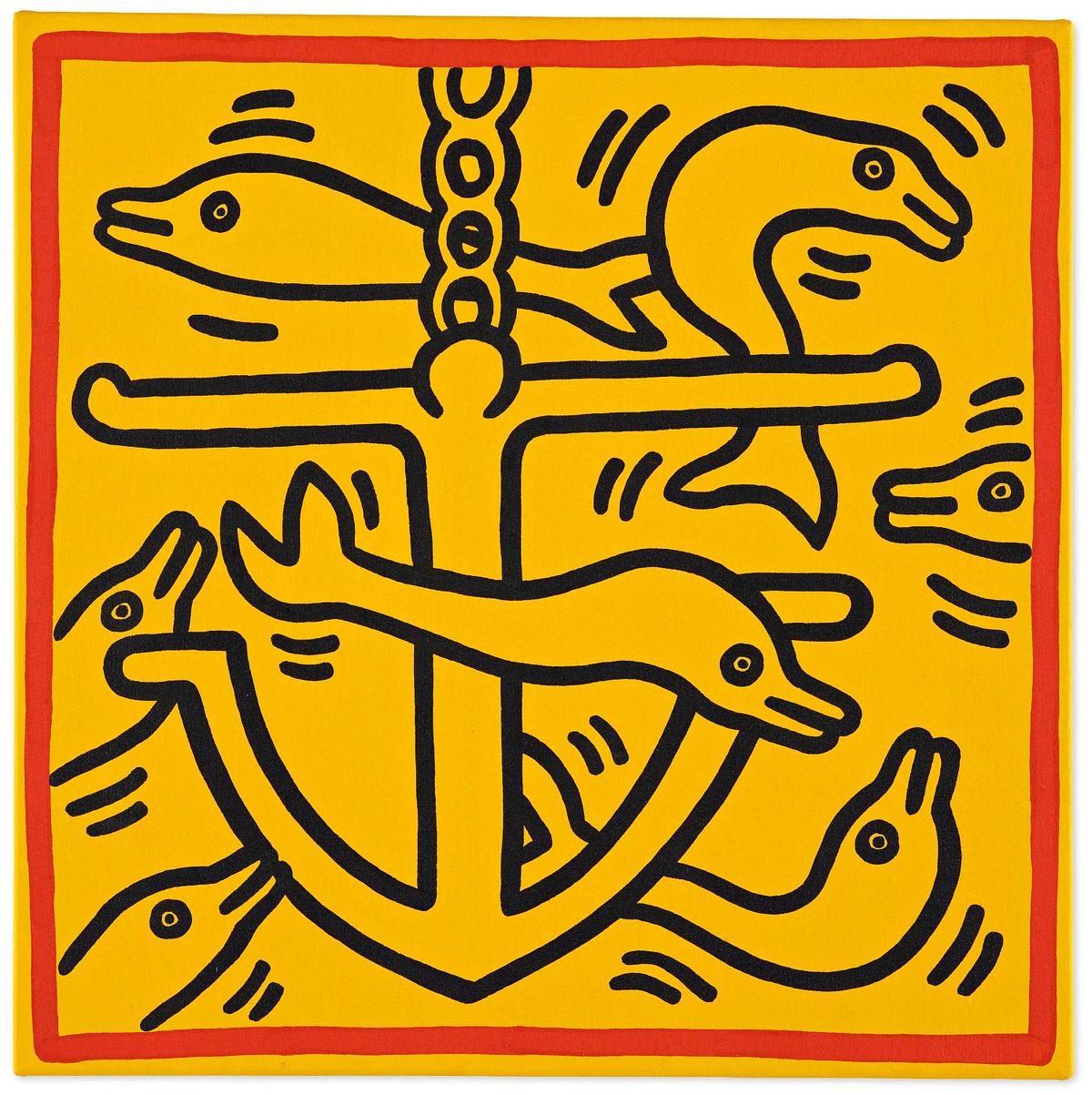
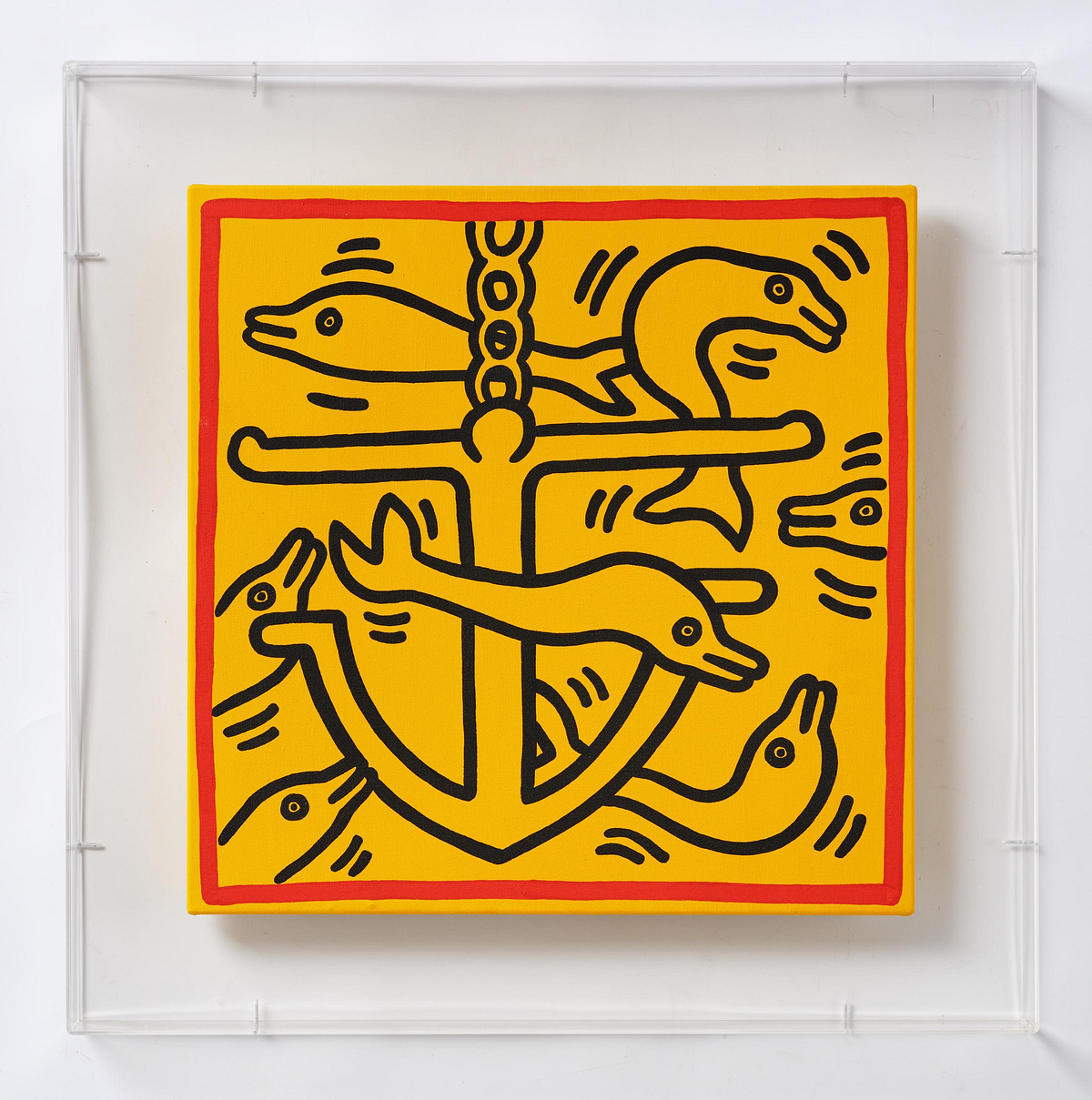
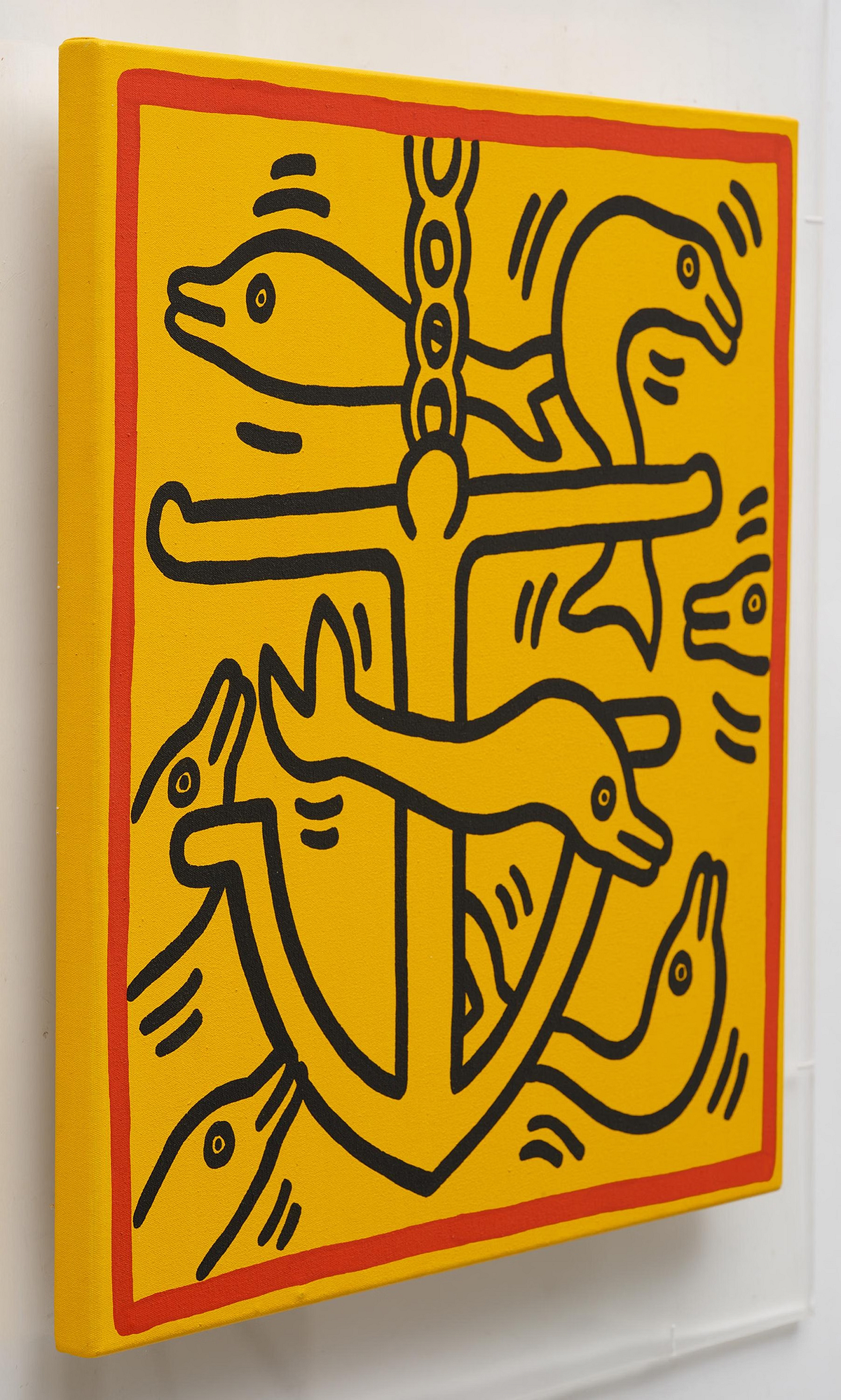
This exceptional and iconic work by Keith Haring, created in 1989, contains many of the elements of the artist’s enduring imagery that has been embraced around the world.
The work also reveals his increasing engagement with Christian iconography while maintaining the bold, simplified visual language that defined his art. Haring framed the image with a bright red line against the yellow background. The motif, painted with characteristic, energetic black lines, is simultaneously playful, confrontational, and deeply concerned with questions of life, death, and transcendence. Centrally placed is the anchor, a symbol of hope, held afloat—or, more likely, sinking—through a school of wiggling dolphins. The anchor takes the shape of a crucifix, which should be understood within the context of the late 1980s. Haring was confronting the AIDS crisis and his own mortality. In this important work, he addressed death, suffering, compassion, resurrection, and hope without abandoning his direct and accessible style.
New York in the 1980s
Keith Haring rose to prominence in the 1980s, with his career marking a historic mixing of the worlds of fine art and street art. He learned to draw, at an early age, from his father, who encouraged him to continue at art school in Pittsburgh. Drawing became a way for Haring of commanding respect and more importantly communicating with an audience. Having dropped out of the professional art school, Haring moved to New York to enroll in the School of Visual Arts in 1978. There, he discovered a thriving art community outside the traditional gallery and museum world.
Haring became immediately attracted to the graffiti in the New York subway system. After two years of observing and experimenting with video and performance art, Haring returned to drawing. He saw an empty black advertising panel at the Times Square station and immediately bought some crayons and filled the panel with a chalk drawing. After this first drawing, he continued appropriating empty spaces in the subway system and filling them with his drawings. He wanted his motifs to be easily readable, and they were designed to provoke and stimulate the viewer’s imagination. It was also necessary to work quickly to avoid being arrested by the police. Since the spaces were reserved for advertisements that aimed to tell people what to think, his drawings became a form of provocation.
As he created hundreds of drawings, New Yorkers would stop to watch and sometimes critique the production of these works. Engaging with the frenzied energy of the subway system, as well as the short-lived nature of such chalk drawings, Haring was able to use the underground as a “laboratory” for experimentation.
Haring’s career quickly developed above ground over the course of the decade, propelling the artist into the limelight of the New York art world. He went on to create dozens of public murals throughout the city, known for combining his vibrant, graphic style with political and social messages.
Iconography
His was the time of computers and subways, spaceships and television, racial uprisings, ethnic repression, consumerism, and AIDS. Haring was noted for his involvement in raising awareness about AIDS and safe-sex practices, opening a public dialogue around taboo subjects in the New York art world. He aimed to depict the complexity of the present, in all its sublime and horrifying aspects, with lightness and irony, while making his work easily accessible to the public.
Haring has been described as moving through different media like a fish through water as he developed a series of symbols and icons rooted in mass media. His feverish images were populated by the radiant child, the barking dog, flying saucers, and universal symbols such as the halo, the cross, and the pyramid. The unexpected combination of symbols and their interaction was instrumental in communicating his message. His symbols for violence, money, sex, religion, and racism were easily recognizable. He painted pierced hearts and pitch-black, pointed pliers as symbols of the horror associated with AIDS, and he took part in the fight against the disease to which he ultimately succumbed at the age of 31.
A Life's Work
Keith Haring died on February 16, 1990, after suffering complications related to AIDS. His legacy is immense. During the decade following his arrival in New York, he created an estimated ten thousand works across virtually every medium and surface available to him. He also founded a charitable organization, opened Pop Shop, a retail space, created murals on five continents, published significant print portfolios with international publishers, and developed an audience that crossed social, economic, and cultural boundaries. The scale of his achievements within such a short period of time is remarkable.
Estimate: 6 000 000 - 8 000 000 SEK

Contact Our Specialists
Enquiries and Condition Reports