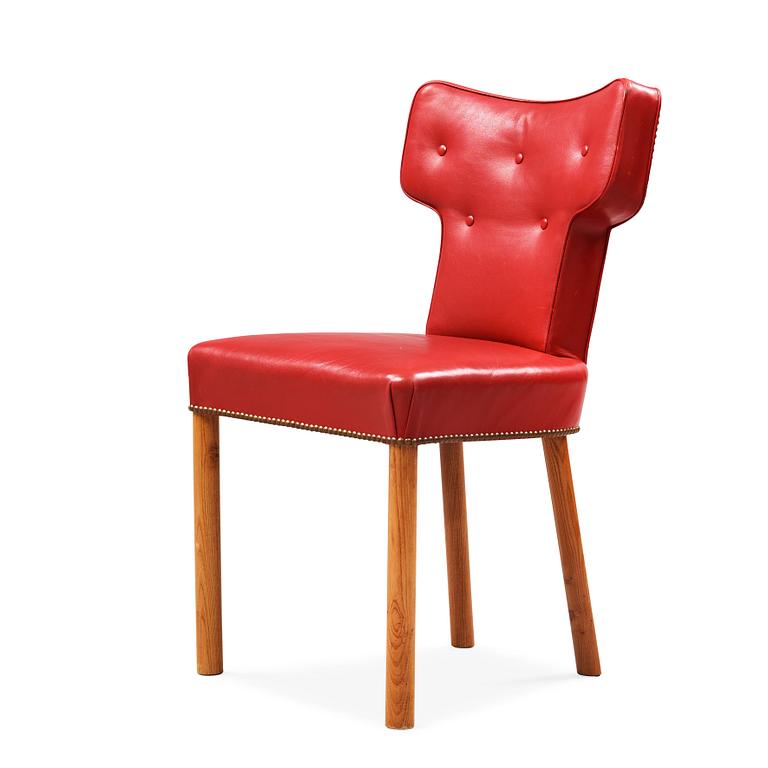
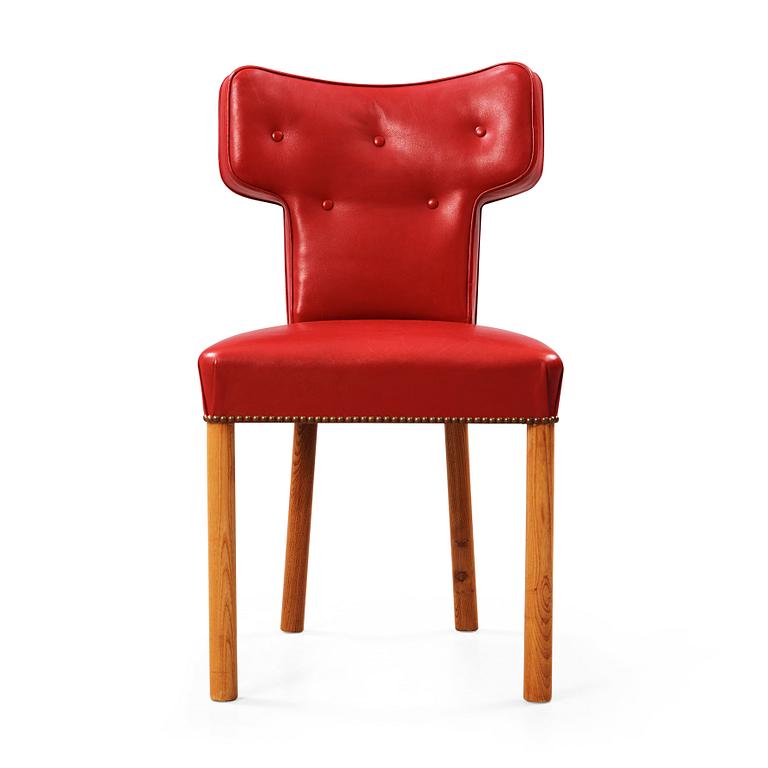
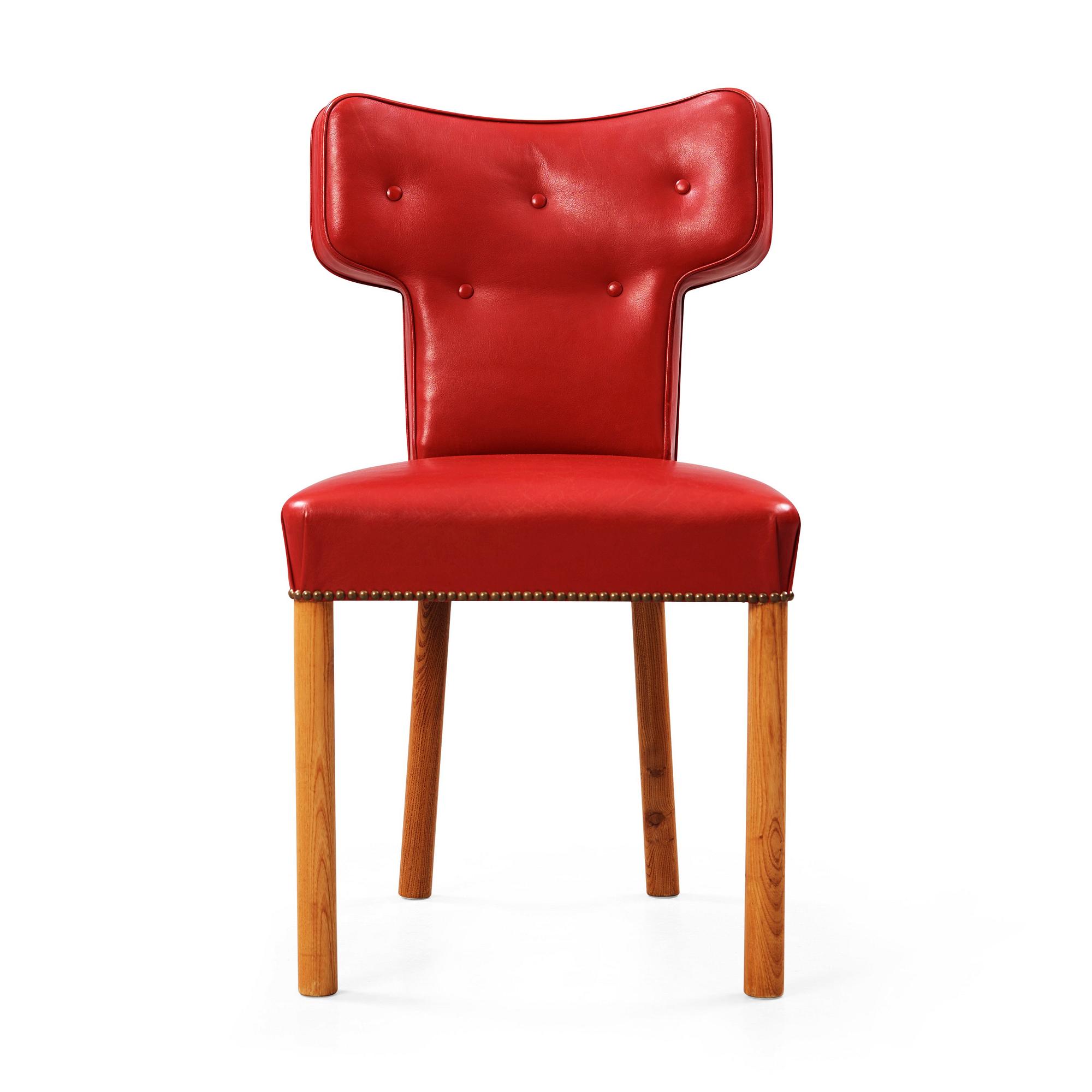
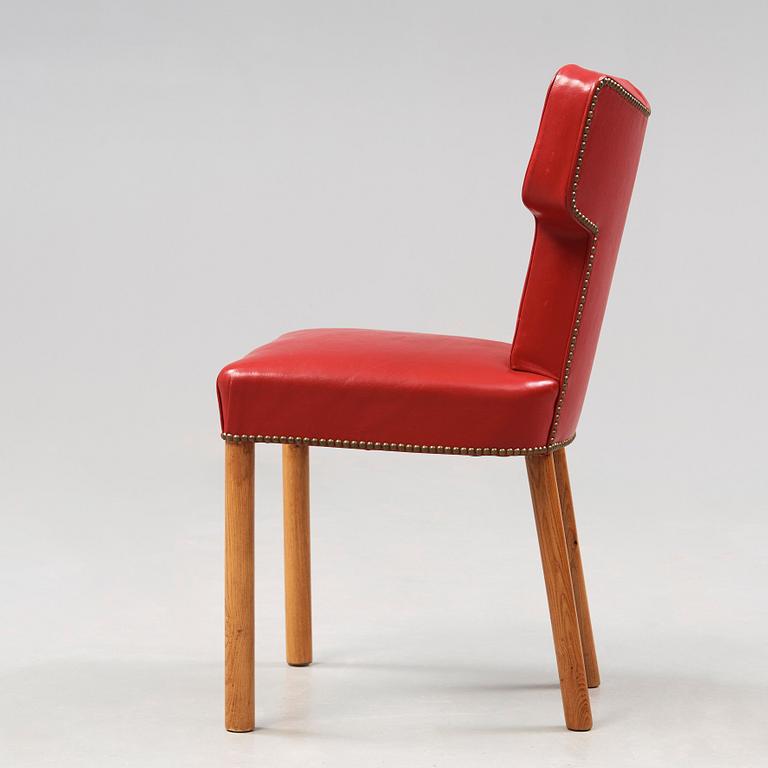
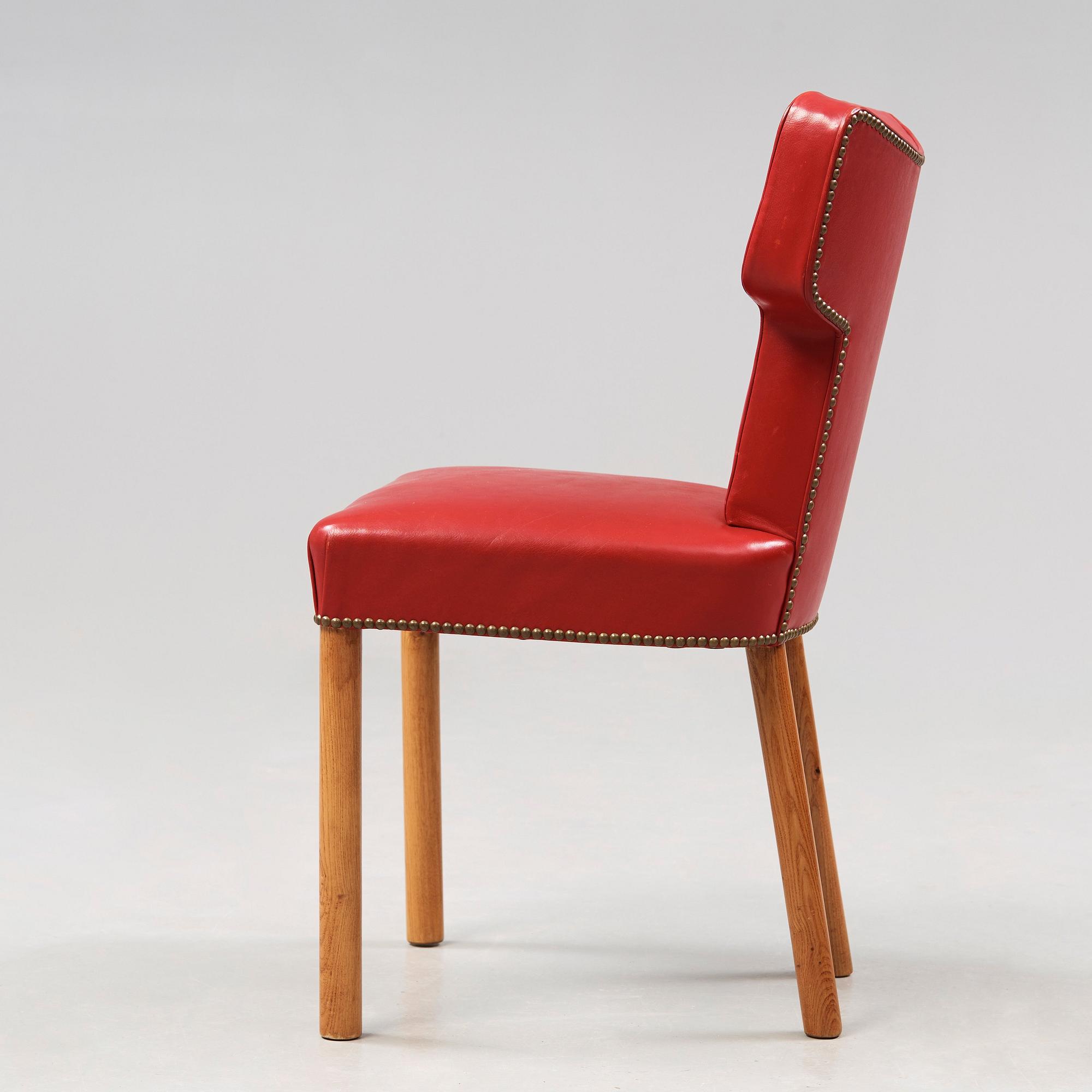
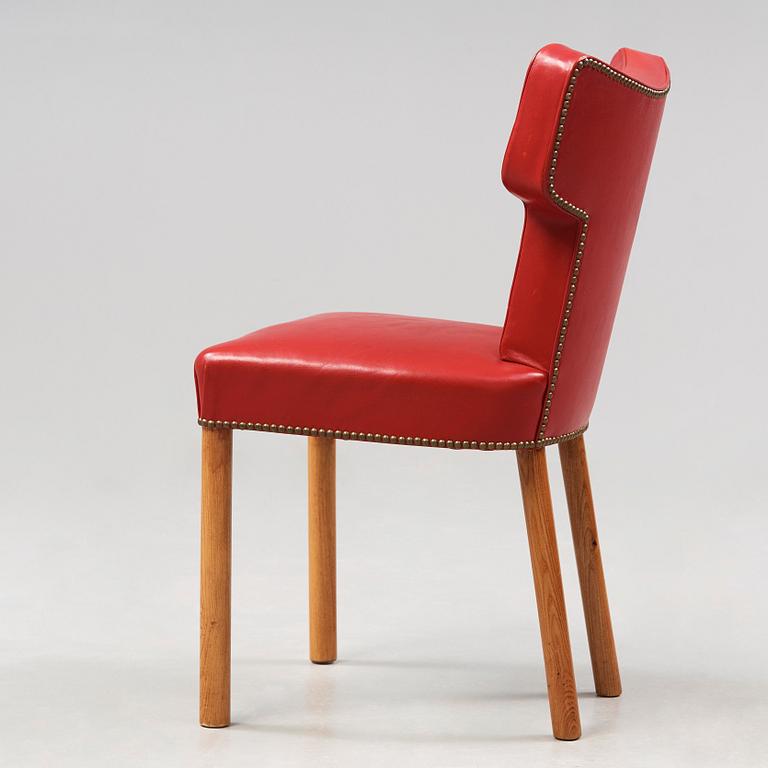
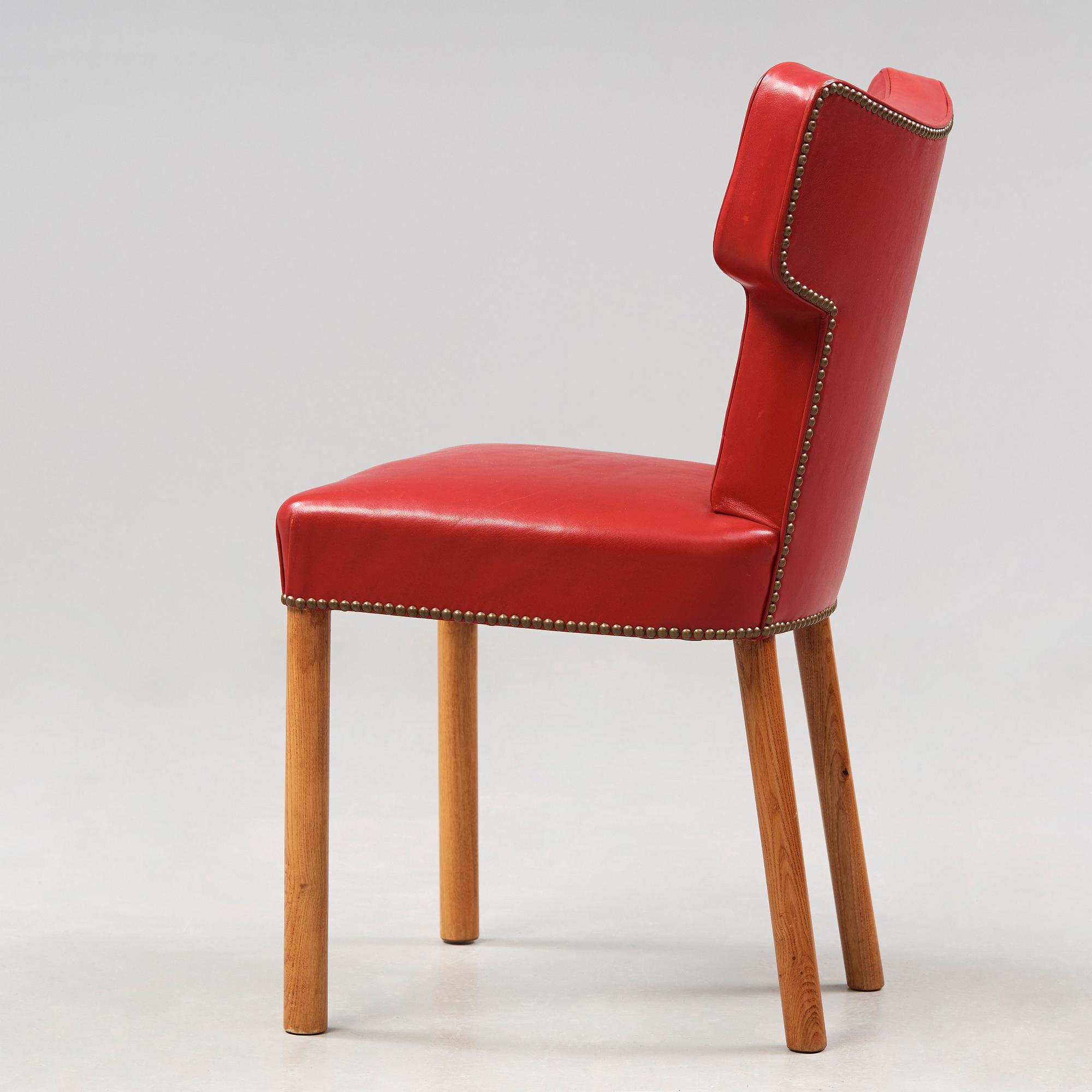
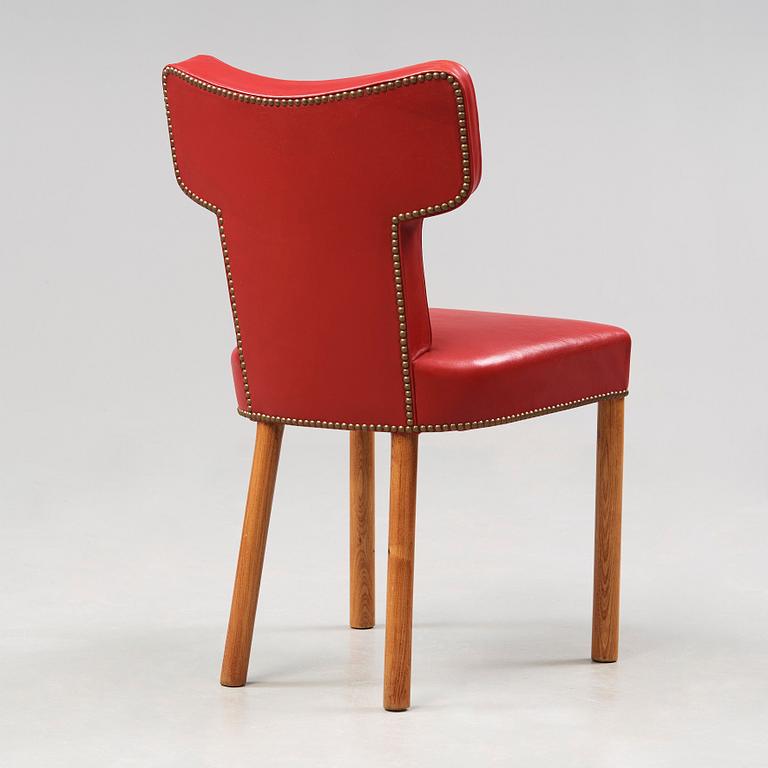
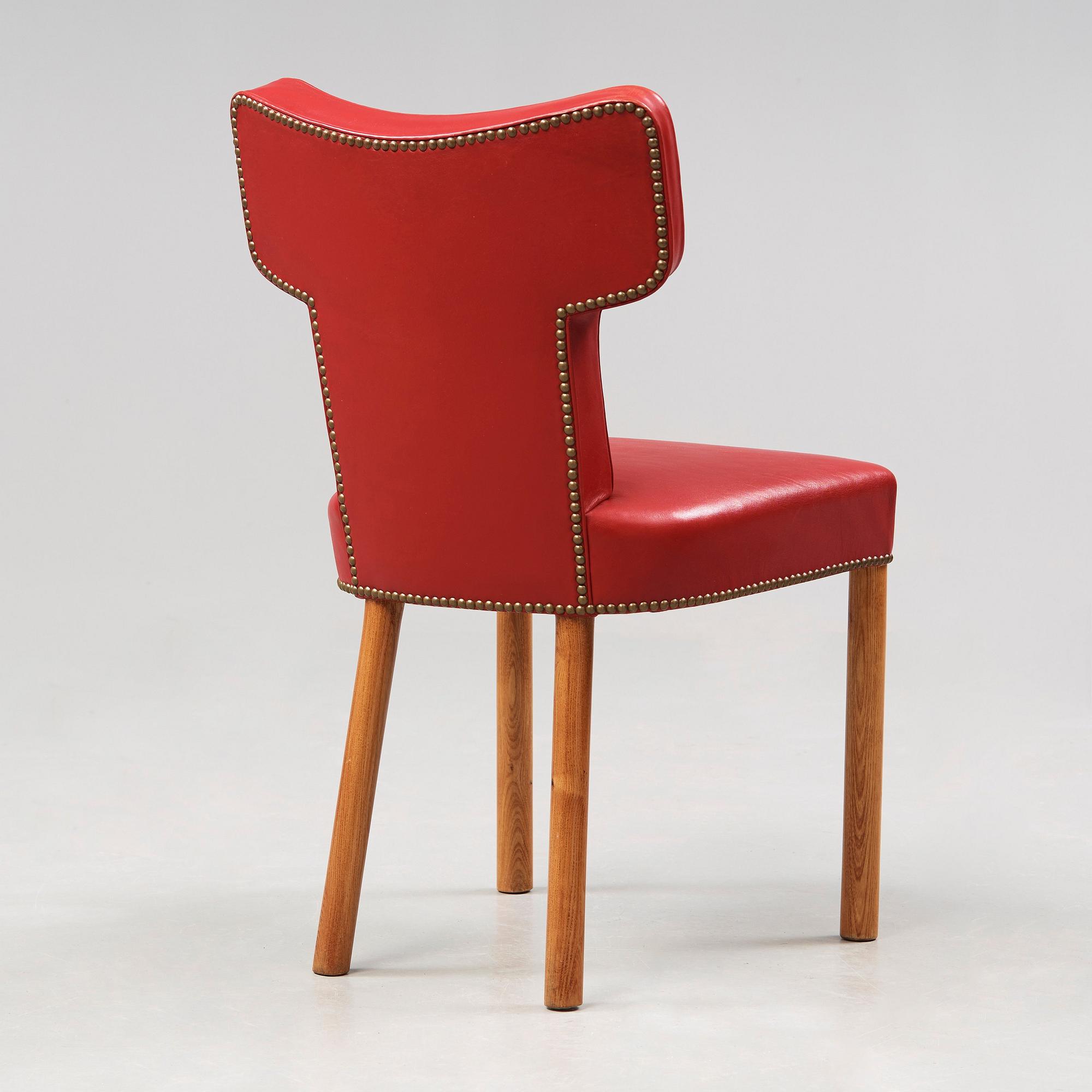
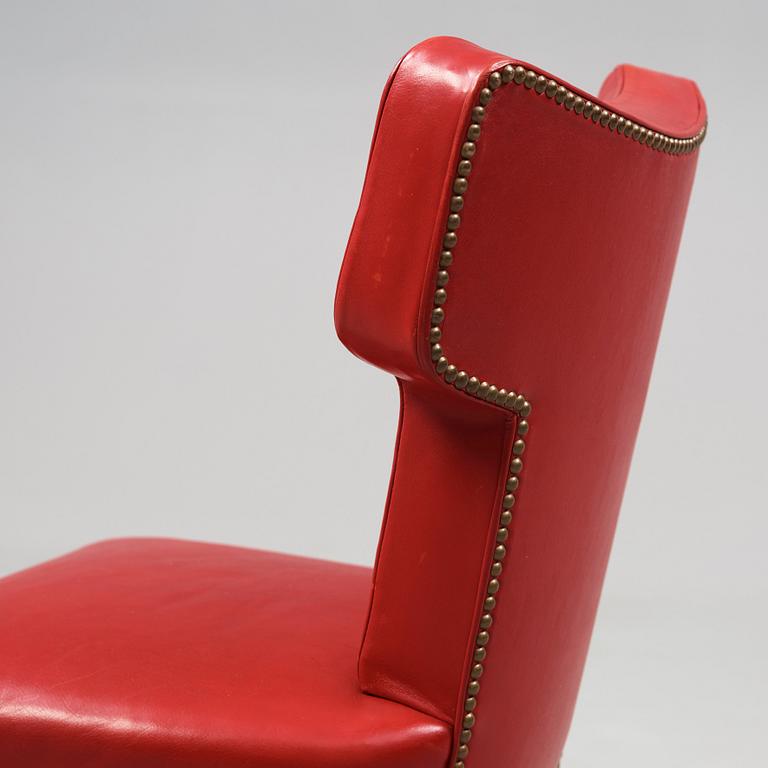
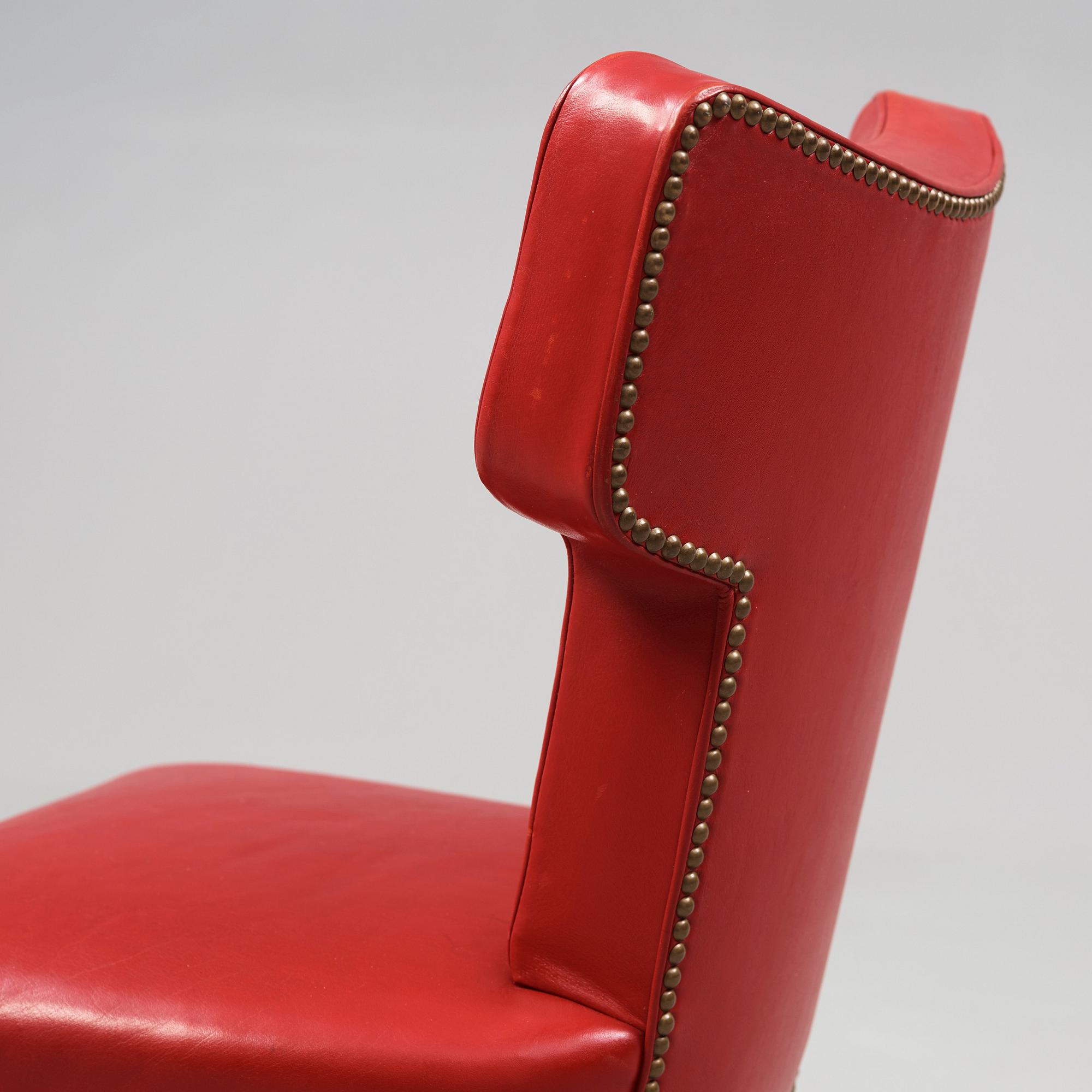
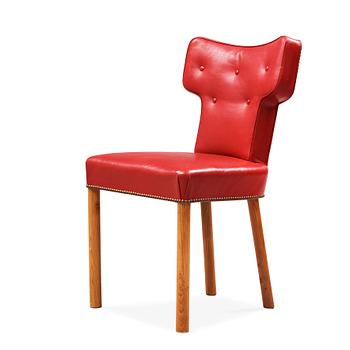
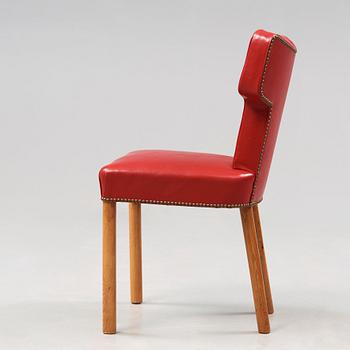
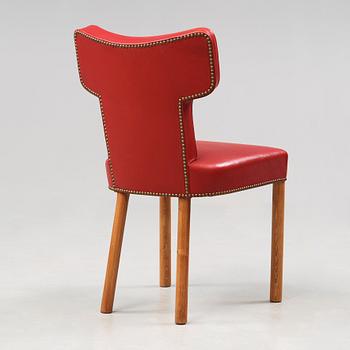
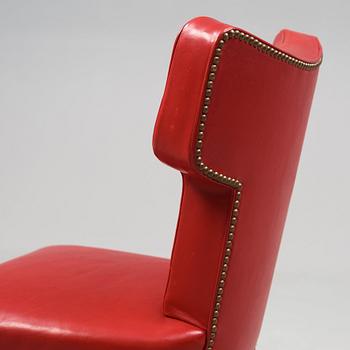
An Uno Åhrén chair, Svenskt Tenn, Sweden circa 1930.
Upholstered in red leather, mahogany legs.
Provenance
The Collection of Hjalmar Olson (1902-1990), Gustavsberg. Acquired from Estrid Ericson, Svenskt Tenn, Stockholm.
Hjalmar Olson was president of Gustavsberg Porcelain Factory 1937-1968, and a Vice Chairman of LKAB 1962-1973. He was elected in 1942 as a member of the Academy of Engineering Sciences, where he was 2nd Vice Chairman from 1954 to 1956, and was appointed as the first honorary member in 1963. He received his degree in 1962 honorary doctor of technology at the Royal Institute of Technology in Stockholm.
As an engineer he studied modern porcelain industry in Germany. This took him to Gustavsberg porcelain factory already in 1929.
With his great interest in art and craft, he built up a private collection where quality was always of utmost importance. With help from close friends like Estrid Ericson, owner of Svenskt Tenn, he created his collection during the middle of the 1900's.
Literature
Nils G. Wollin, 'Nutida Svensk konstslöjd i bild', Stockholm 1931, compare model, p 33: 'Skrivbord och stol, komp. av Uno Åhrén. Utförda av Hjalmar Jackson 1930. Tillhöra fröken Estrid Ericson'.
Christian Björk, 'Estrid Ericson -Svenska arkitekter och formgivare', Orosdi-Back, 2011. The model depicted at p 132, the image originally from the Svenskt Tenn archives.
More about Uno Åhrén
Uno Åhrén was a significant Swedish architect and urban planner who graduated from Stockholm's Tekniska Högskolan (Royal Institute of Technology) in 1919 and made his debut with an interior design at the Hemutställningen (the Home Exhibition) exhibition at Liljevalchs in Stockholm 1917. Åhrén, who initially drew inspiration from Neoclassicism and Swedish Grace, subsequently became one of the leading advocates of Functionalism, with a focus on the social aspects of housing. He was one of the earliest designers to collaborate with Estrid Ericson at Firma Svenskt Tenn, where he designed both furniture and more luxurious pewter objects.
From the late 1910s onwards, Åhrén participated in a number of exhibitions, including, in addition to the aforementioned Hemutställningen in 1917, the Gothenburg Exhibition in 1923, the World’s Fair in Paris in 1925, the Stockholm Exhibition in 1930 and the World’s Fair in Chicago in 1933. After 1930, Åhrén devoted himself primarily to urban architecture and town planning, serving, among other positions, as city planning architect in Gothenburg from 1932 to 1943 and as head of Svenska Riksbyggen during the 1940s.
Read moreFor condition report contact specialist

Image rights
The artworks in this database are protected by copyright and may not be reproduced without the permission of the rights holders. The artworks are reproduced in this database with a license from Bildupphovsrätt.



Others have also viewed