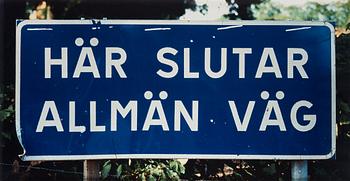
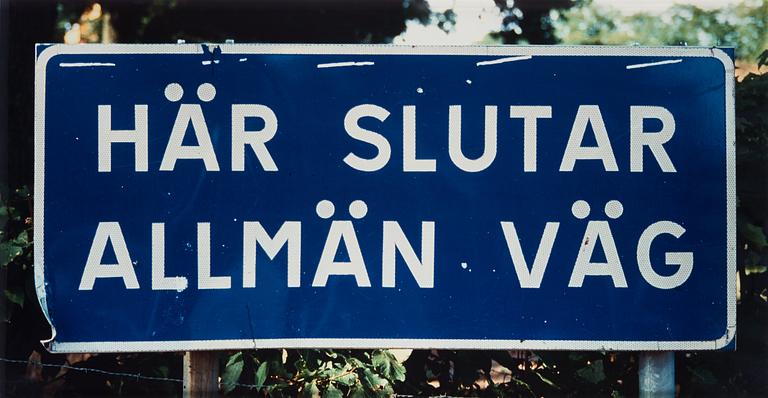
"Här slutar allmän väg III", 1995
Signed Dan Wolgers and dated 1995 on verso. Edition 2/3. Cibachrome mounted on kapa board 120 x 232 x 4 cm.
Provenance
Galleri Lars Bohman, Stockholm.
Galerie Aronowitsch, Stockholm.
The Saltarvet collection, Fiskebäckskil, Sweden.
Private Collection, Sweden.
Exhibitions
Galerie Aronowitsch, Stockholm.
Literature
Mårten Castenfors (ed), "Samling Saltarvet", 2001, illustrated spread p. 12-13.
Dan Wolgers e.a, "Dan Wolgers verksamhet 1977-2001", Liljevalchs Konsthall, 2001, exhibition catalogue, illustrated.
More information
Dan Wolgers has a fantastic ability to read the age in which he lives. With works apparently ahead of his time, everything he has undertaken has subsequently become a well-known marker of its era, classics in fact. For a couple of years in the early 1990s, Dan Wolgers was easy prey for the critics and the thinking public. The first great art scandal came in 1991 with Wolgers’ ground-breaking exhibition at Galleri Lars Bohman, where he gave an advertising agency free rein to create an exhibition in his name. The following year saw a repeat performance with the release of the well-known yellow pages phone directory with Wolgers’ own name and phone number printed on the front. One of these directories is now in the collection of MoMa in New York. In 1992 Dan Wolgers was part of the group exhibition “Ecce Homo” at the Liljevalchs gallery. As a political artistic act, he had two of the art gallery’s benches sold and taken away. The “bench robbery” received a great deal of media attention and aroused heated debate, particularly when he then sold the envelope containing the judgment from Stockholm District Court to his Norwegian gallery.
“Här slutar allmän väg”, the photographic suite of the Swedish Roads Administration’s dry, blue and white road signs, completed in 1995–1998 became Dan Wolgers’ personal stop sign. The title means “Public road ends here” and the message could not have been clearer and only this photographic suite was presented at Galleri Lars Bohman when Wolgers exhibited there in 1995.
“We never thought it would sell. It wasn’t photography or art in a traditional sense, not lit or post-edited. Everything sold. Including to the Swedish Public Art Agency.”
The pictures are in high demand among collectors and institutions. Moderna Museet has the whole suite in its collections. The suite comprises five different motifs, all with the blue and white road sign. What distinguishes them is the surrounding nature, as they are all photographed in different locations, most of them on main roads south of Stockholm.
More about Dan Wolgers
Dan Wolgers is a Swedish sculptor, born in 1955 in Stockholm and educated at the Royal Institute of Art from 1980 to 1985 (he later became a professor there from 1995 to 1998). Wolgers is full of inspiration and humour, a playful Dadaist who experiments with and questions almost everything, and of course, he provokes and shocks the viewer. He was commissioned to design the cover for the Stockholm telephone directory, but instead of creating an image, he placed the phone number for his studio. The directory is now in the Museum of Modern Art in New York. When he was to participate in a group exhibition at Liljevalchs Art Hall, he requested to borrow two benches, which he immediately sold at auction. He was reported for embezzlement and was conditionally sentenced to daily fines. The verdict arrived in the post in a sealed envelope, which he signed and sold for 20,000 SEK. Wolgers puts everything to the test, even the sign "Here ends the public road." "I try to visualise and manifest different aspects of life in my art," he says. "On a personal level, I use my work to try to understand something of what I and others have to do here on earth."
Read moreFor condition report contact specialist

Covered by droit de suite
Image rights
The artworks in this database are protected by copyright and may not be reproduced without the permission of the rights holders. The artworks are reproduced in this database with a license from Bildupphovsrätt.
Others have also viewed