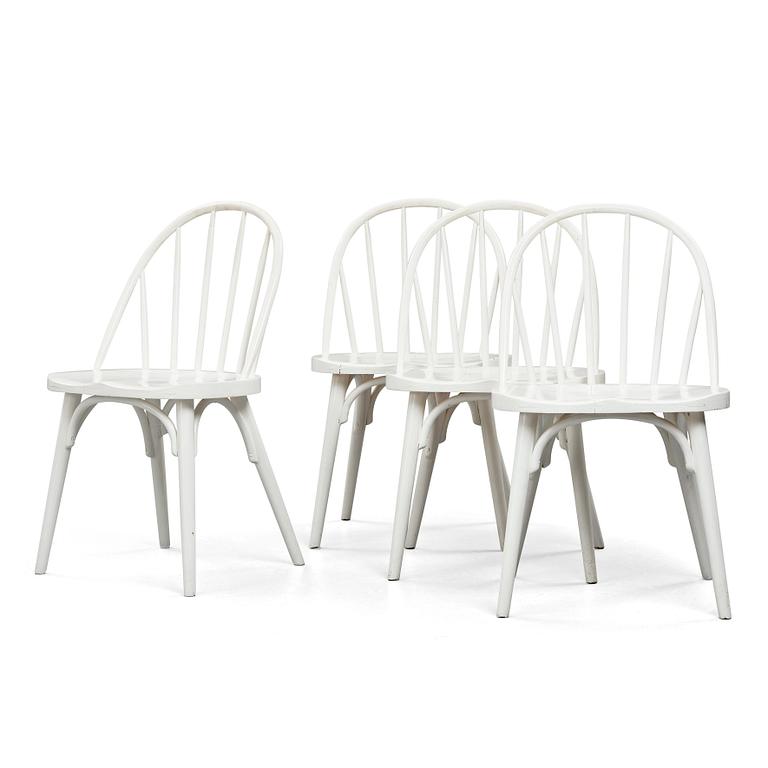
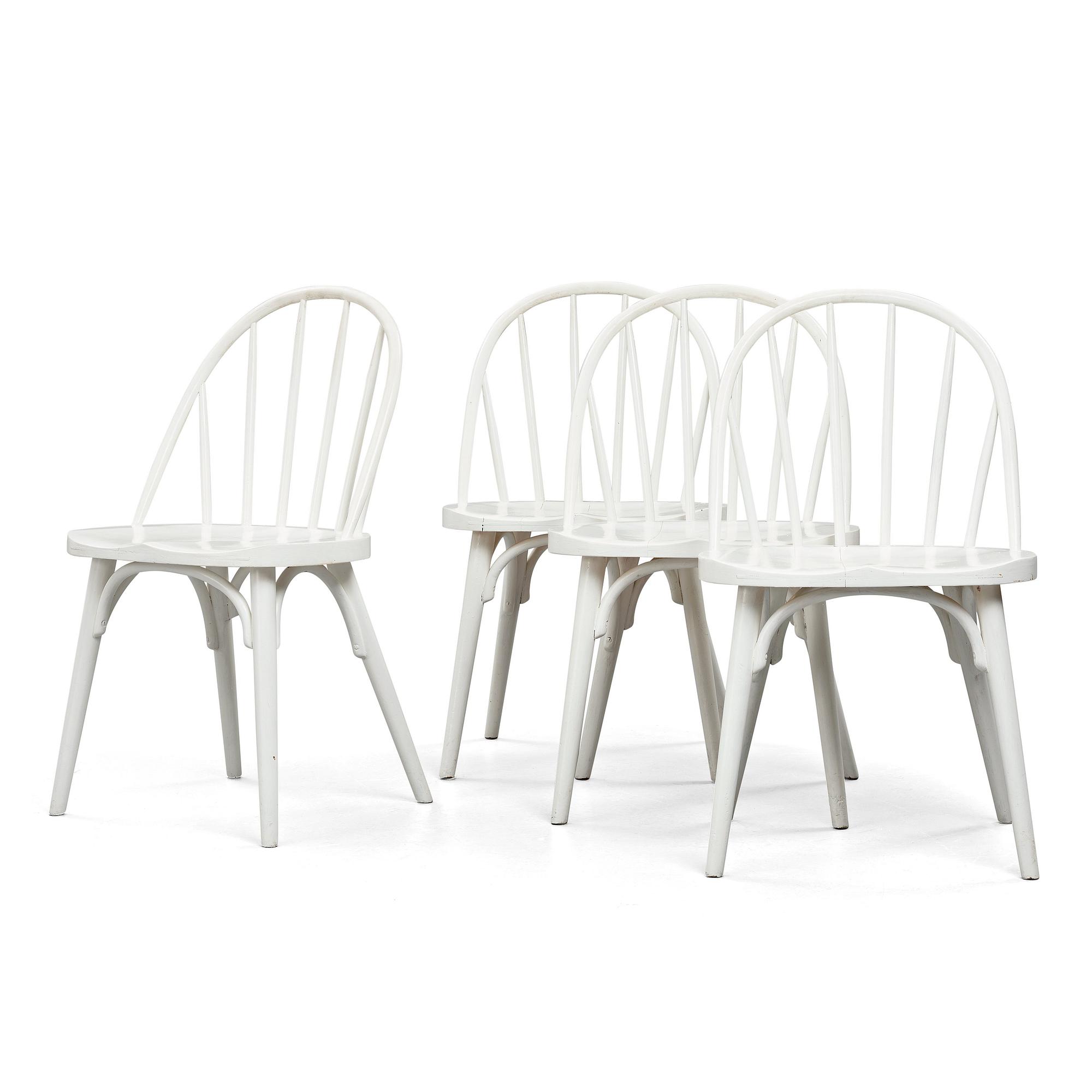
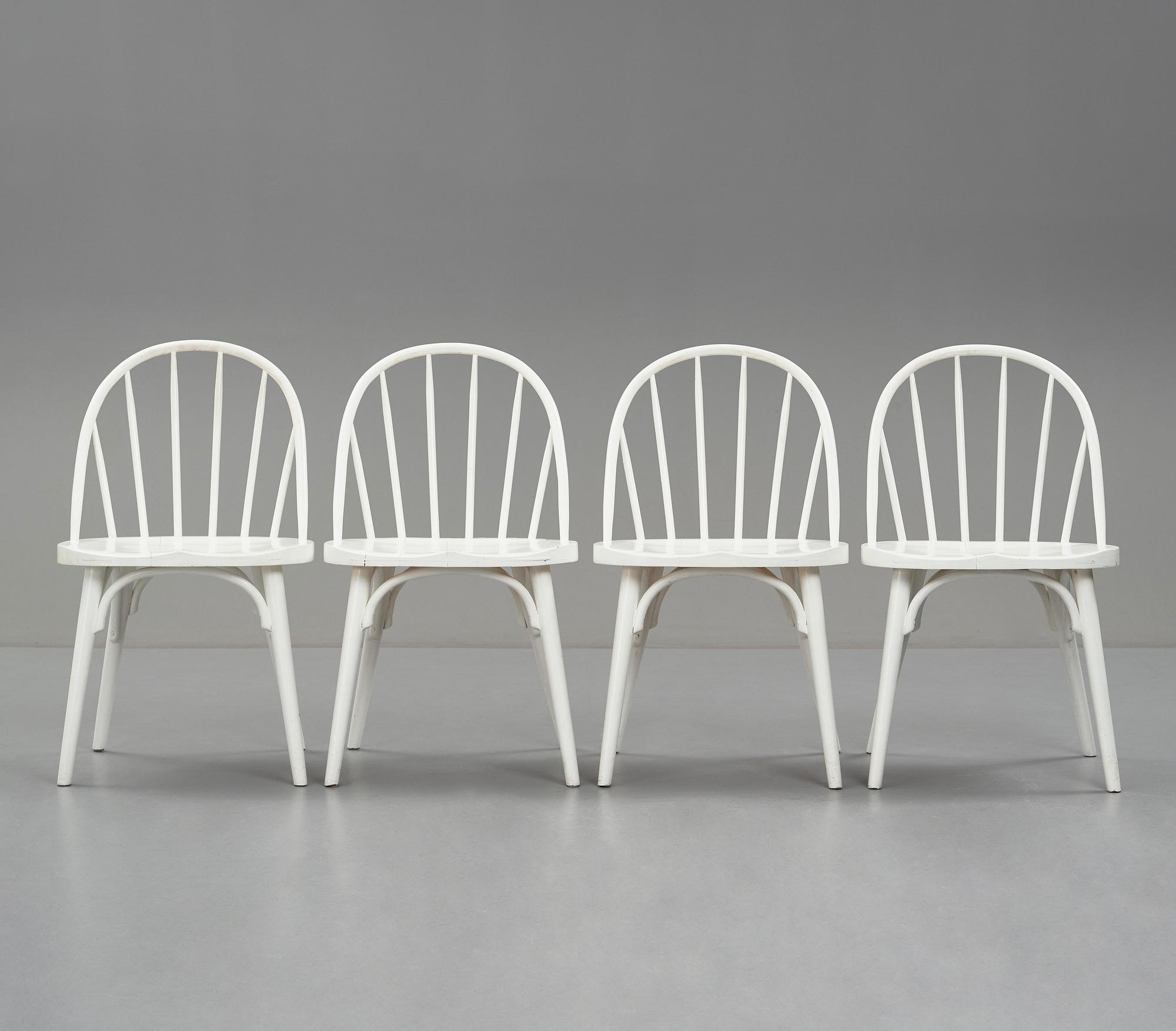
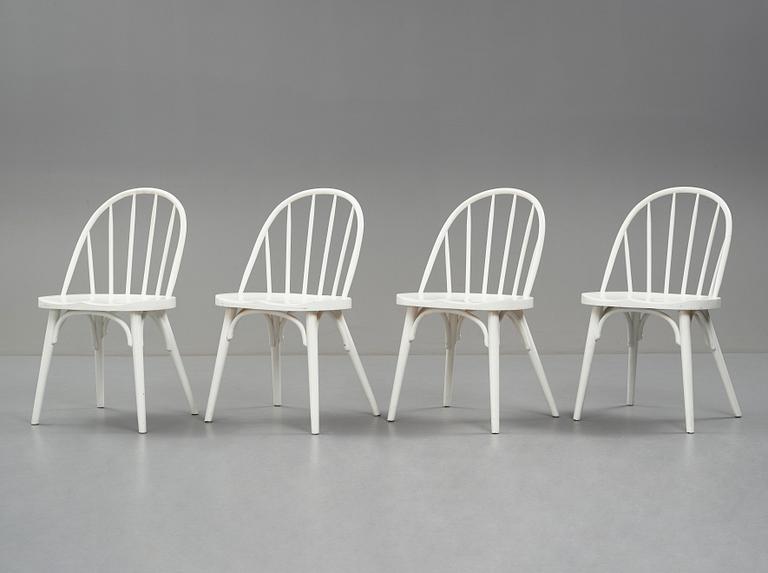
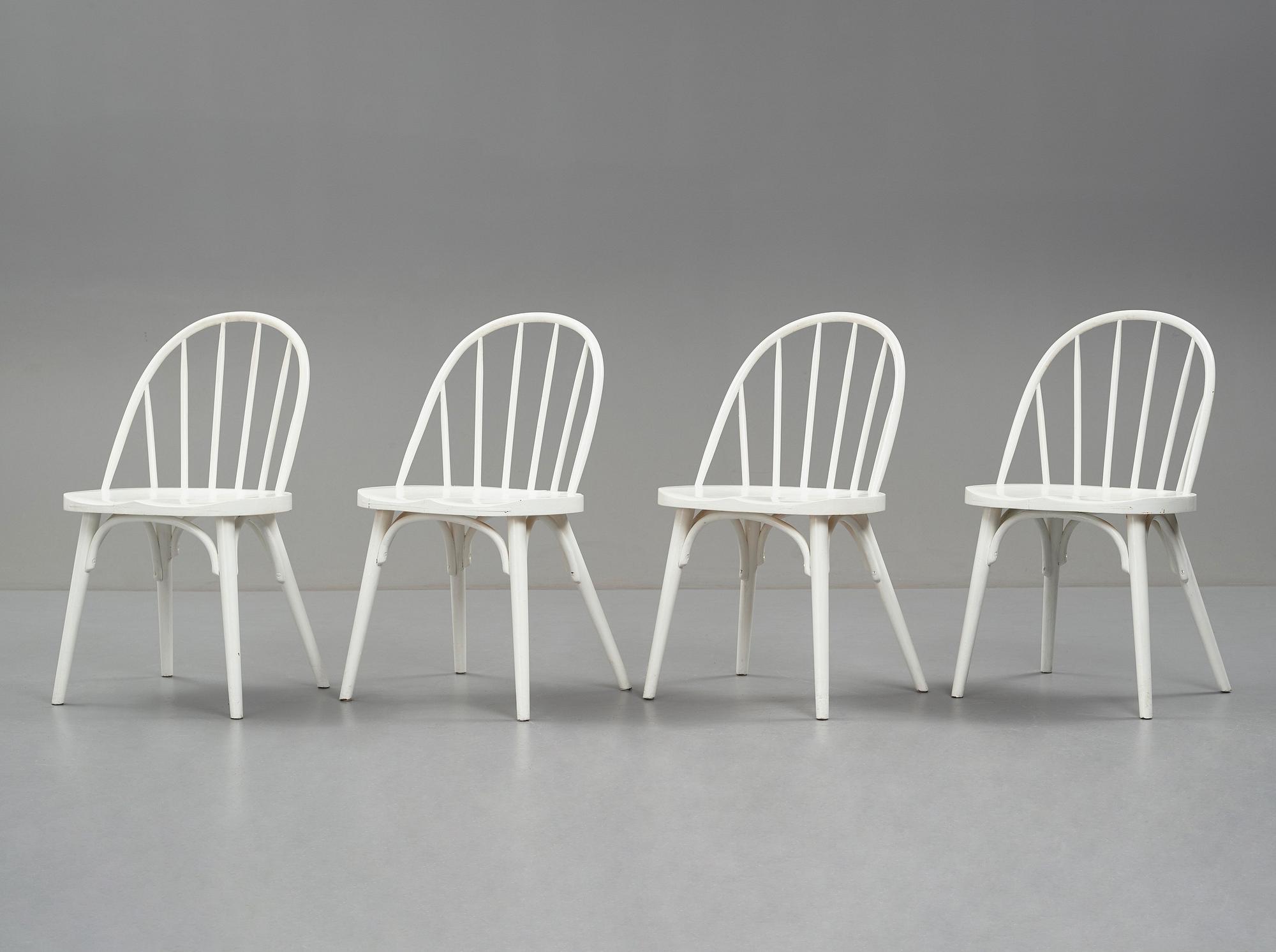
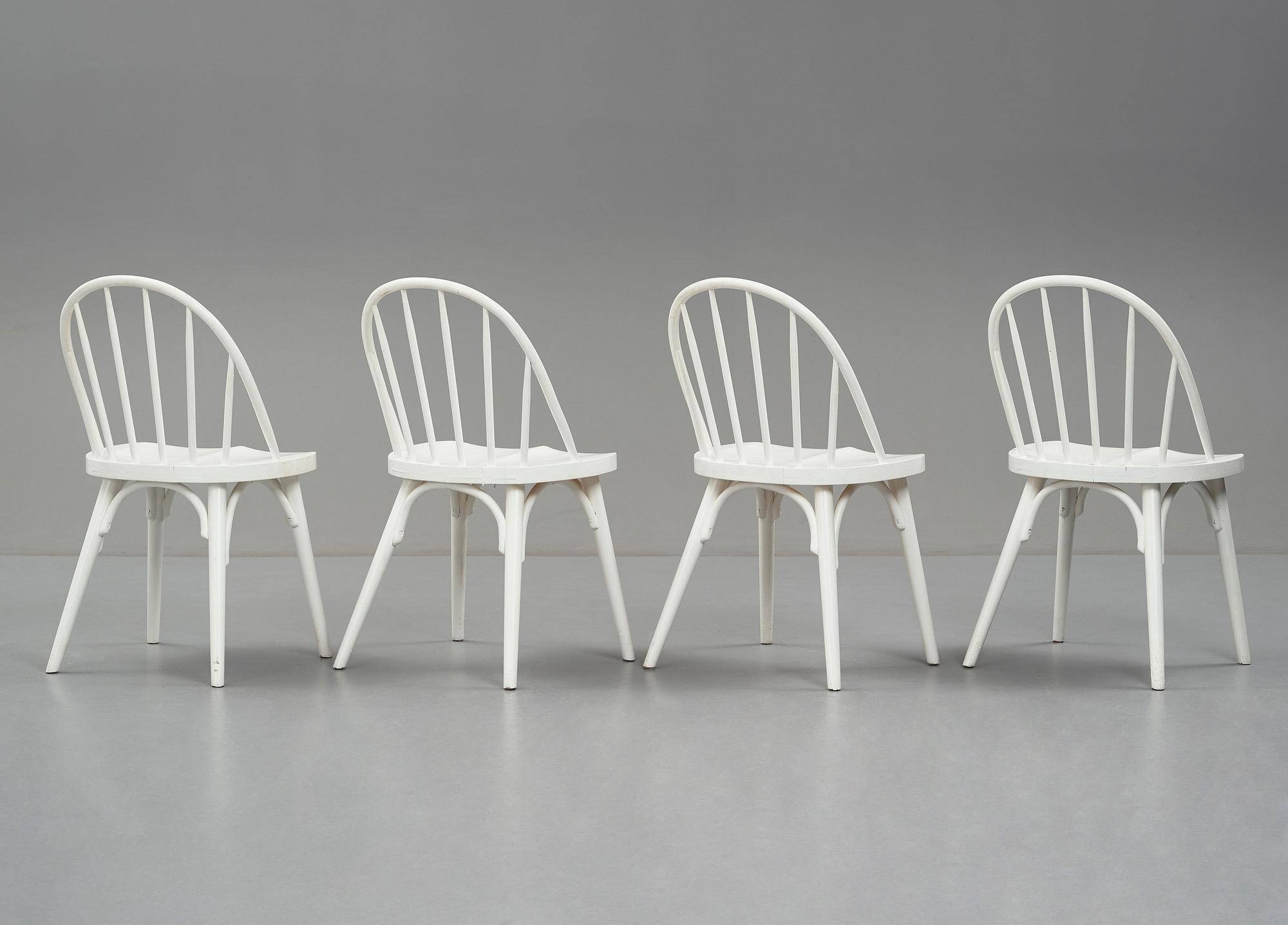
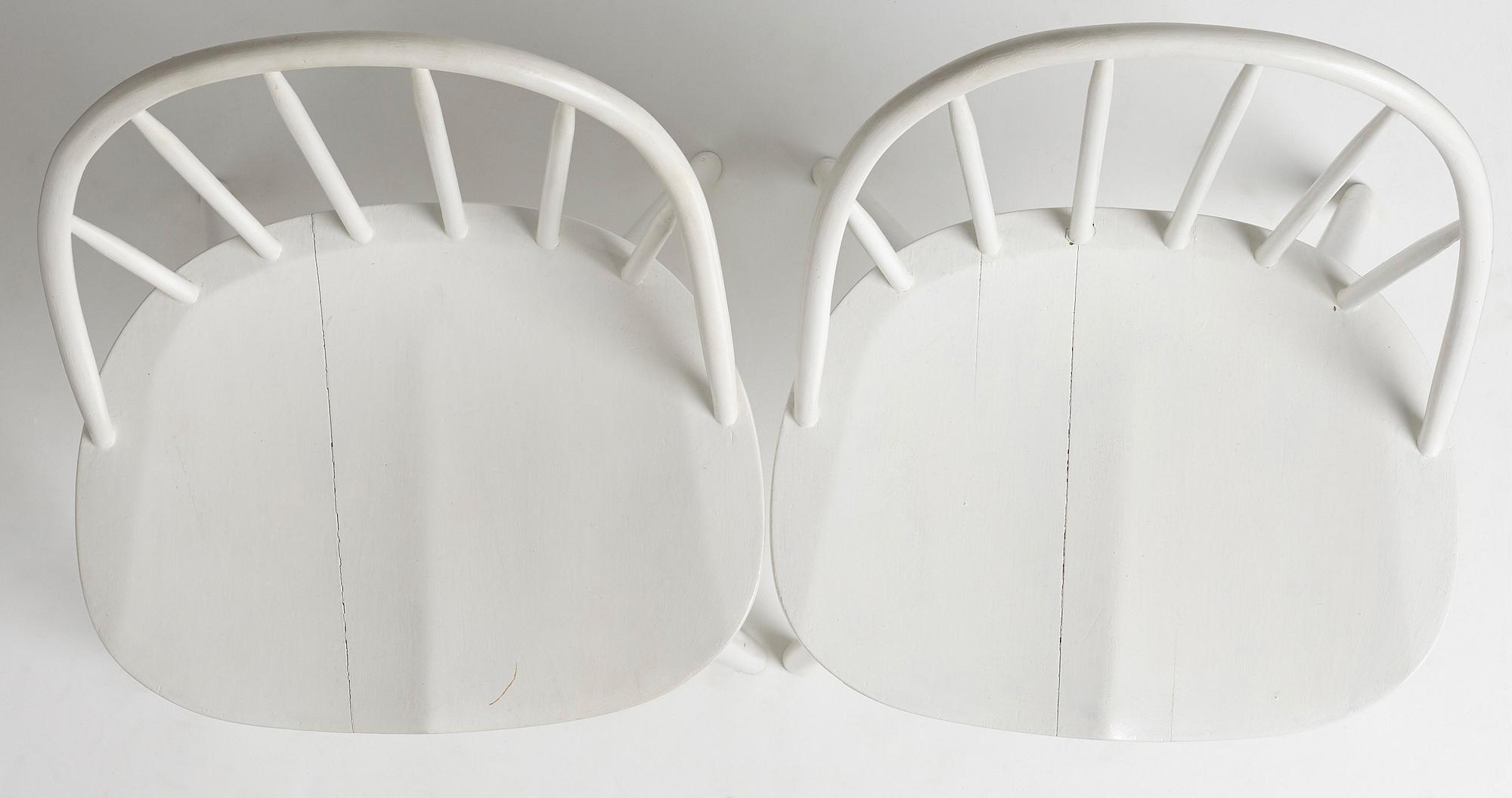
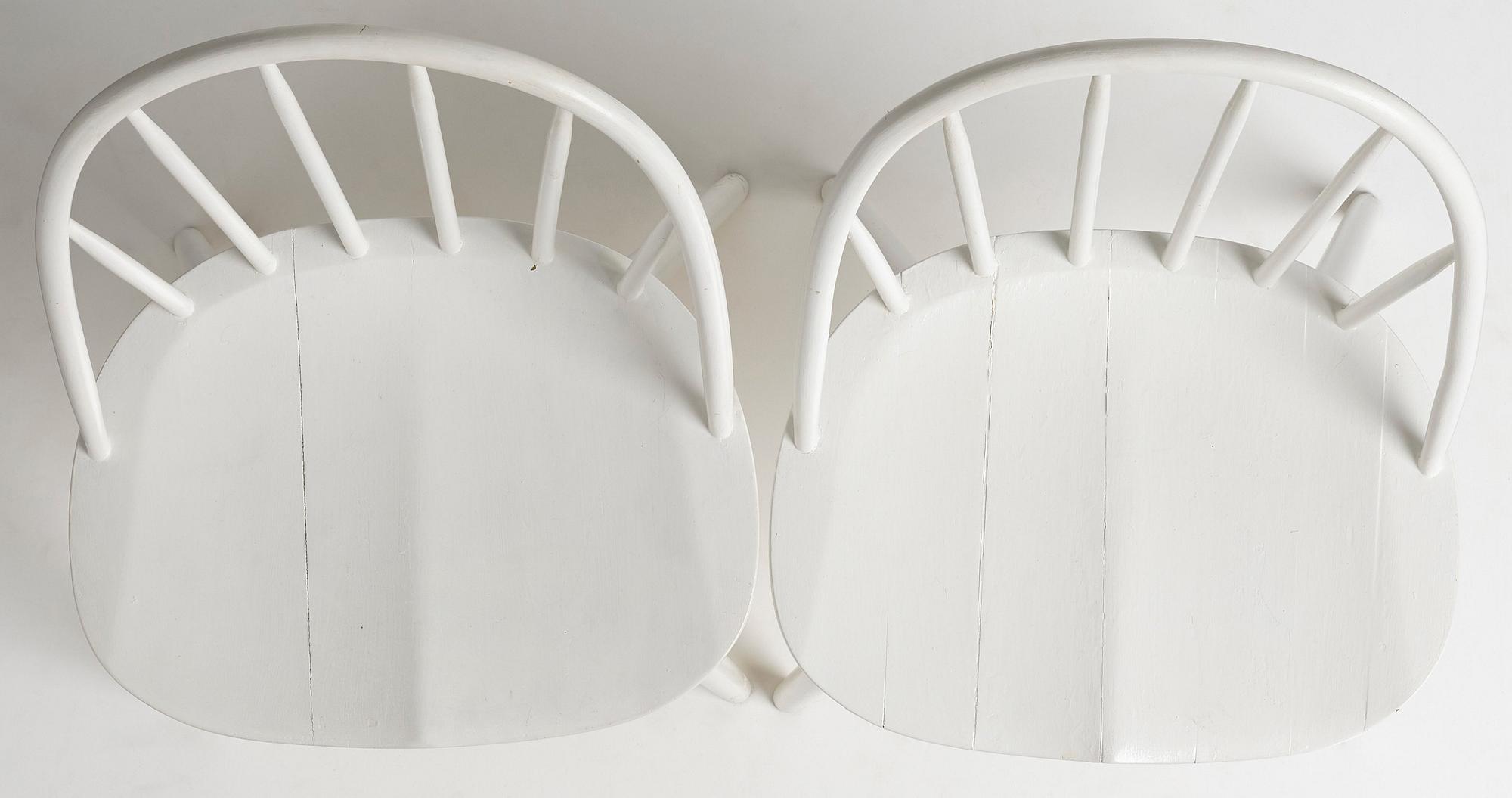
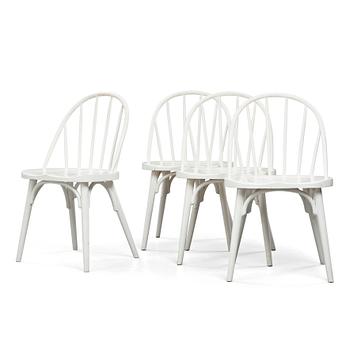
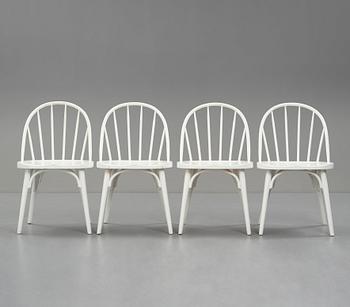
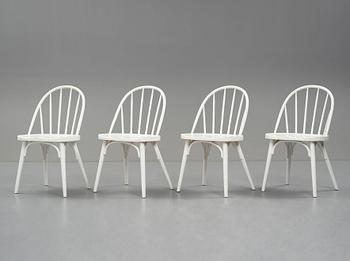
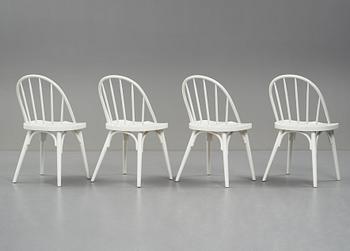
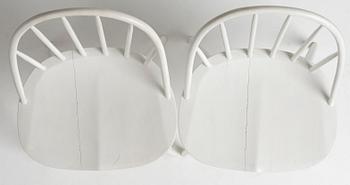
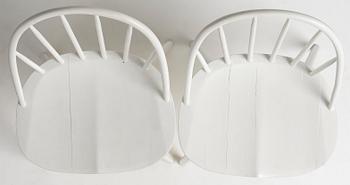
A set of four chairs, Gemla, Sweden 1930's, provenance Estrid Ericson.
White painted wood, height 84,5 cm, seat height ca 45 cm, width 50 cm.
Wear, later painted.
Provenance
Estrid Ericson, founder of Svenskt Tenn, thence by descent
More information
The model was designed for The Stockholm exhibition in 1930.
Estrid Ericson (1894-1981)
Estrid Maria Erikson was born in 1894 in Öregrund. When Estrid was only a year old, the family moved to Hjo where they ran a hotel and restaurant business. The father Adolf passed away in 1924 and at the death of mother Helga in 1932, Estrid and her sisters Elsa, Christina and Irma released their two brothers Sven and Beler. Sister Christina ran the business until the early 1960s when the company was closed down.
After the graduation in Hjo, 19 year old Estrid went to Stockholm and educated at Tekniska skolan (current Konstfack) 1913-1917. Her plan was to work as a drawing teacher in Hjo, but after her graduation in 1917, it was only one semester in the profession before she returned to Stockholm. The first employment was at Svensk Hemslöjd's shop on Biblioteksgatan at their home and furniture department. After a while she went on to work as curator at Vackrare Vardagsvara at Strandvägen 7A. In 1923 the company started a department with modern pewter design in collaboration with the brothers Nils and Tage Fougstedt. A short time later, Estrid decided to quit her employment and start her own business. During the following summer, she rented a room at Kungsholmstorg 6 and established the company "Konsthantverkets Verkstad" together with the brothers Fougstedt. In the autumn of 1924, operations moved to Smålandsgatan 40 in central Stockholm. With the help of a legacy from her father who passed away the same year, Estrid started her company Svenskt Tenn. When the store opened in 1924, after a very intensive work, Estrid and Nils had created about 300 different models. Some of the models were found in the collections of the Ethnographic Museum, where Estrid drew inspiration from different cultures. In 1927, Svenskt Tenn moved to the new and current address at Strandvägen 5A.
Estrid Ericson had a good ability to continiously associate new talents with Svenskt Tenn. Architect Uno Åhrén designed the interior for the new shop and besides Björn Trägårdh he was the one who designed the furniture for Estrid's private apartment above the shop at Strandvägen. The sculptor and designer Anna Petrus was another important coworker. In the years following the Paris Exhibition in 1925, she began a collaboration with Estrid Ericson and Svenskt Tenn. Several of Petrus’ pewter objects, usually with the characteristic lion, are still being manufactured today. A few years later in the 1930's Estrid began her successful and lifelong collaboration with Austrian architect Josef Frank. This was the starting point of a new chapter in the company's history. In 1934, Josef Frank's design for Svenskt Tenn was first shown at an exhibition for contemporary Swedish interior design at Liljevalchs in Stockholm.
Estrid Ericson's interiors was created like a magical world of things. Simple, everyday objects could be combined with the most exclusive pieces of the highest quality. Her style was surprising and imaginative but also had a sense of timelessness. Estrid should have said that "good things need no change". Only the best is good enough, something that has characterized Svenskt Tenn's assortment of carefully selected items. The walls would preferably be white and a flat would be sparsely furnished leaving room for free floor space, but otherwise she had a philosophy that advocated a freedom from strict rules. She saw no problems in freely mixing different colours, patterns and woods.
Estrid acquired her summer home, "Tolvekarna", at Tyresö, outside Stockholm in 1931. For many years the house became her refuge for rest and recreation. Ten years later, she rebuilt and decorated according to Frank's drawings. In 1944, she married Sigfrid Ericson, who was a sea captain and commander of the Swedish American Line's Gripsholm.
Estrid and Sigfrid Ericson had no children. Bukowskis has been entrusted with selling a collection of items that have been inherited to Estrid's closest relatives through her brother Sven's daughter. Some objects have been found in photographs, others are not documented, but everything comes directly from Estrid.
More about Uno Åhrén
Uno Åhrén was a significant Swedish architect and urban planner who graduated from Stockholm's Tekniska Högskolan (Royal Institute of Technology) in 1919 and made his debut with an interior design at the Hemutställningen (the Home Exhibition) exhibition at Liljevalchs in Stockholm 1917. Åhrén, who initially drew inspiration from Neoclassicism and Swedish Grace, subsequently became one of the leading advocates of Functionalism, with a focus on the social aspects of housing. He was one of the earliest designers to collaborate with Estrid Ericson at Firma Svenskt Tenn, where he designed both furniture and more luxurious pewter objects.
From the late 1910s onwards, Åhrén participated in a number of exhibitions, including, in addition to the aforementioned Hemutställningen in 1917, the Gothenburg Exhibition in 1923, the World’s Fair in Paris in 1925, the Stockholm Exhibition in 1930 and the World’s Fair in Chicago in 1933. After 1930, Åhrén devoted himself primarily to urban architecture and town planning, serving, among other positions, as city planning architect in Gothenburg from 1932 to 1943 and as head of Svenska Riksbyggen during the 1940s.
Read moreFor condition report contact specialist

Image rights
The artworks in this database are protected by copyright and may not be reproduced without the permission of the rights holders. The artworks are reproduced in this database with a license from Bildupphovsrätt.
Others have also viewed