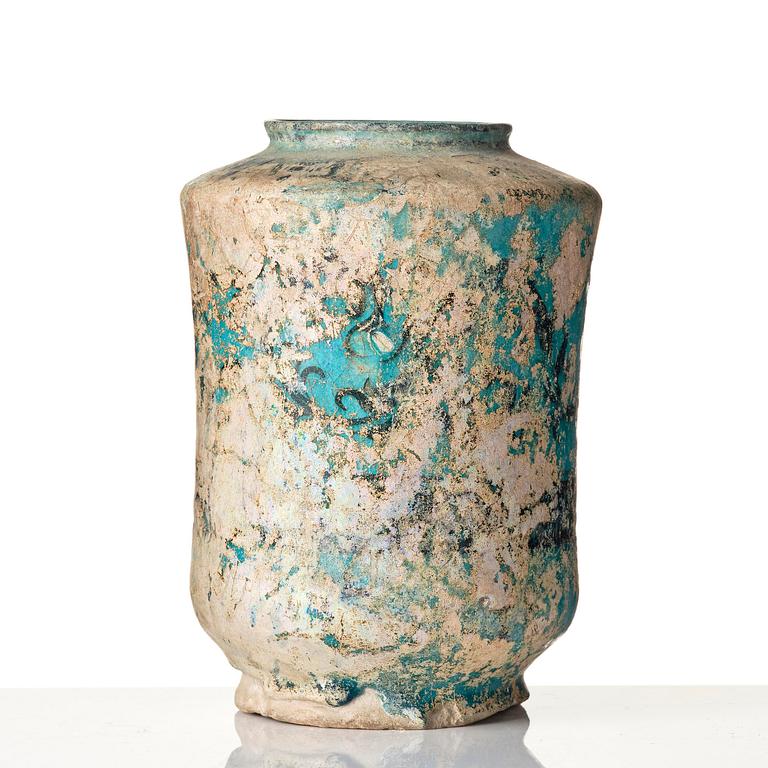
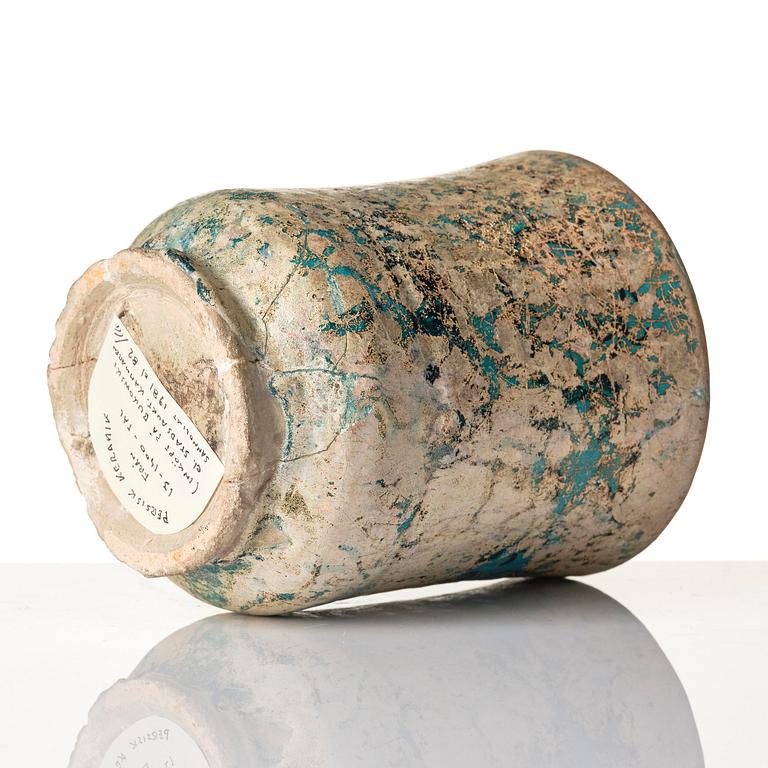
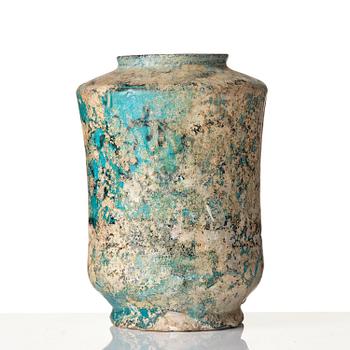
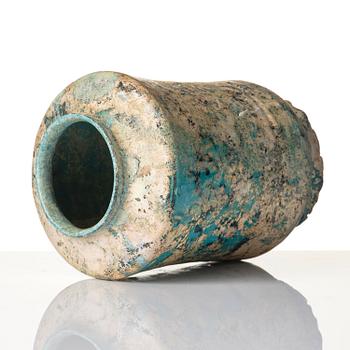
Winding black plant ornamentation and bands with calligraphy. Height 18 cm.
Provenance
From the Collection of Johan Almqvist (1940-2024). Johan spent his early years in various countries and learned many languages thanks to his father, Karl Fredrik Almqvist (1906-1982), who was a Swedish diplomat. Johan had a passion for art and travel early on. In the early 1960s, as one of his first jobs as a free-lance journalist, he traveled to the Middle East where his interest in Persian ceramics and collecting started.
He then came to be based in Japan, still as a free-lance journalist for all the major Scandinavian Newspapers as well as Springer (Die Welt and Zeitung), Swedish Television, Svensk Radio and Radio Luxembourg. He covered a large part of Asia, including The Philippines, Korea, and Vietnam.
1974 he was hired by Beijer Invest to be based in Japan.
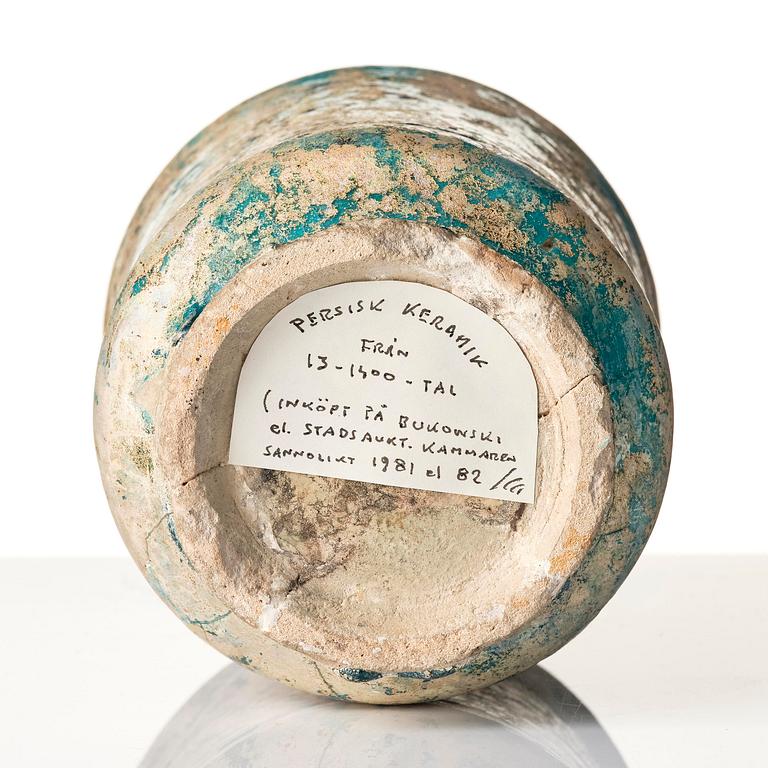
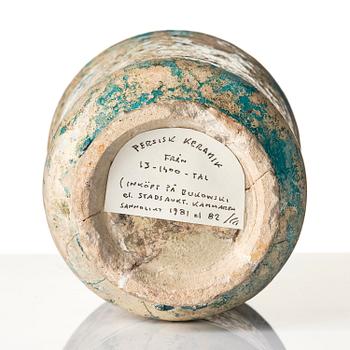
Bukowskis Auctions auction 410, April 1979, Stockholm, lot 1241.
Bukowskis Auctions, The Autumn Classic Auction 565, Stockholm, lot 1139.
More information
In the 13th century, Kashan emerged as one of Persia’s most distinguished and influential centres for turquoise-glazed earthenware. Its workshops achieved an exceptional level of technical refinement, producing a glaze of remarkable depth and clarity that has become one of the most recognisable colours in Islamic ceramic art.
These pieces are defined by their elegant proportions and disciplined design. The silhouettes are clean and harmonious, while the glaze—applied with notable precision—creates a rich, saturated surface that reflects an outstanding command of ceramic technique. Decoration ranges from refined kufic elements to pure monochrome, allowing the turquoise glaze to dominate the aesthetic.
Today, surviving examples from this production are highly prized, valued both for their luminous visual presence and for their connection to Kashan’s role as a pioneering and culturally significant ceramic centre at the height of the Persian medieval period.
For condition report contact specialist










Others have also viewed