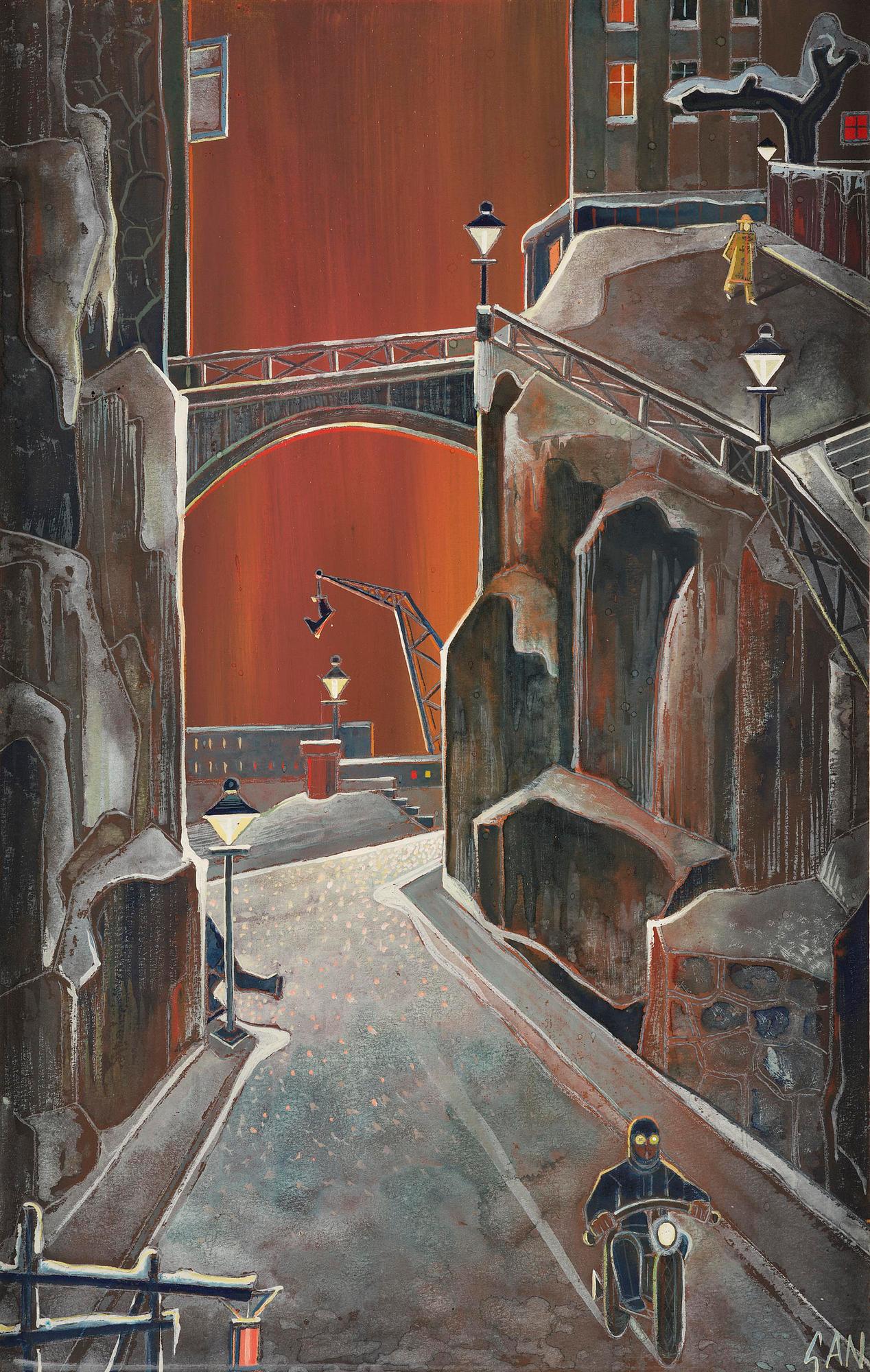
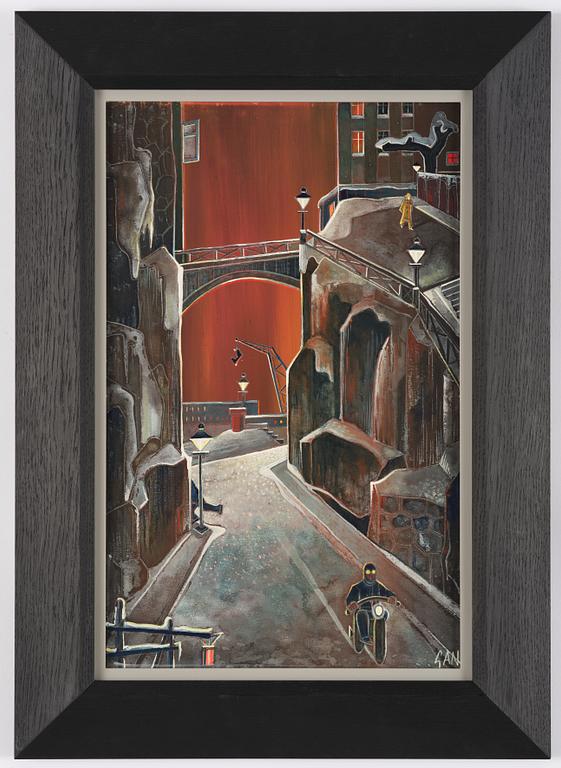
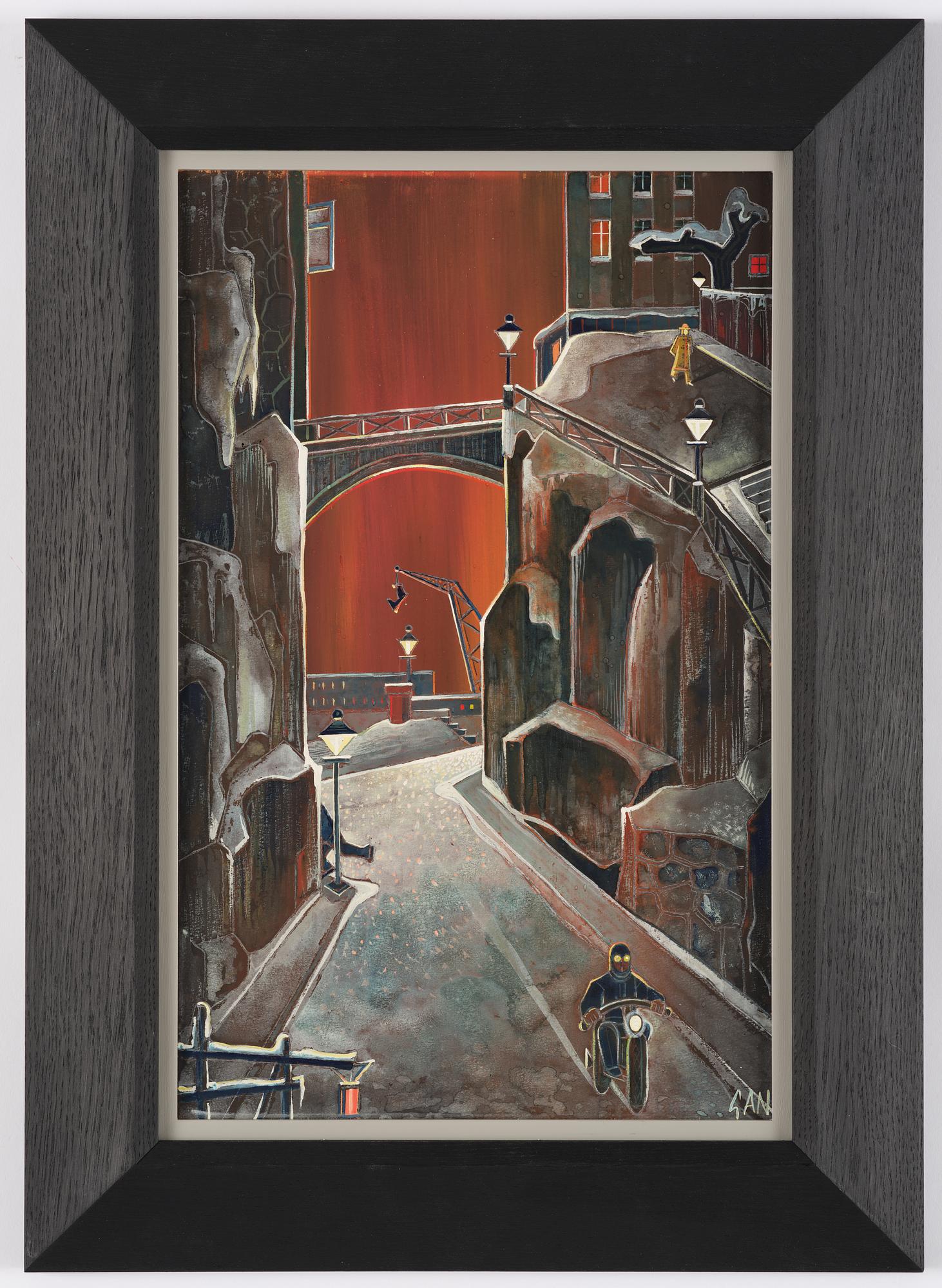
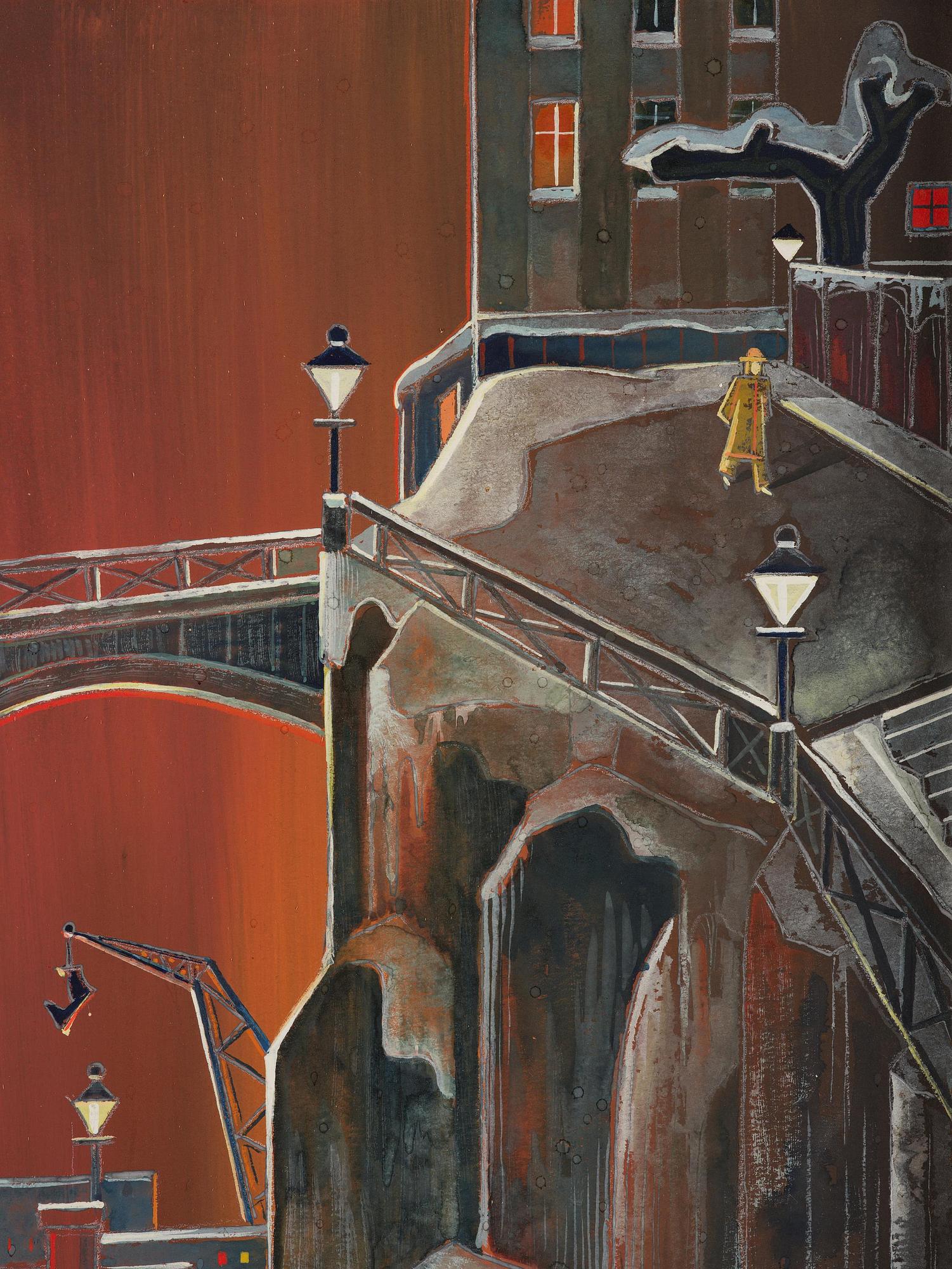
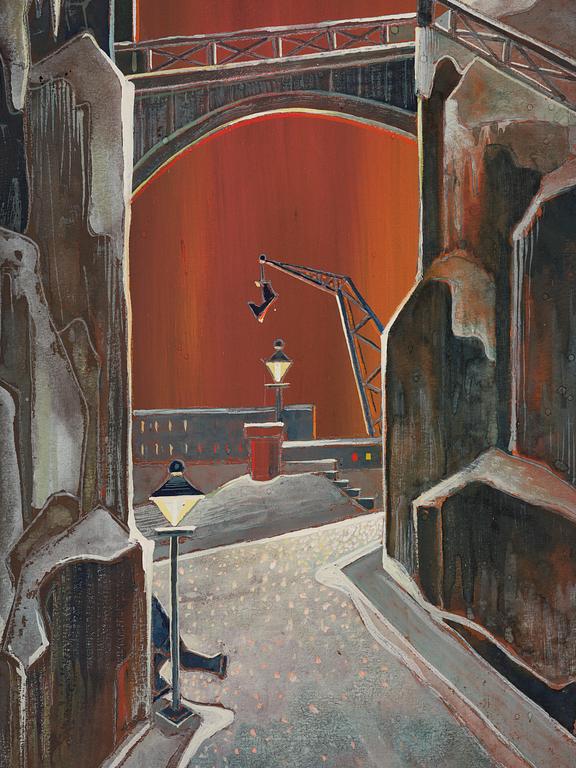
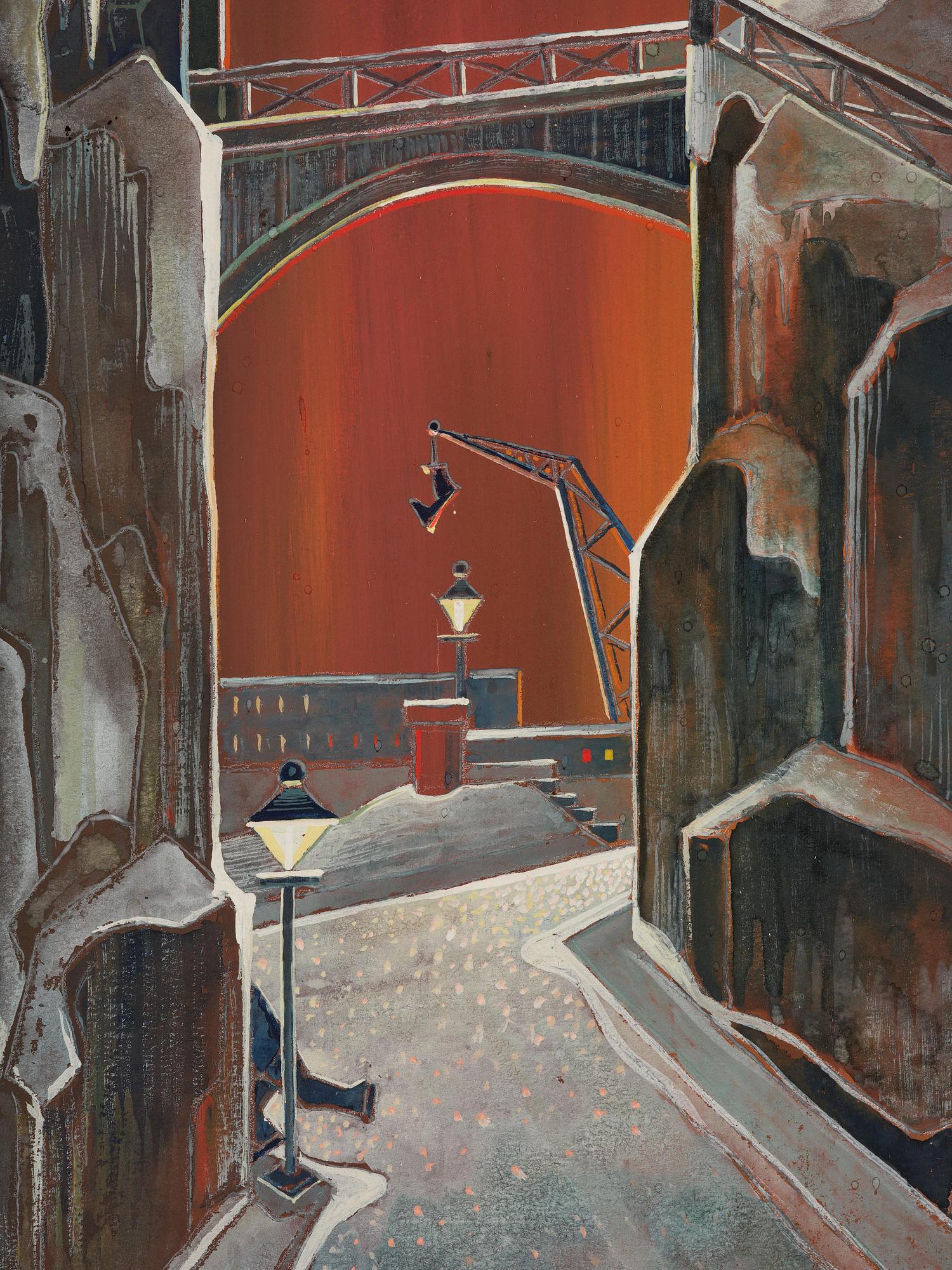
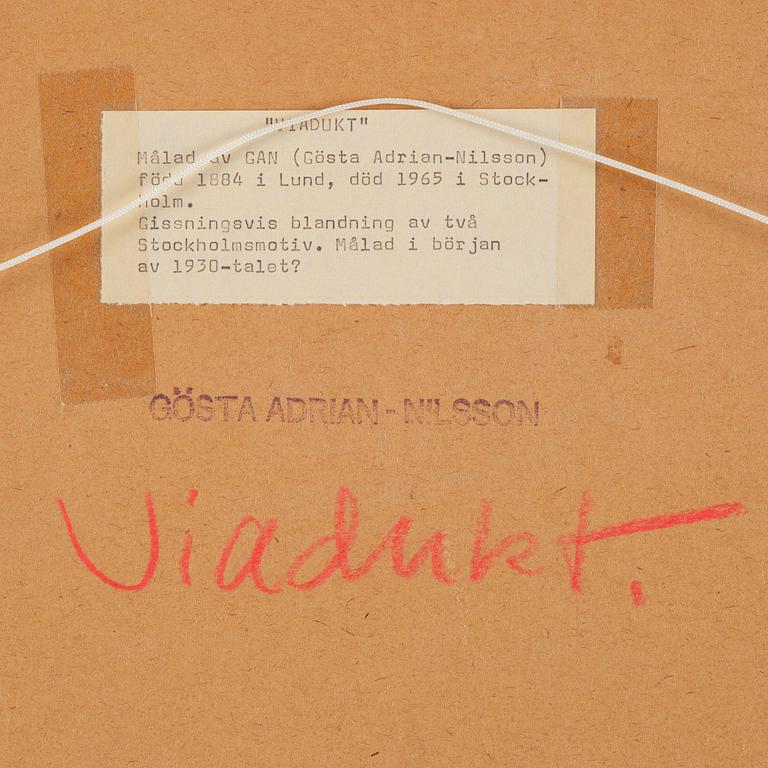
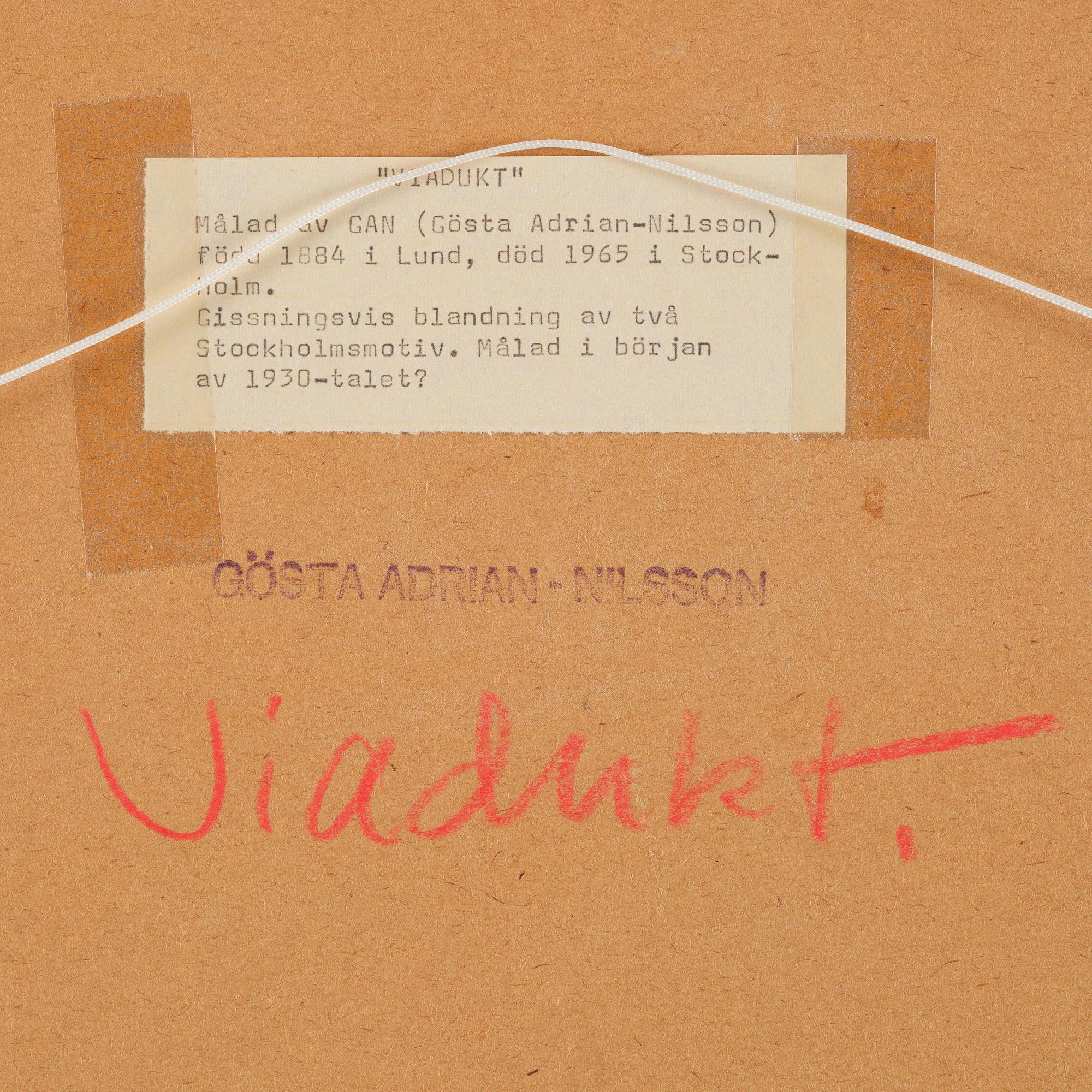
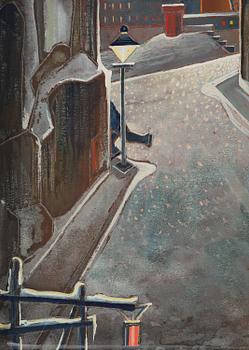
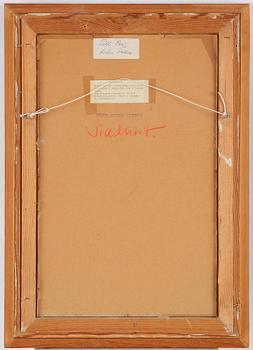
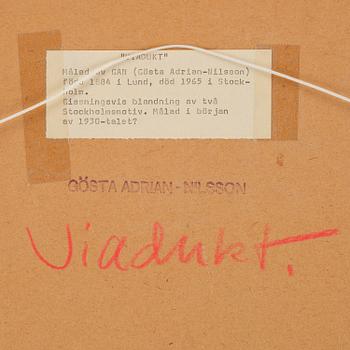
"Viadukt"
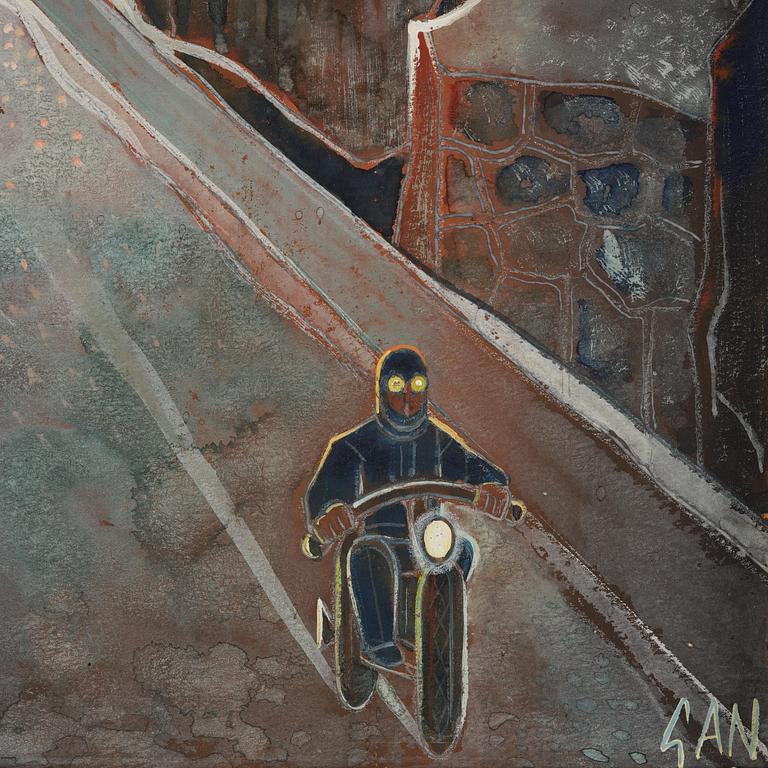
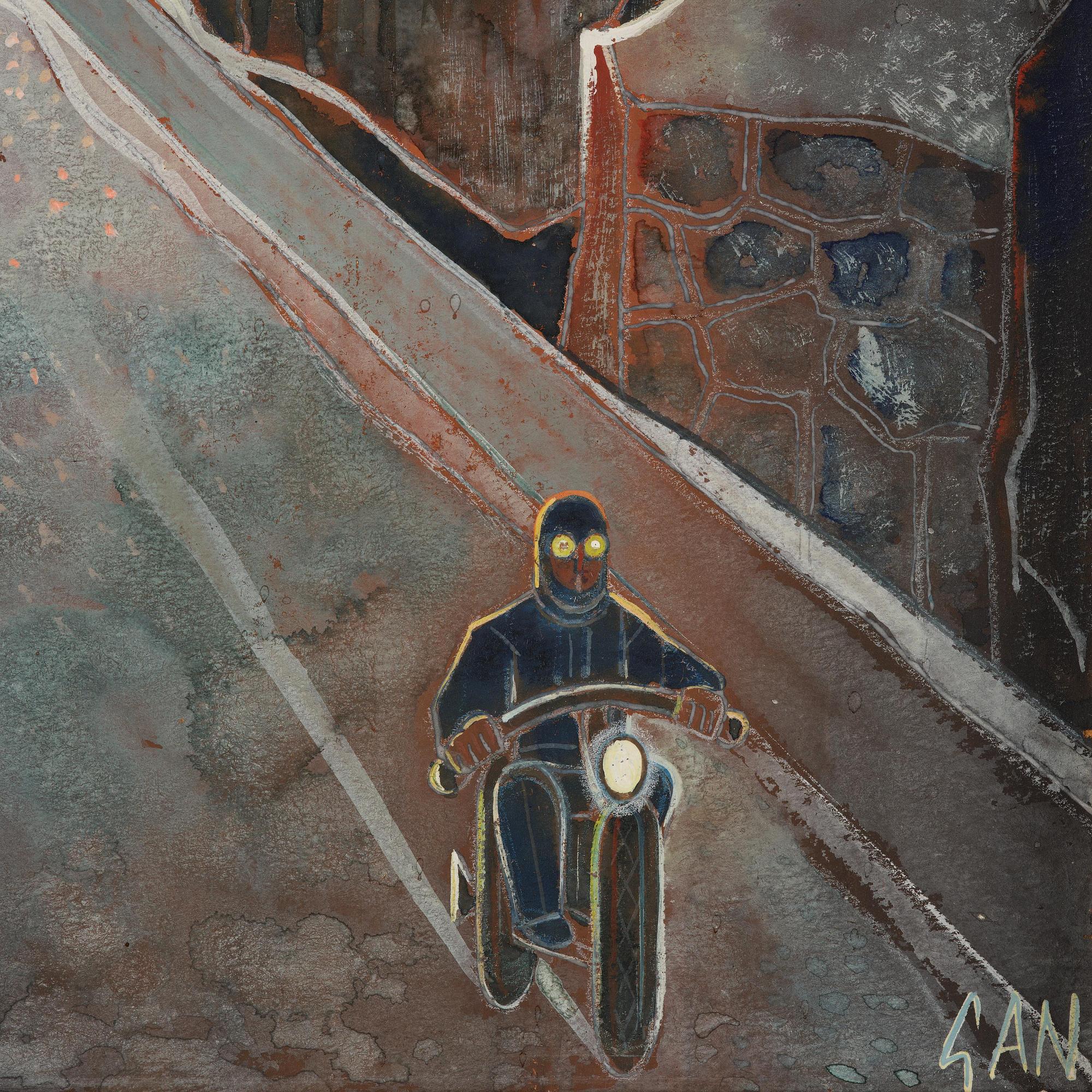
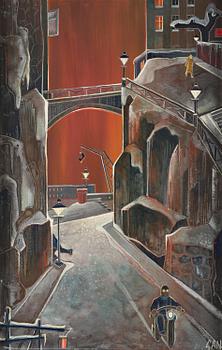
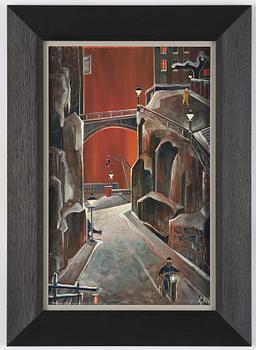
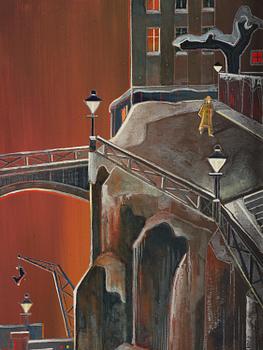
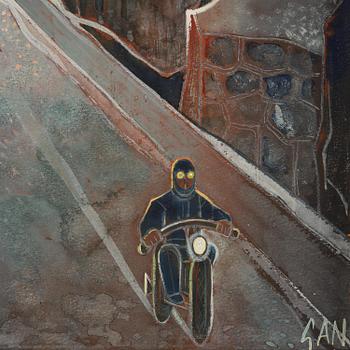
Signed with monogram GAN. Tempera and watercolour on cardboard panel, image 45.5 x 29 cm.
Provenance
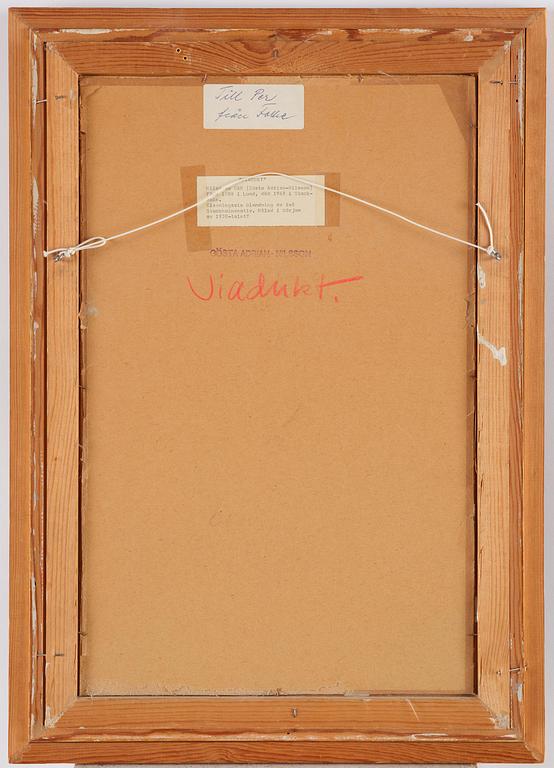
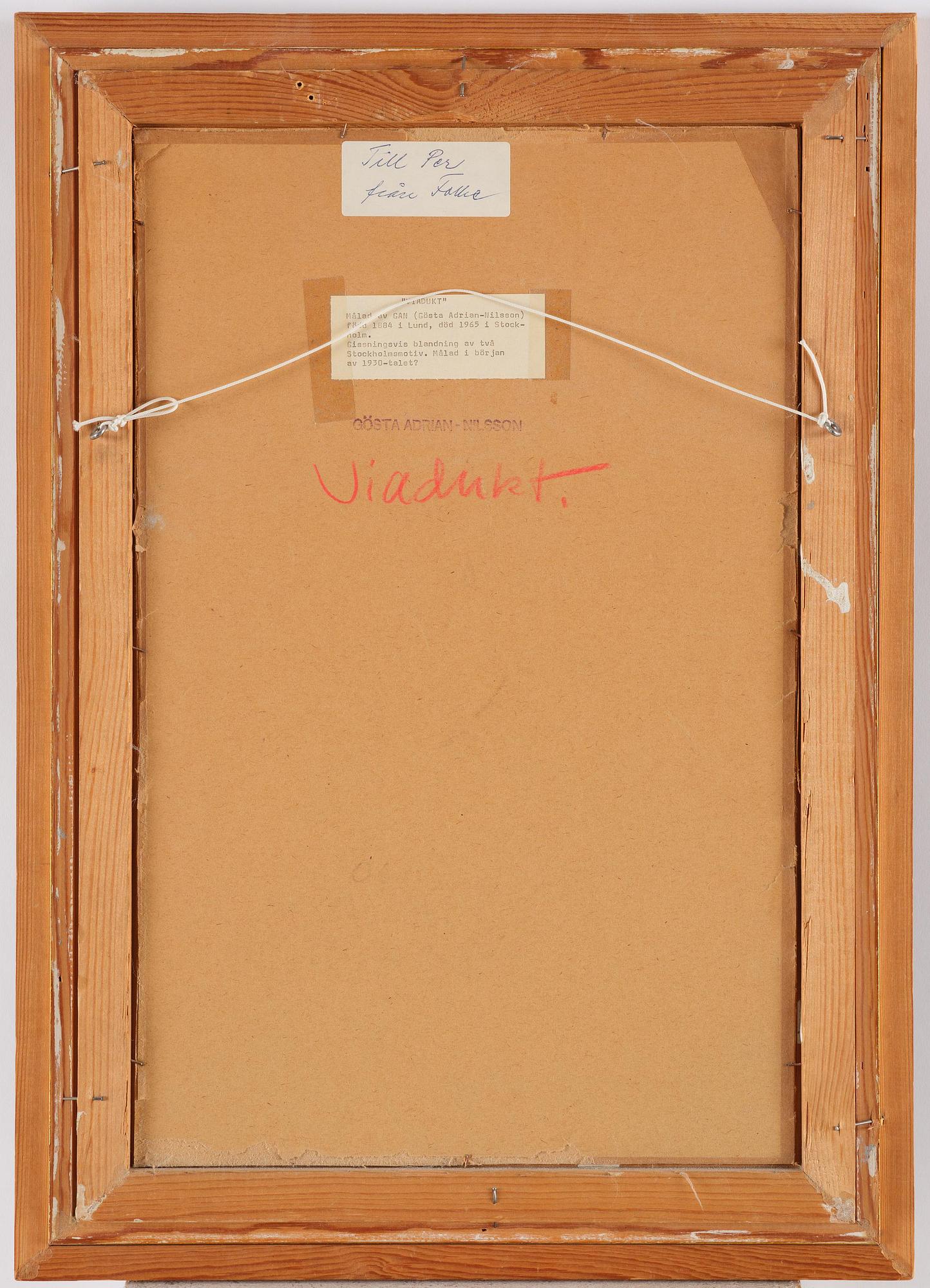
The chess player Folke Ekström (1906-2000), received as second prize in a chess competition in the beginning of the 1930s.
Thereafter inherited by the current owner.
More information
Gösta Adrian-Nilsson (GAN) occupies a central position within Swedish modernism and stands out as one of its early pioneering figures. His artistic career is characterised by a remarkable versatility, both in expression and in technical and stylistic development. His debut took place in 1907 with a self-illustrated collection of poems, whose vignettes testify to an already developed sensitivity to the prevailing Jugendstil aesthetics. However, during the following decade, Adrian-Nilsson completely transitioned to painting. After initial studies in Copenhagen, he travelled to Berlin in 1913, where his encounter with the circle around Herwarth Walden and the gallery Der Sturm proved decisive. Here, he was exposed to contemporary avant-garde movements, not least Wassily Kandinsky's abstraction and the dynamic imagery of Italian Futurism, both of which would exert a lasting influence.
Like the Futurists, GAN embraced a fascination with the technological advancements of modernity. His painting from this period is characterised by a striving to articulate movement, energy, and rhythm, resulting in powerfully expressive compositions with an almost kaleidoscopic structure. The motifs encompass both urban and mechanical elements—buildings, vehicles, and machines—as well as human figures, particularly young, vital men who emerge as recurring subjects.
In 1920, GAN established himself in Paris, where he participated in the discourse of the international avant-garde for a five-year period. During this time, he published the Kandinsky-influenced manifesto The Divine Geometry, in which he emphatically argued for non-representational art. Concurrently, his own painting underwent a shift towards a more purely geometric-abstract idiom, characterised by static, highly reduced forms and an iconographic austerity that can partly be traced back to medieval pictorial traditions.
This reduction culminated around 1930 in a consistently concrete and planar geometric expression. During his years in Paris, Adrian-Nilsson also came into contact with the members of the Halmstad Group, whose early development within geometric painting he would significantly influence. The relationship later became mutual; in the latter part of the 1930s, surrealist elements can also be traced in his own work.
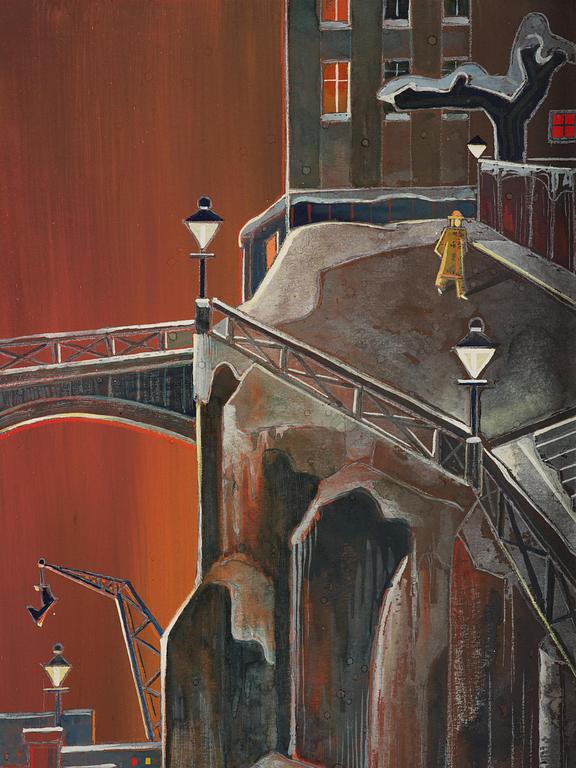
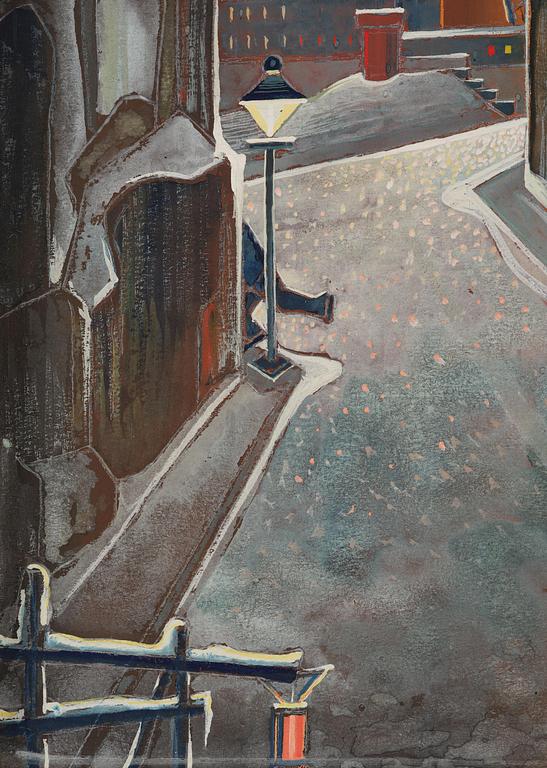
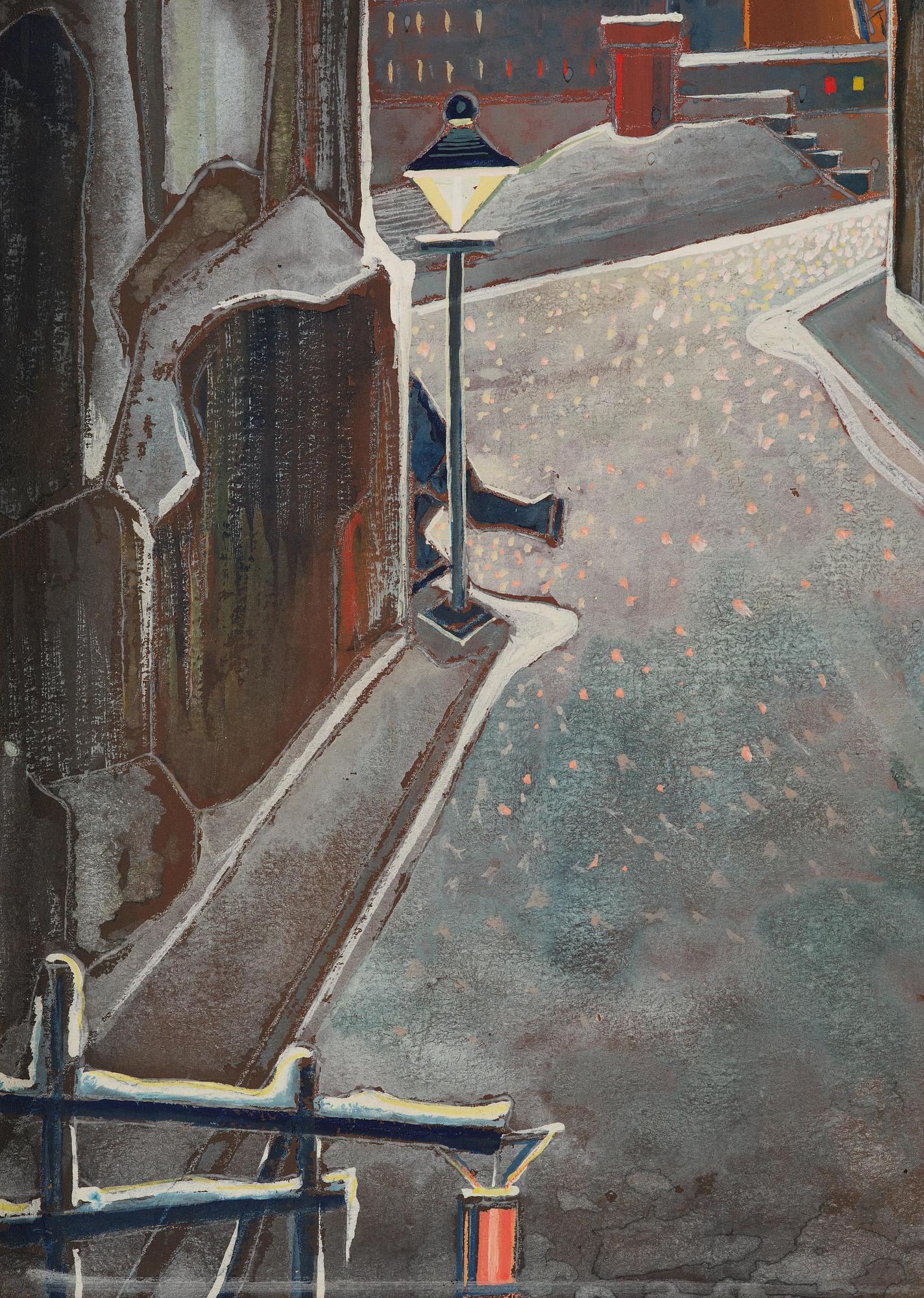
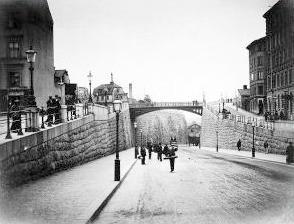
In the auction's "Viaduct," GAN takes us to a fanciful and scenic depiction of Torkel Knutssonsgatan in Södermalm, Stockholm. The painting, with its burnt palette, is held together by the geometry of the composition, where sharp angles meet taut curves. In the centre, we see the Lundabron, a footbridge leading from Gamla Lundagatan across Torkel Knutssonsgatan. A motorcyclist speeds down the hill, a figure mysteriously disappears behind a corner, and another figure dressed in a monochrome yellow outfit and hat strolls in the upper right on Bastugatan, GAN's home address from 1932 until his death in 1965.
More about Gösta Adrian-Nilsson
Gösta Adrian-Nilsson is most notable as a visual artist, and he is a pioneer of Swedish modernism. He studied at the Tekniske Selskabs Skole in Copenhagen and later for Johan Rohde at Zahrtmann’s school in Copenhagen. As an avant-gardist, Nilsson was constantly searching for new influences. In Berlin, he was influenced by the circle around the radical magazine Der Sturm, through Kandinsky and och Franz Marc. In Paris through Fernand Legér and the artists in his circle. GAN was an eclectic in the positive sense of the word. He took the the artist styles of the 1900s and created new impressions. Symbolism, cubism, futurism, expressionism, constructivim and Theosophy were the colours occupying his internal pallet. He had a sharp eye for the masculine and his painting was often energized by the vitality of modern technology, vibrant eroticism, and echoes of tyrants. No other Swedish modern artist exhibits such a unique style.
Read moreFor condition report contact specialist
Covered by droit de suite
Image rights
The artworks in this database are protected by copyright and may not be reproduced without the permission of the rights holders. The artworks are reproduced in this database with a license from Bildupphovsrätt.
Others have also viewed