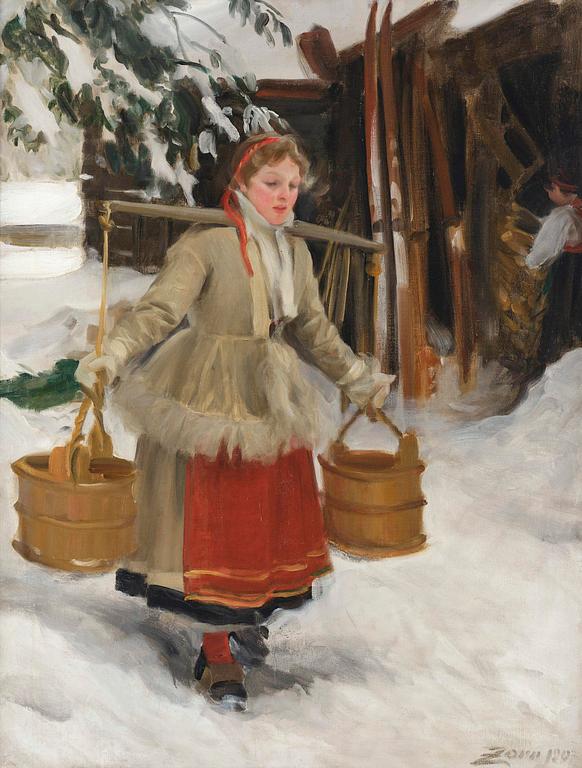
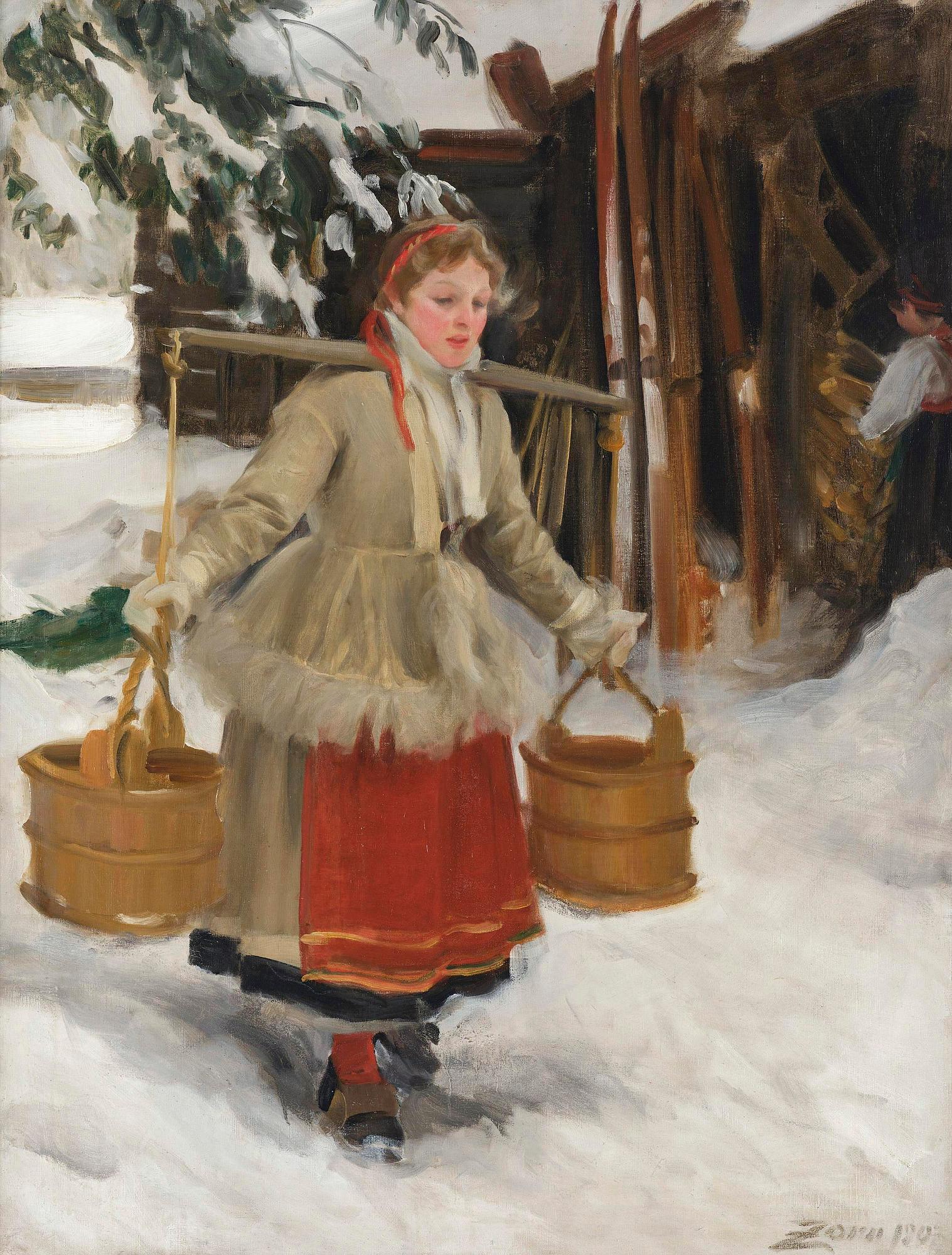
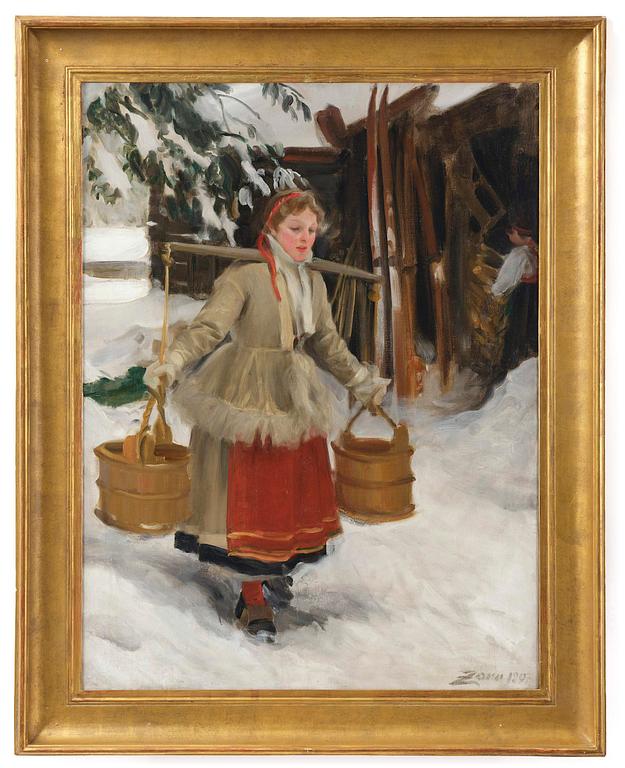
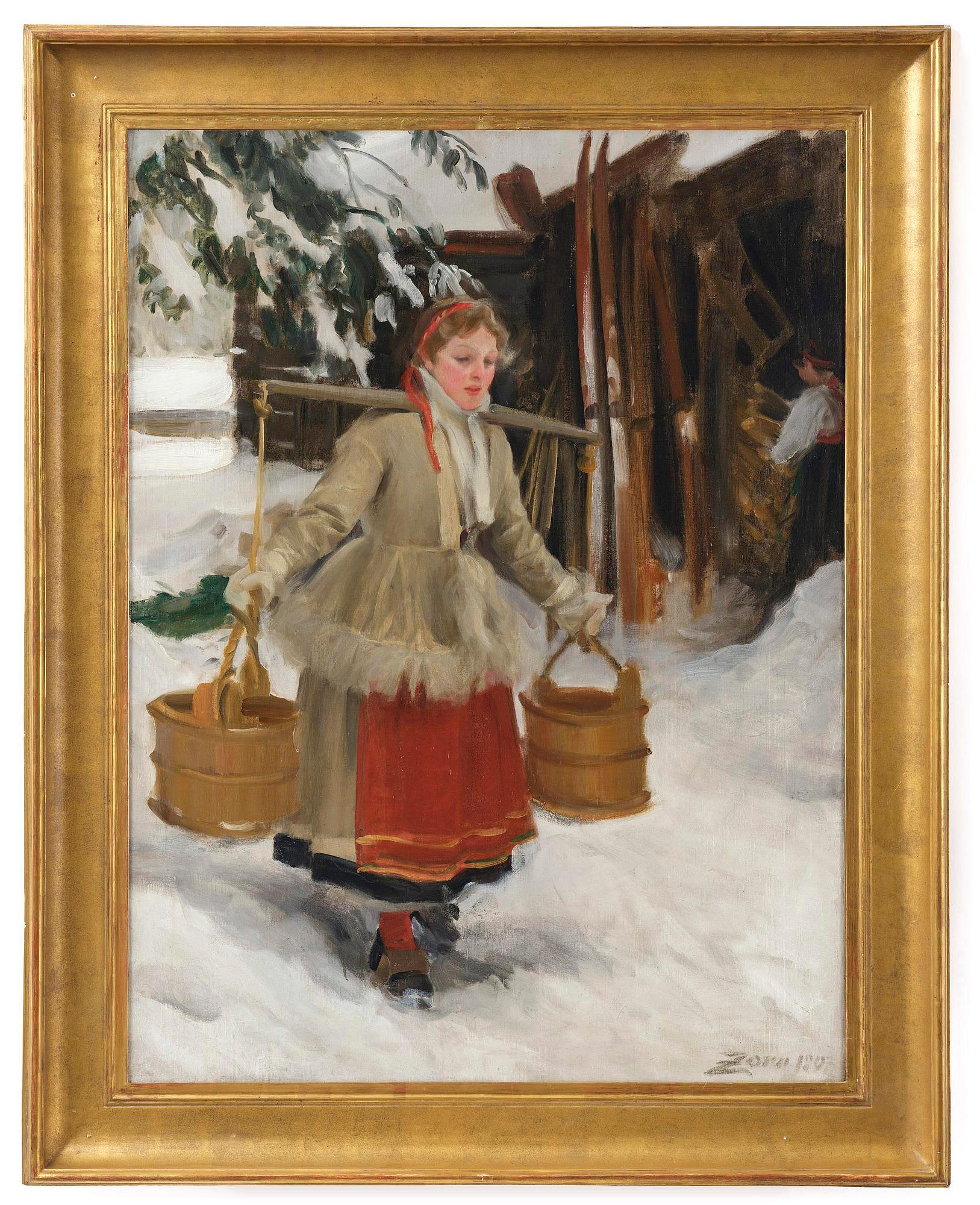
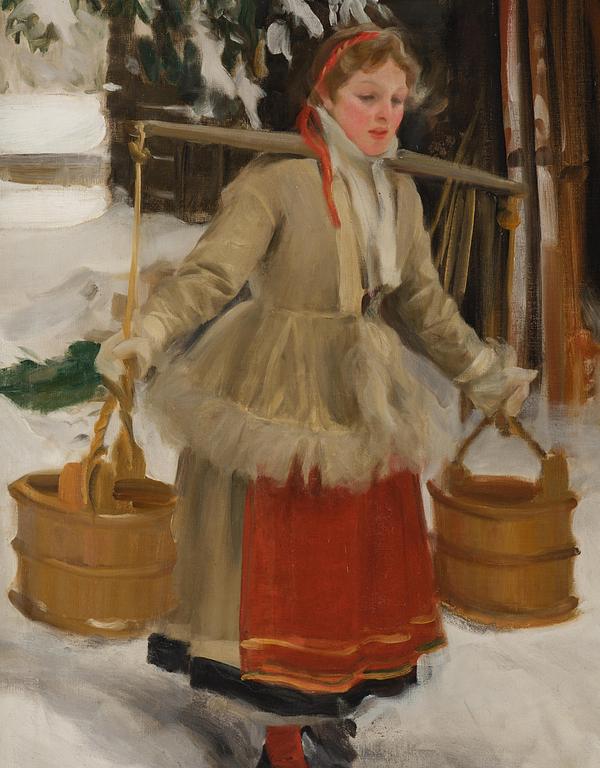
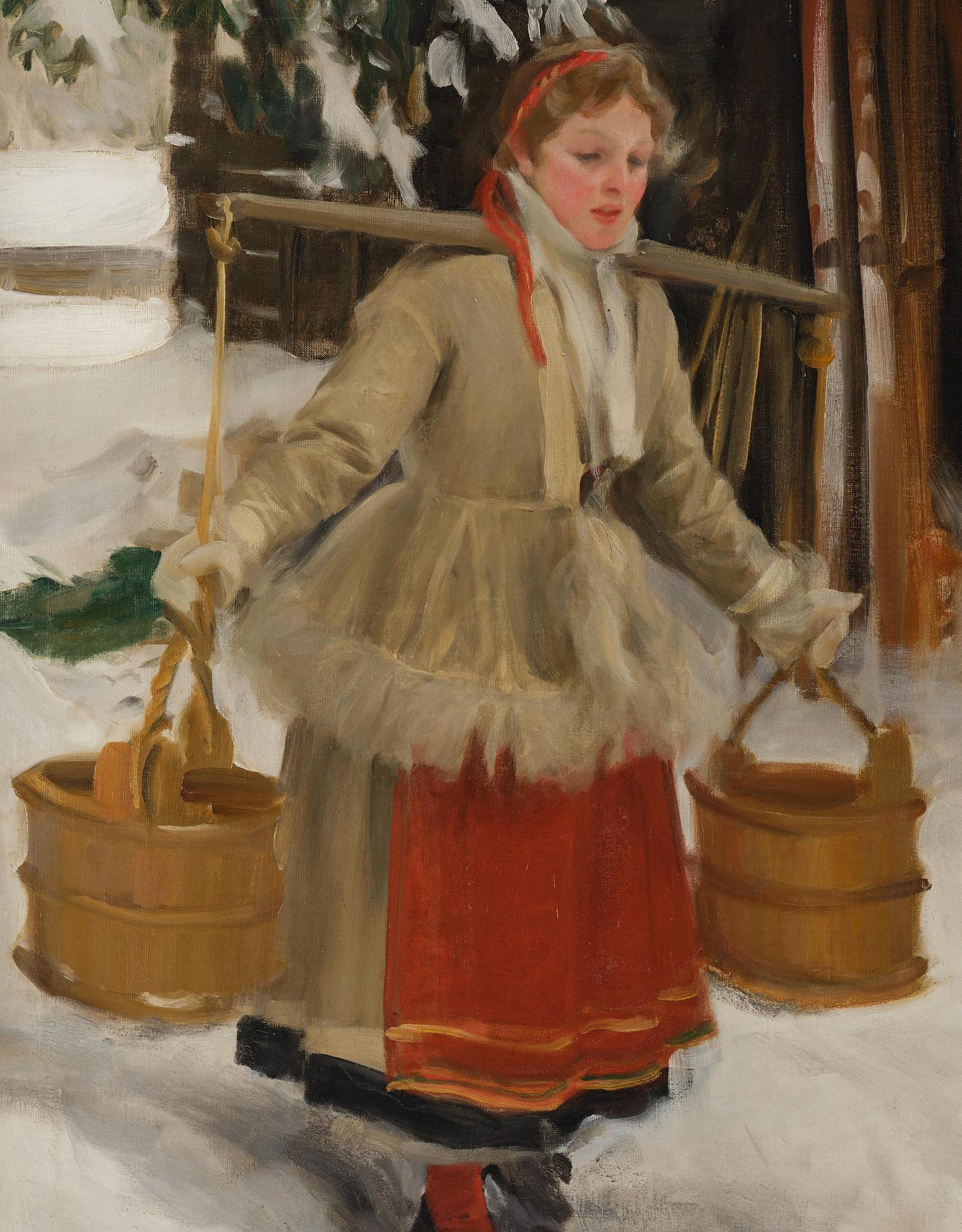
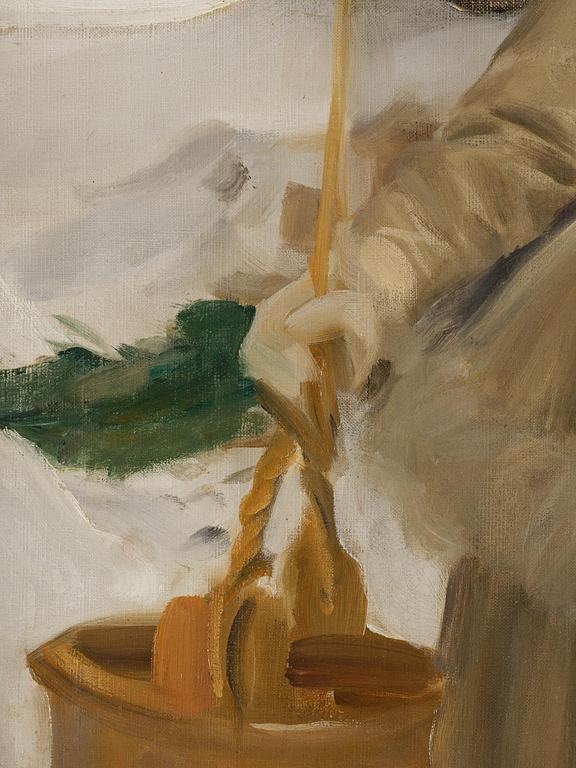
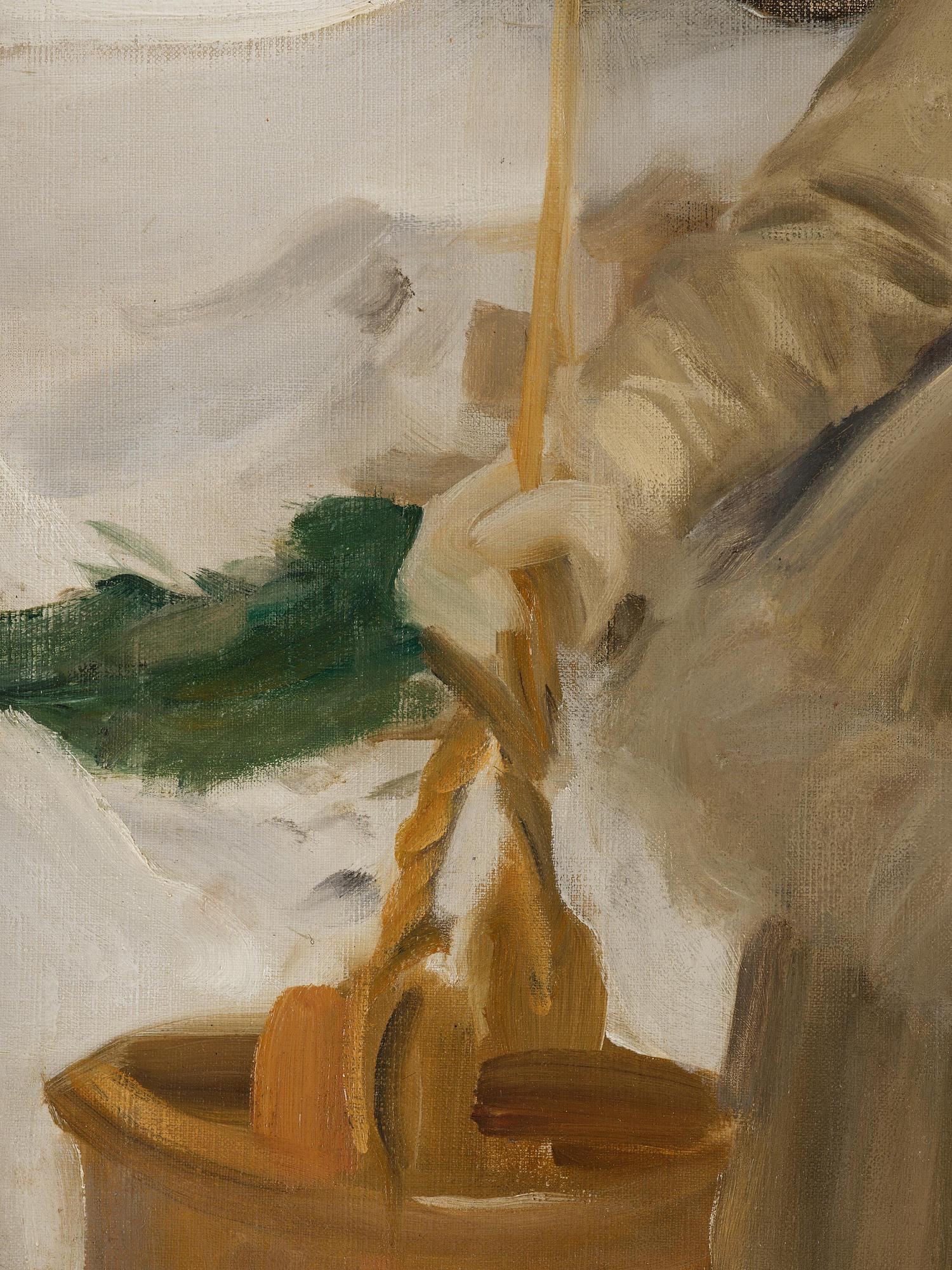
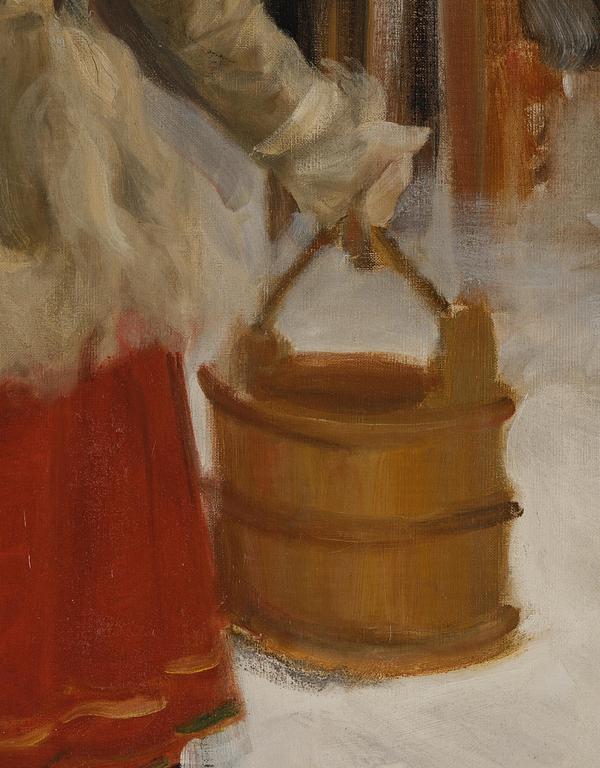
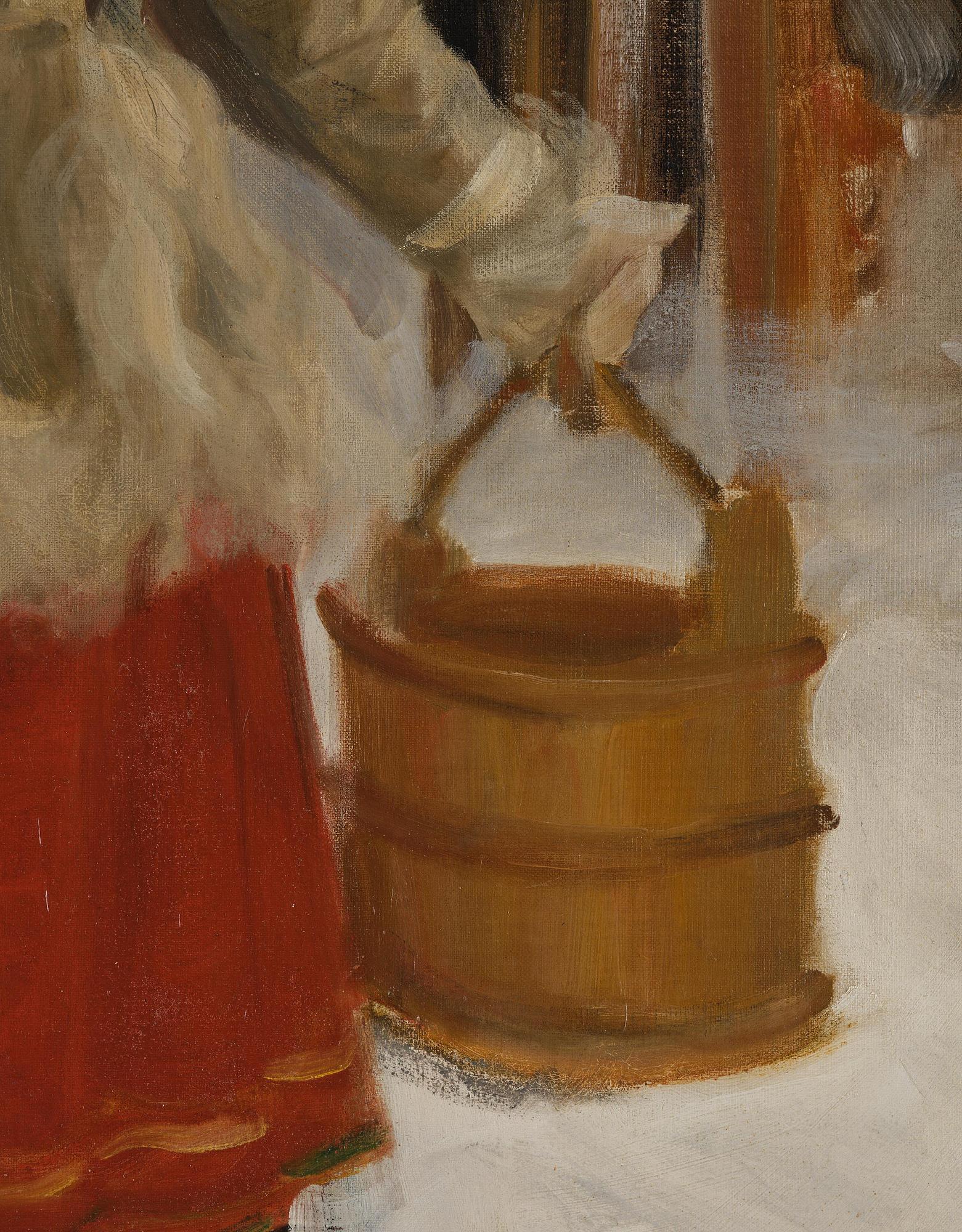
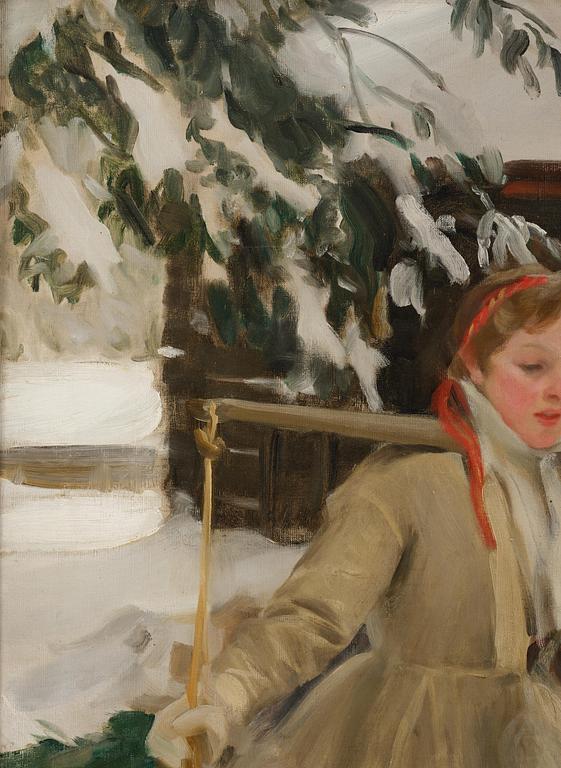
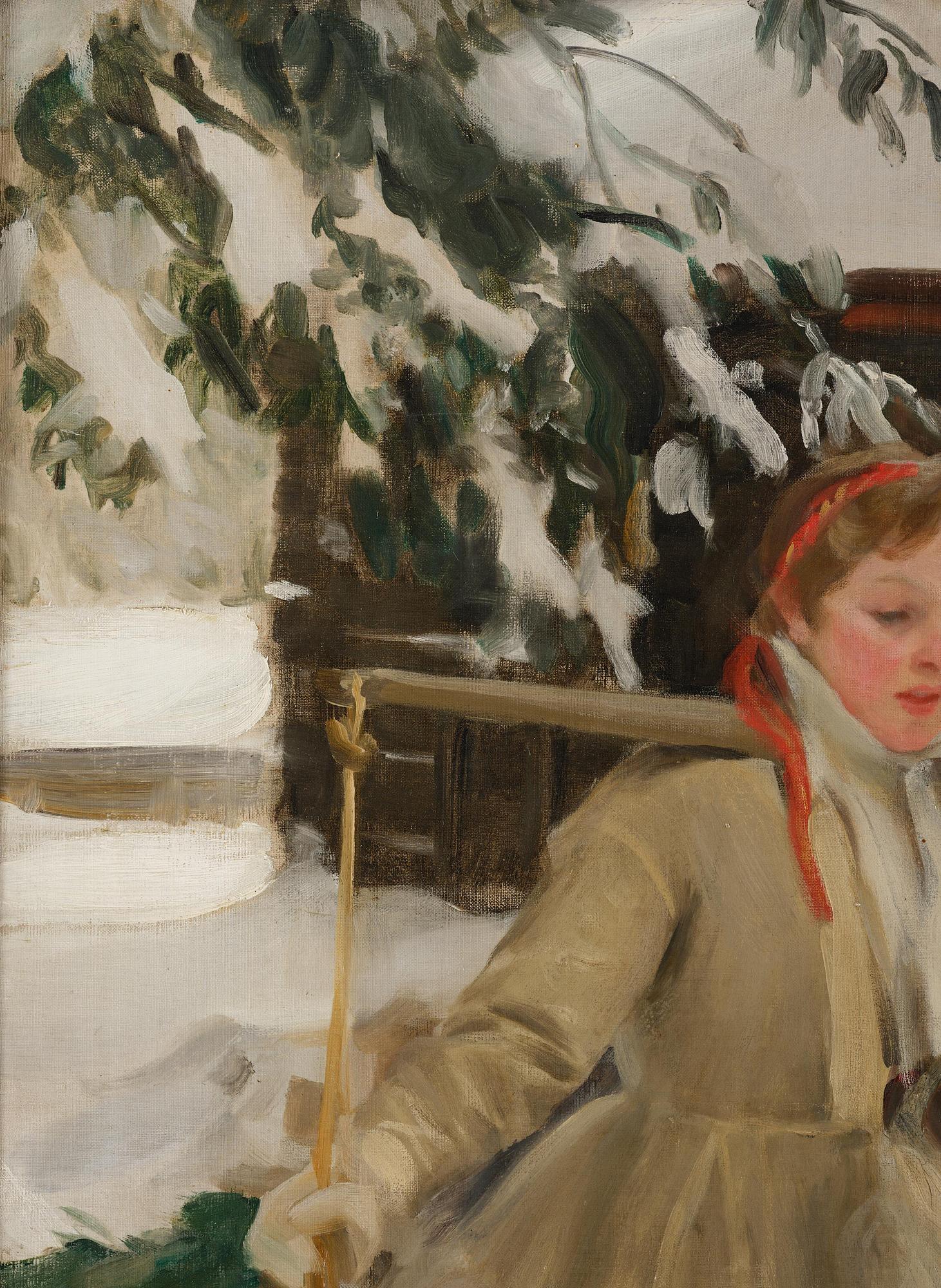
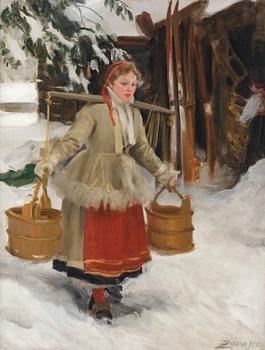
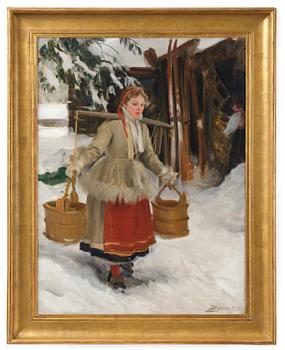
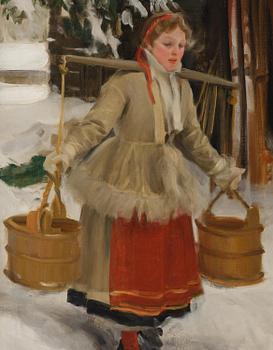
"Hämta vatten" ("The Water Pails")
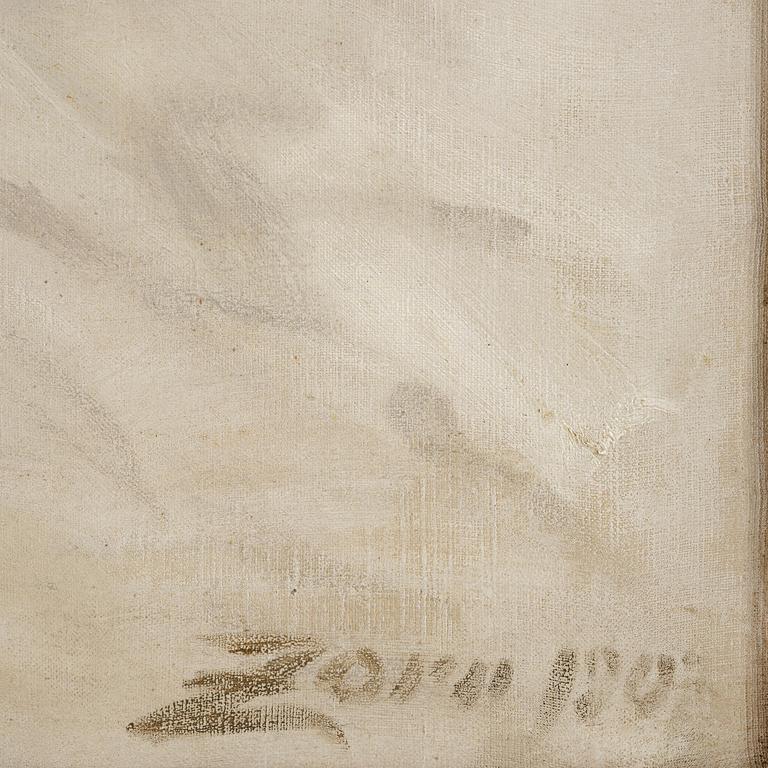
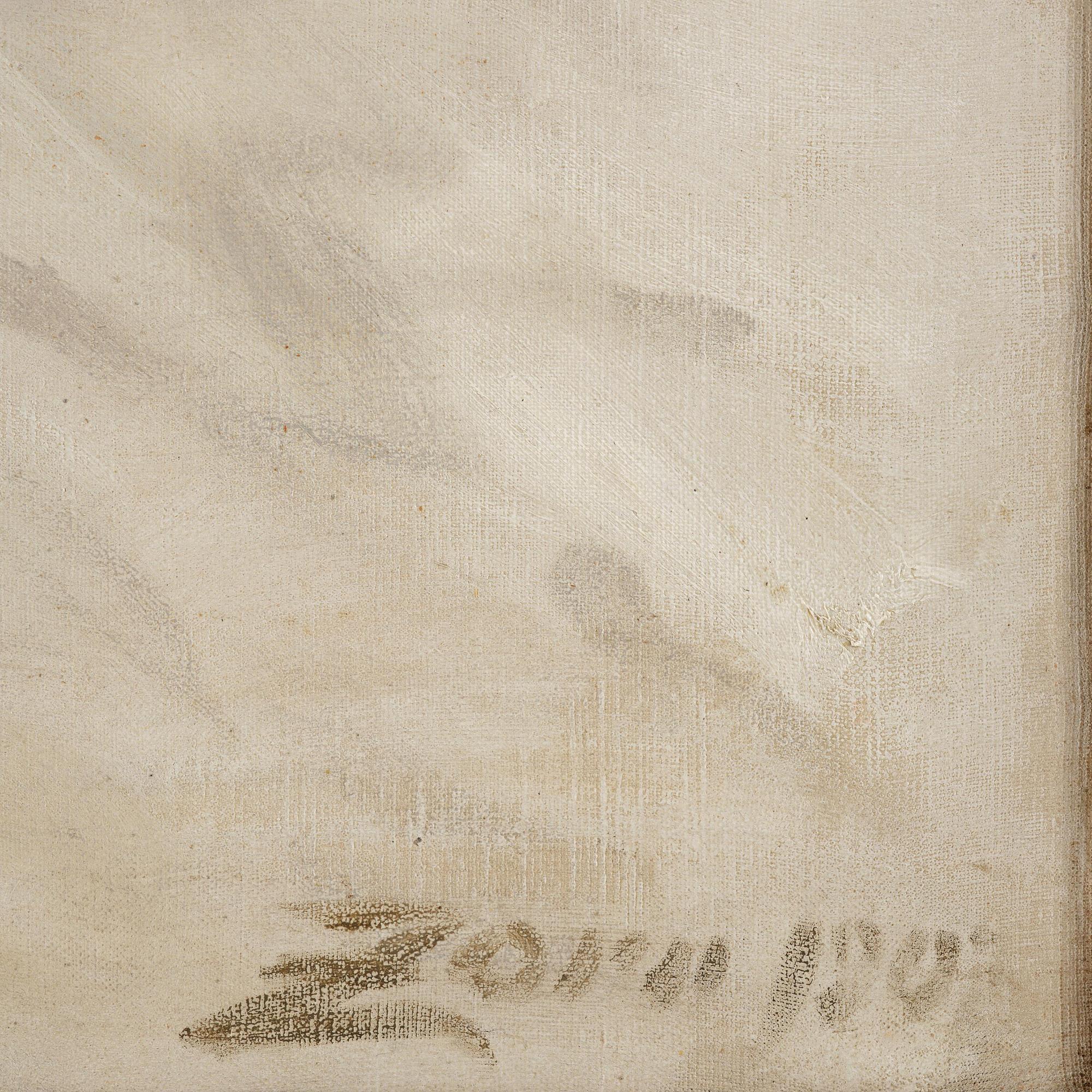
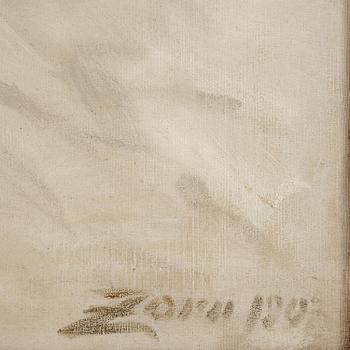
Signed Zorn and dated 1907. Oil on canvas 120 x 91 cm.
Provenance
The Artists' Pension Lottery, 1912 (valued at 18,000 SEK).
Arthur H. Hahlo & Co., New York.
Solomon S. Rosenstamm (1860–1919), New York.
The American Art Association, New York, auction of S. S. Rosenstamm, January 27, 1920, lot 171.
P. & D. Colnaghi & Co., London.
Consul Erik Brodin's (1872-1931) Collection, Stockholm, acquired via Fritzes.
Beijers Auktioner, Stockholm, Autumn Auction 37, November 7, 1989, lot 484B.
Private Collection, Sweden.
Bukowski Auktioner, International Autumn Auction 530, 2-5 December, 2003, lot 173.
Nordic Private Collection.
Exhibitions
Mora Tingshus, "Arbeten af Prins Eugen, Carl Larsson och Anders Zorn", 16 June - 1 September 1907.
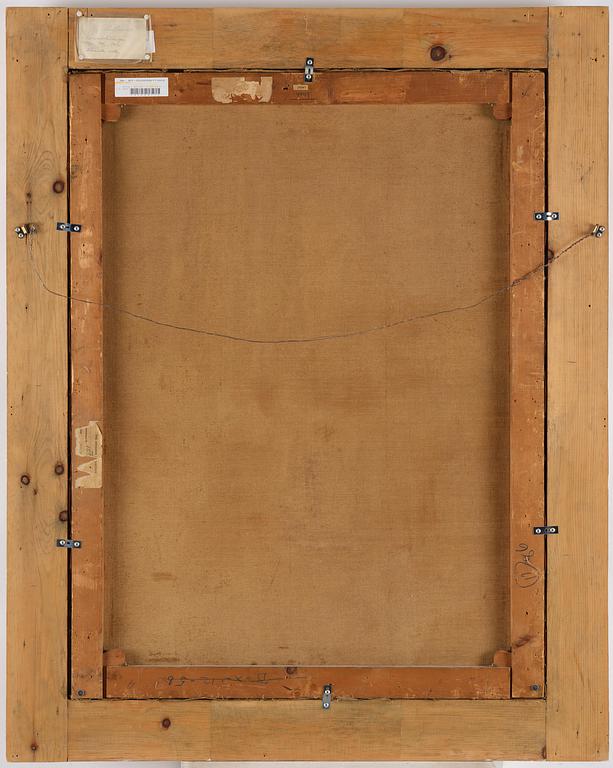
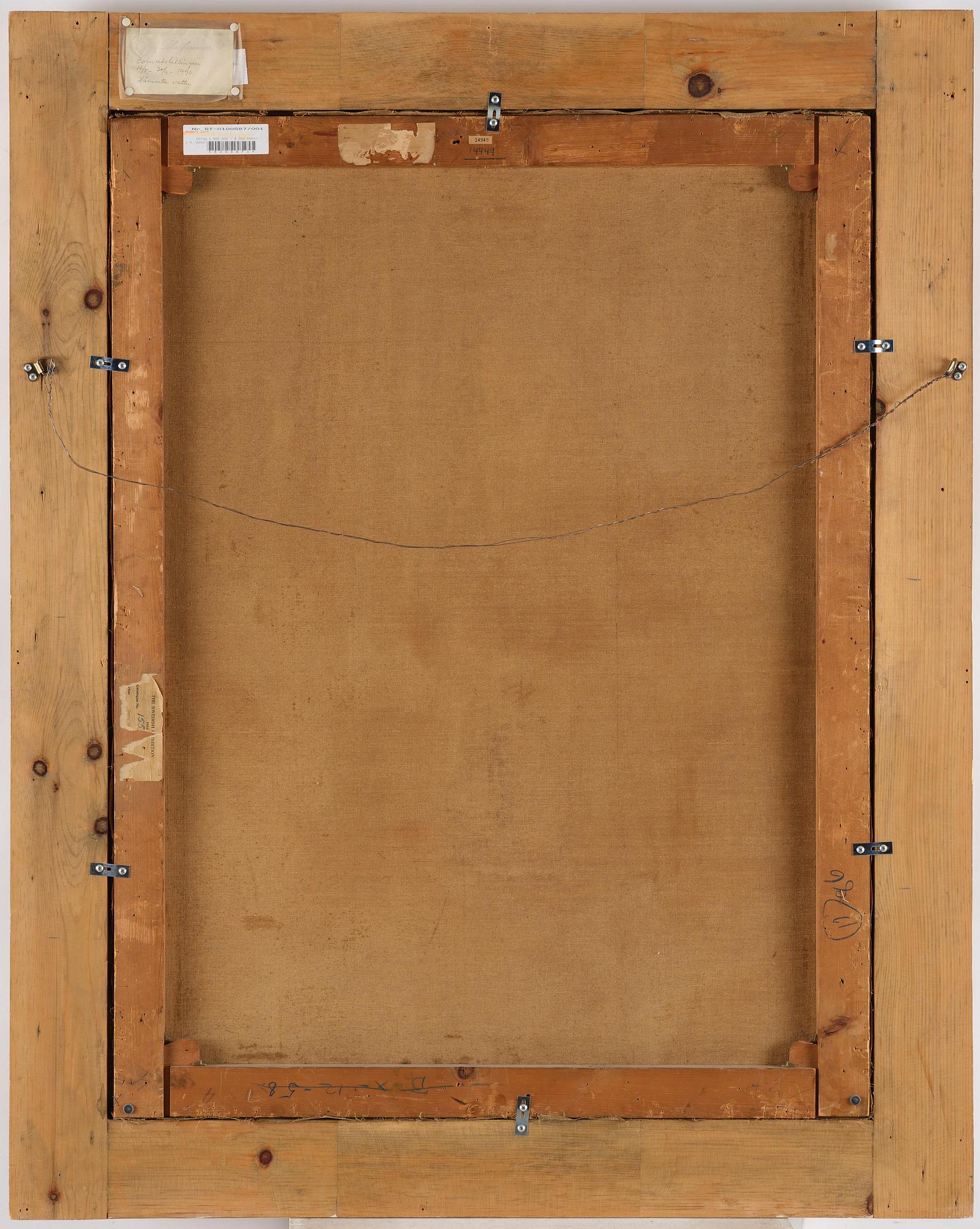
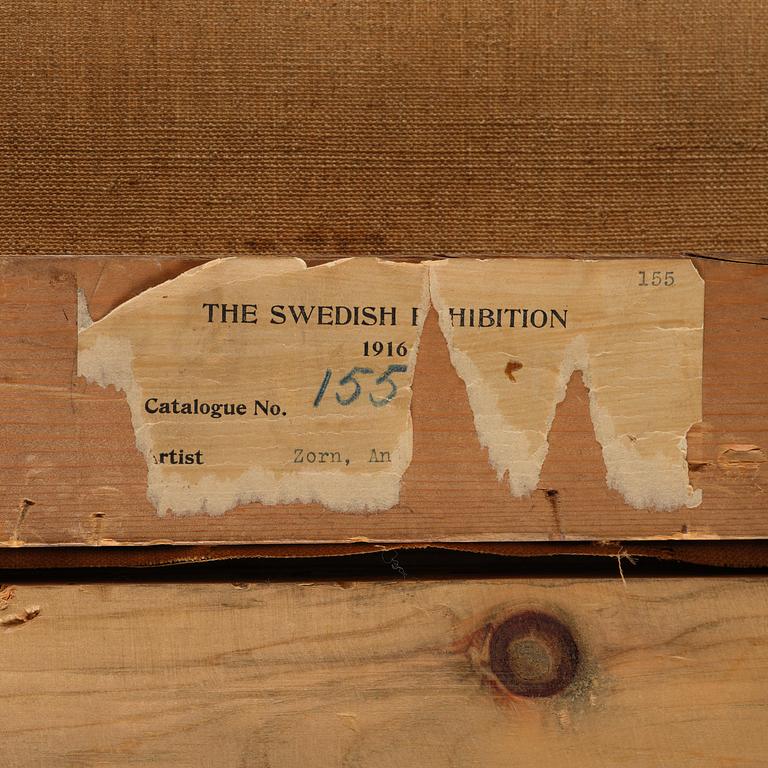
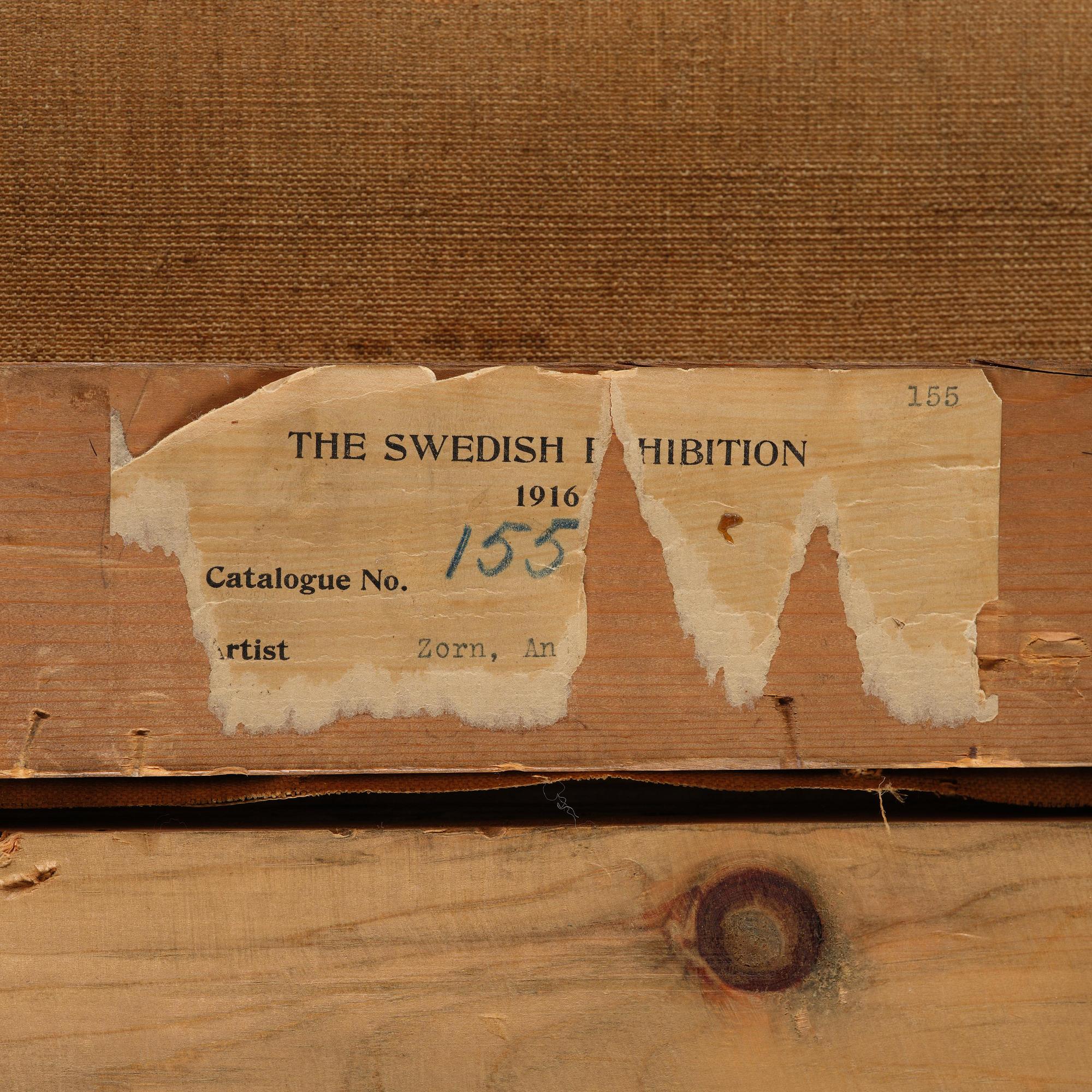
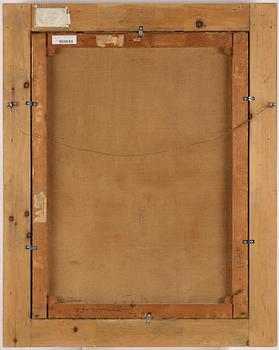
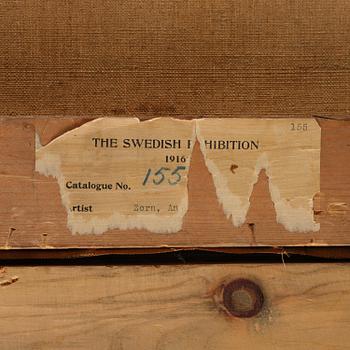
USA, "The Swedish exhibition" (traveling exhibition), 1916, cat. no. 155.
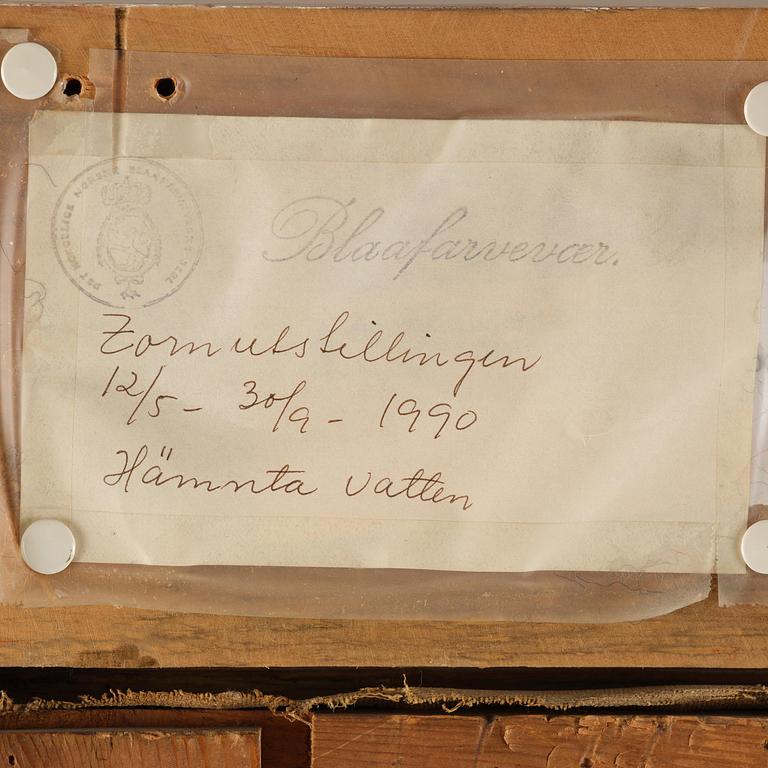
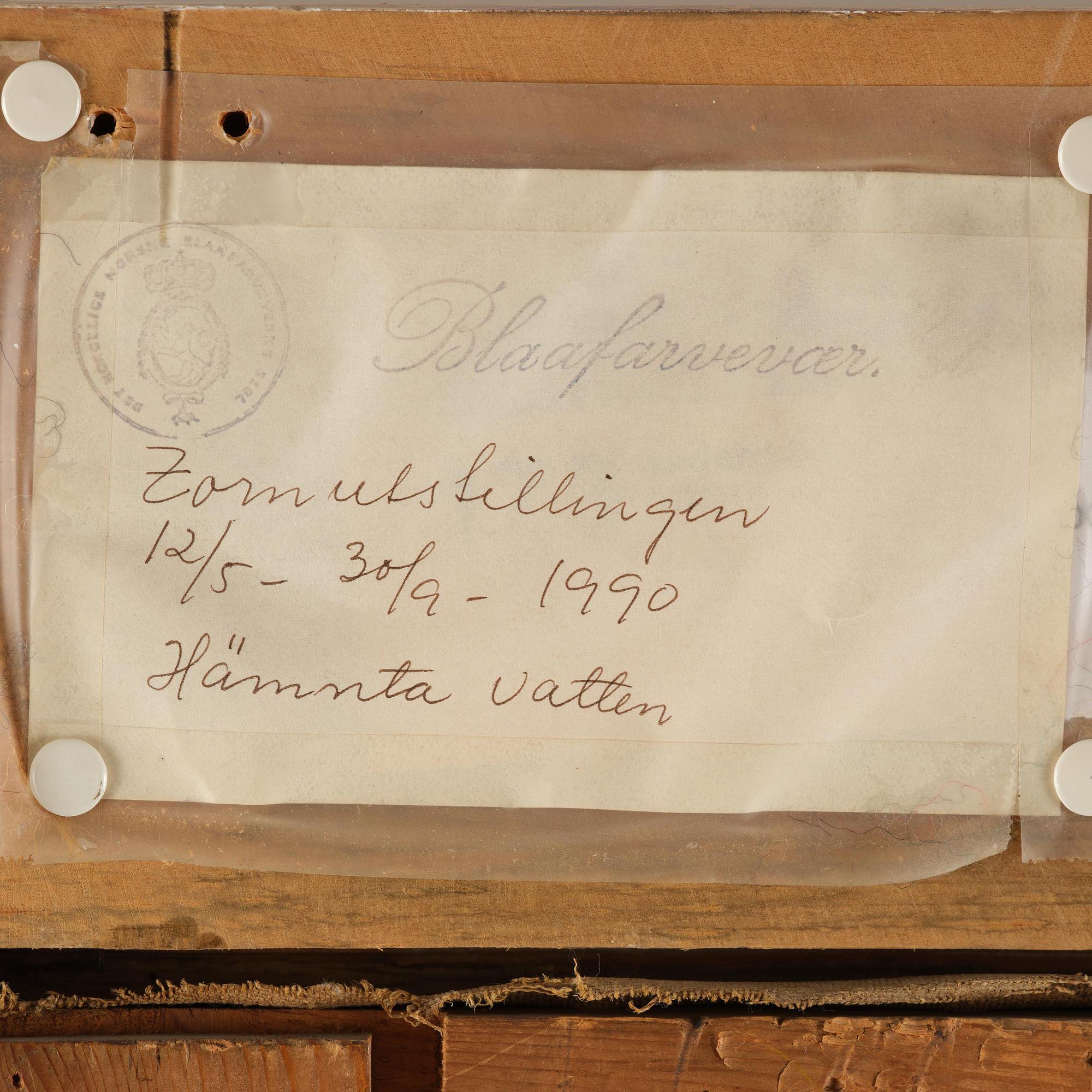
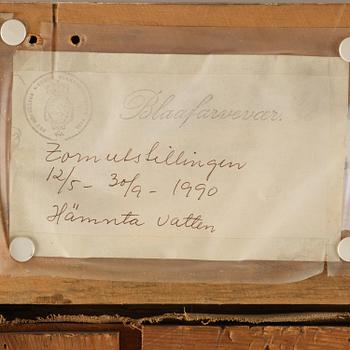
Blaafarvevaerket, Modum, Norway, "Anders Zorn 1860-1920", 12 May - 30 September 1990, cat. no. 90.
Literature
Johan Nordling (ed.), "Några nya taflor af Zorn" from "Idun", 3 October 1907, mentioned and illustrated p. 494.
Christian Brinton, "The Swedish Art Exhibition", 1916, illustrated.
The American Art Association, New York, "Illustrated Catalogue of the Celebrated Rosenstamm Collection: Masterpieces of Etchings and an Original Painting by Anders Zorn", 1920, illustrated.
Tor Hedberg, "Anders Zorn 1894-1920", 1924, pp. 85, 87, illustrated p. 73, image 50.
Ernst Malmberg, "Brodinska hemmet. Villagatan 6, Stockholm" from "Svenska hem i ord och bilder", 1935, p. 229.
Gerda Boëthius, "Zorn - tecknaren, målaren, etsaren, skulptören", 1949, p. 467, as well as in the catalogue p. 551.
"Självbiografiska anteckningar", 1982, published and commented on by Hans Henrik Brummer, mentioned p. 230.
Kjell Rasmus Steinsvik (ed.), "Anders Zorn", Stiftelsen Modums Blaafarvevaerk, 1990, illustrated p. 139.
Anders Zorn, "Självbiografiska anteckningar", 2004, published by Birgitta Sandström, illustrated p. 244.
More information
When Anders Zorn passes away, he does so as one of Sweden's foremost artists of all time. Whatever medium he embraced, he did so with a rarely seen skill and elegance, seemingly uncomplicated and spontaneous, yet often carefully studied and prepared. Likewise, he moved effortlessly between the aristocracy and the common folk, both clothed and buttoned-up as well as naked and free.
From a young age, Anders Zorn was drawn to the world beyond his homeland and undertook many journeys to various exciting places. His remarkably skilled technique as a watercolourist garnered international attention, not least through portraits and genre scenes exhibited at shows across Europe. Zorn's breakthrough came during his travels in London and Paris, where he adapted to an international audience and developed his characteristic painting style. During this period, he increasingly turned to oil, which allowed him greater opportunities to explore light, skin tones, and reflections – particularly in his famous bathing motifs. His artistic talent was exceptional, and regardless of the medium – from early watercolours to meticulously crafted bronze sculptures and powerful oil paintings – his works are marked by an impressive quality and great technical skill. Despite international influences and successes, he always held his homeland in Dalarna in high regard. Mora remained the obvious place for celebrations such as Christmas and Midsummer, and it was in the simple everyday life that he felt most at home. After nearly ten years with Paris as a base, Anders and his wife Emma chose to return to Sweden in the summer of 1896 and settle in Mora, where the artist deepened his interest in the Swedish landscape and rural life. Here, he developed a more nationally oriented subject matter, depicting the common folk, traditions, and nature, often in the form of naked or semi-naked figures in open-air settings.
In 1904, Zorn purchased land by the Österdal River, a few miles outside Mora, with the aim of living a life reminiscent of earlier generations – simple and close to nature. To the site, Gopsmor, he moved several buildings from the area and used it as a retreat where he would travel a couple of times a year. There, he could work undisturbed and immerse himself in his artistry without external distractions. The secluded environment provided space for concentration and creative joy, and several of his most significant works were created there. The dual residence was not unfamiliar to Zorn, who was already well acquainted with the pastoral culture of the common folk. Life there was simpler, perceived by some as perhaps too primitive, as it is described how Erik Axel Karlfeldt, during a visit, felt embarrassed by the simplicity.
Alongside his great artistic career, Anders Zorn became one of the country's major cultural promoters. Above all, he strove for the historical preservation of, among other things, the culture of the common folk. In Gopsmor, Zorn and his household engaged in traditional activities and enjoyed dance games indoors, while in winter, skiing was a frequent pastime. Several of Zorn's most beloved motifs were created in Gopsmor, where "I Eldhuset", "Improviserat bad" and "Dans i Gopsmorstuga" can be mentioned as examples. The models who accompanied him to Gopsmor often participated in household chores, and it is in the depictions of these everyday moments that his art reaches a particular intensity and expressiveness. His Henrik Brummer describes Zorn's images from Gopsmor as "the sensualism of an unpretentious way of life. That he [Zorn] depicted an Arcadian realm of happiness was entirely in line with his artistic programme."
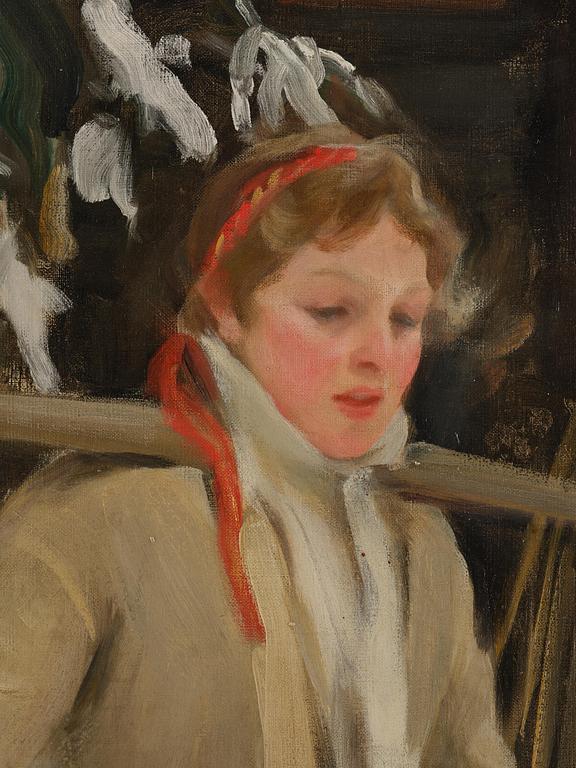
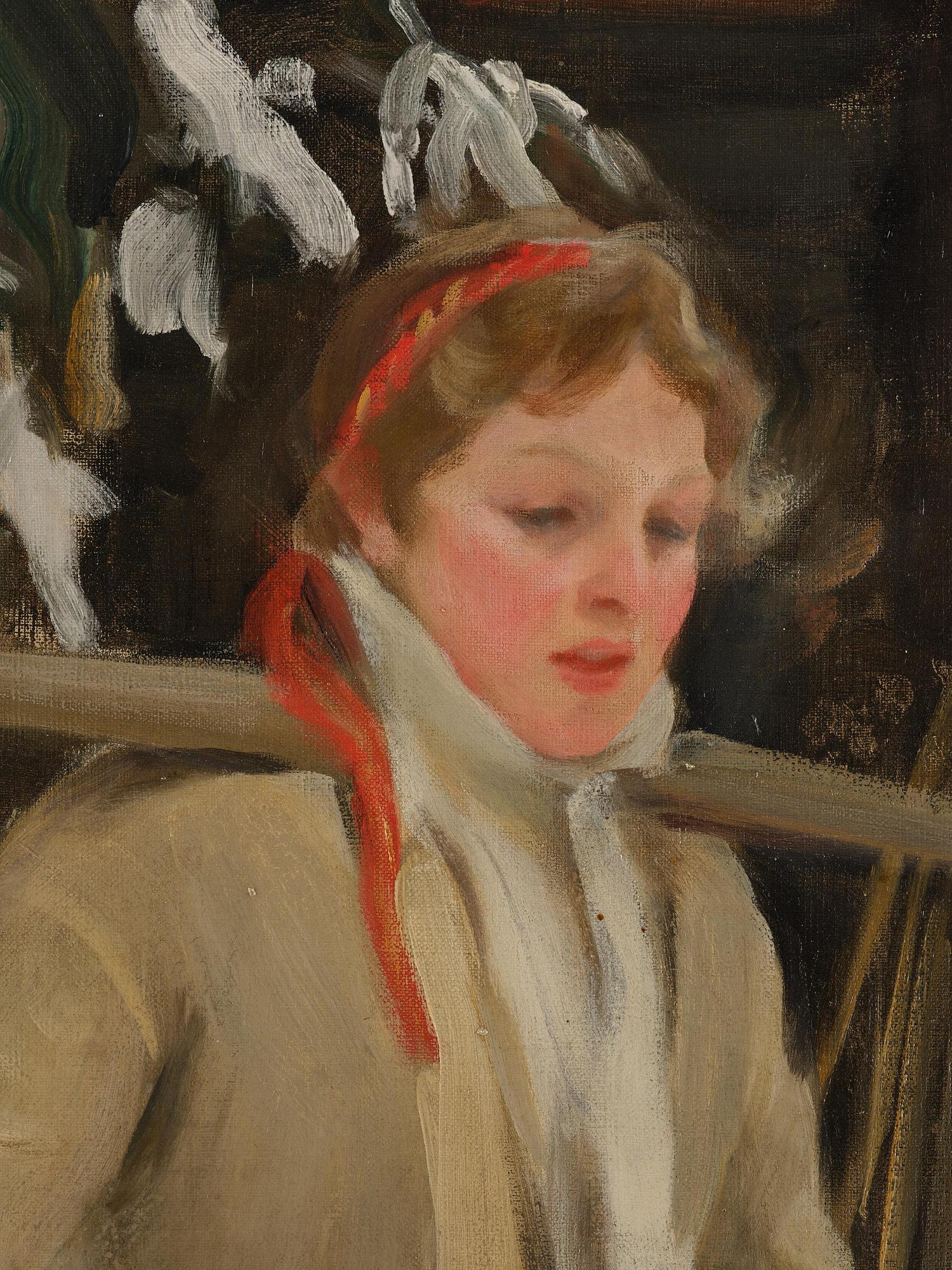
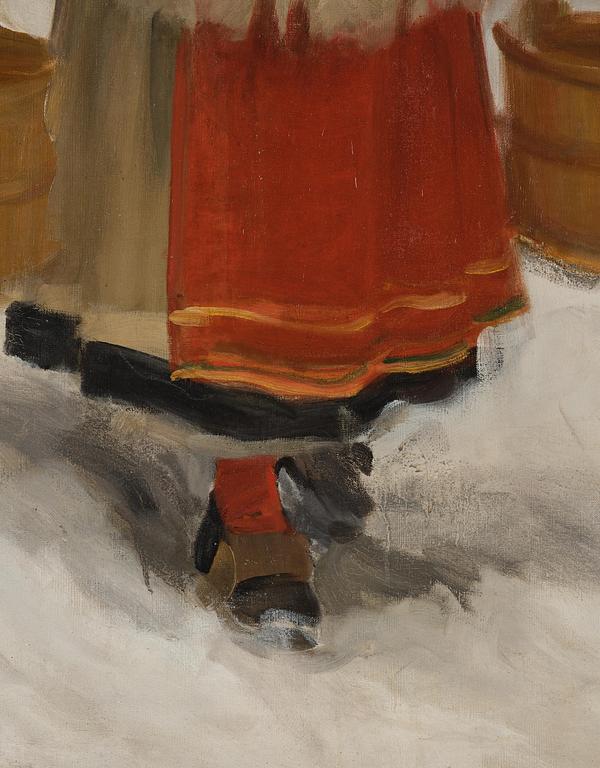
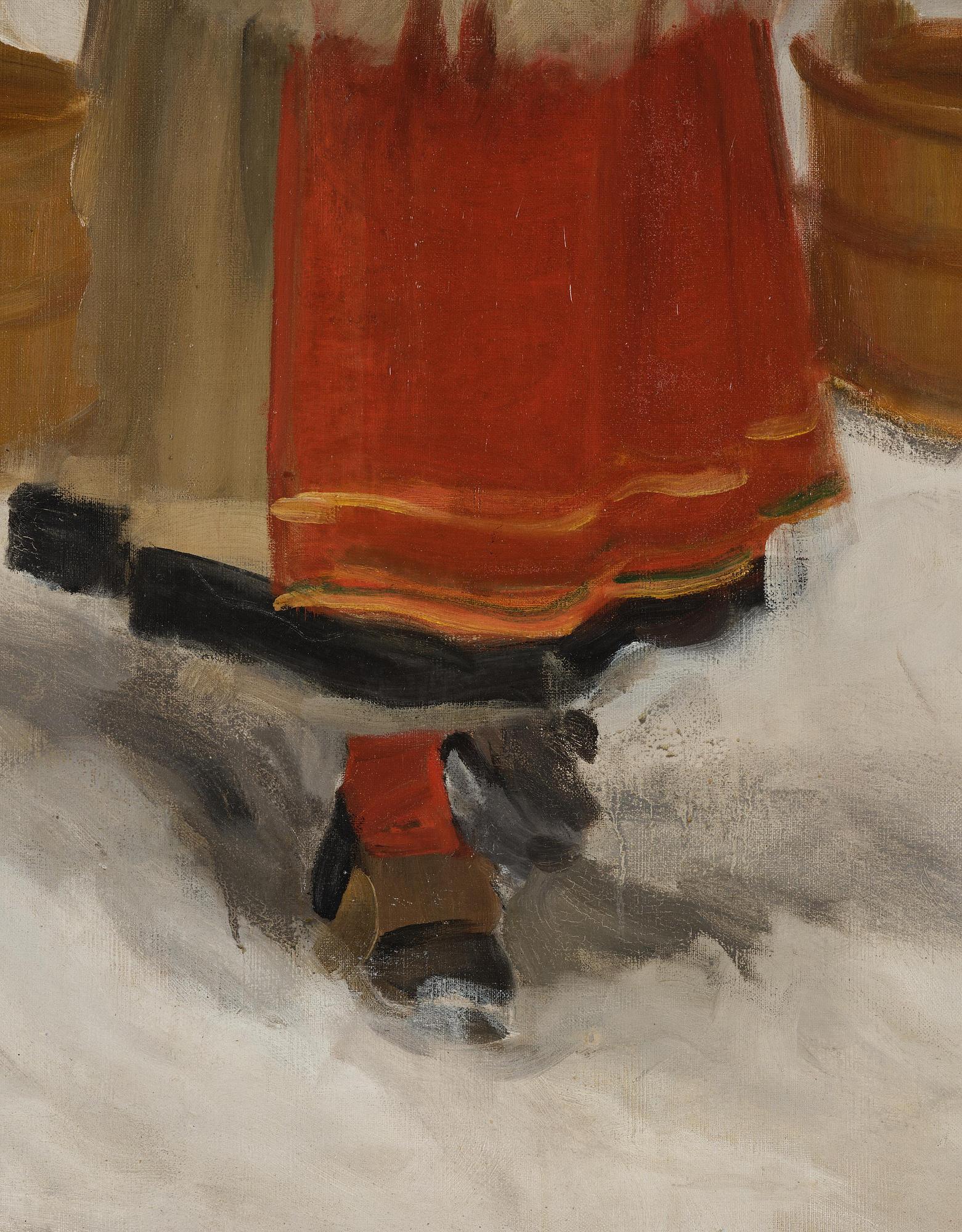
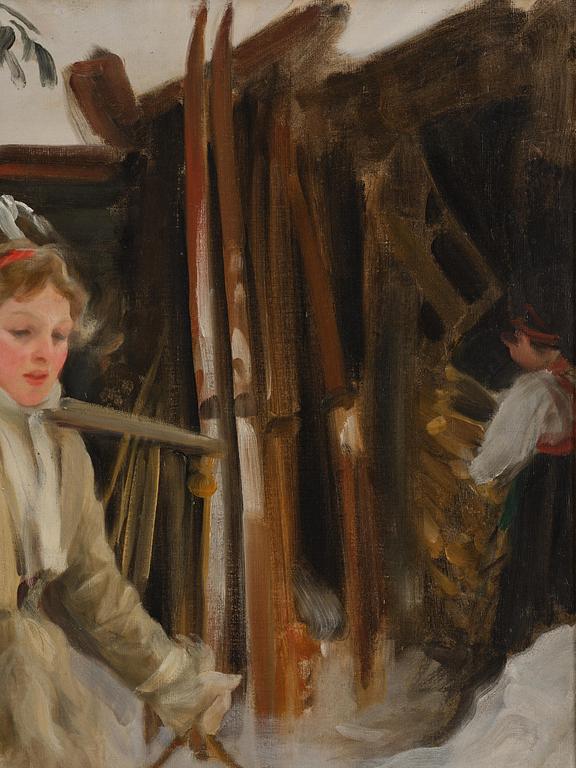
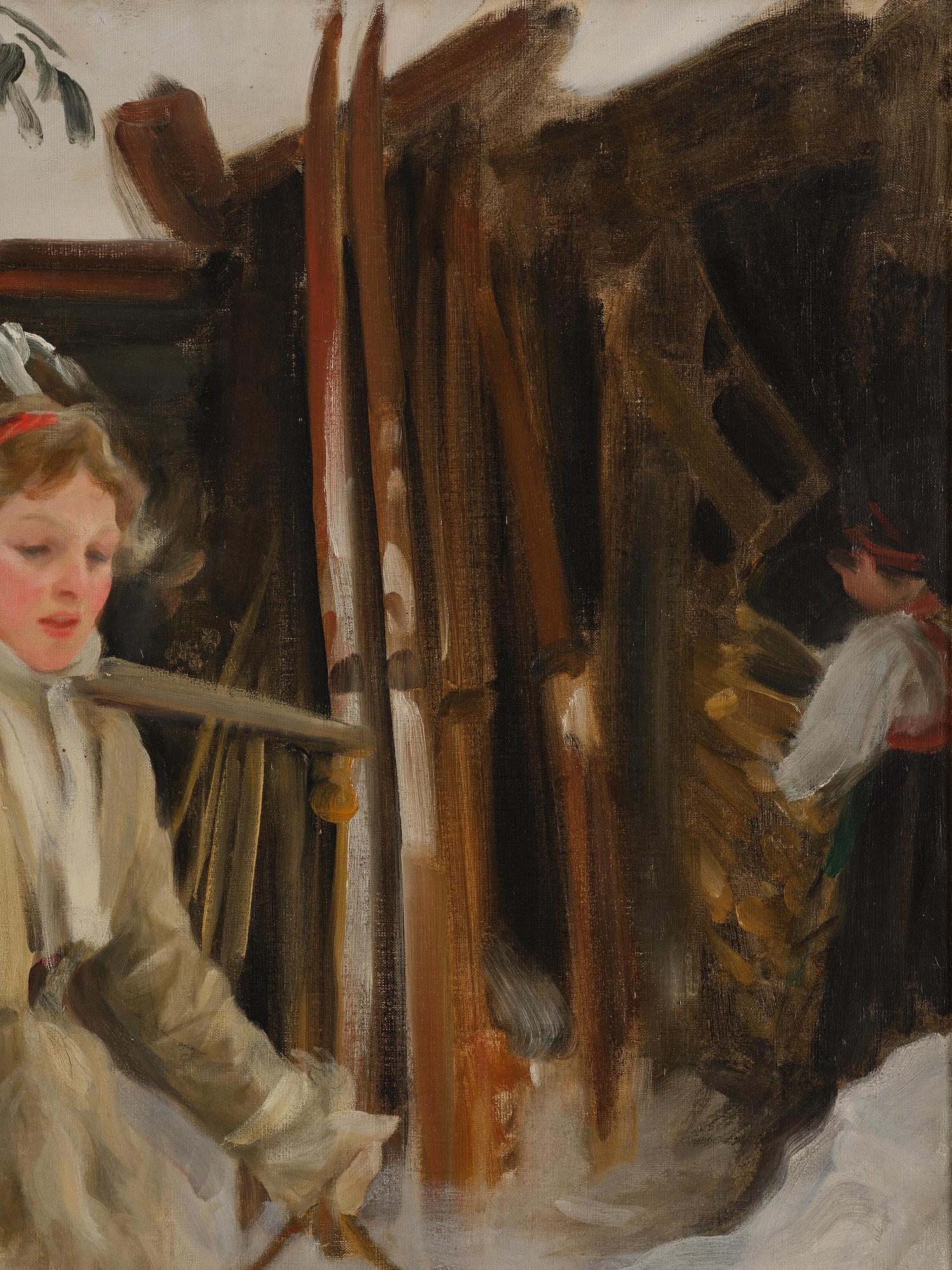
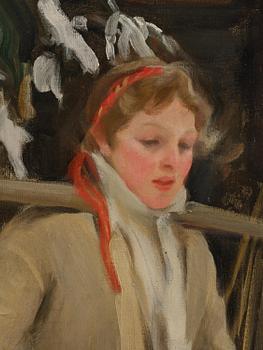
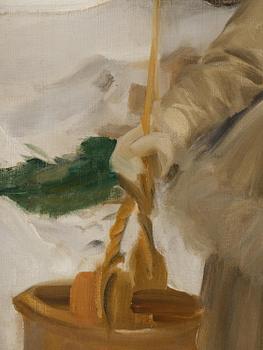
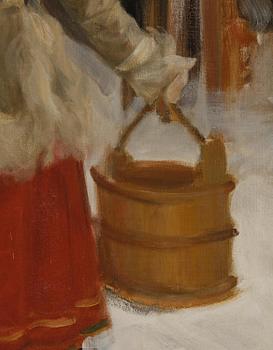
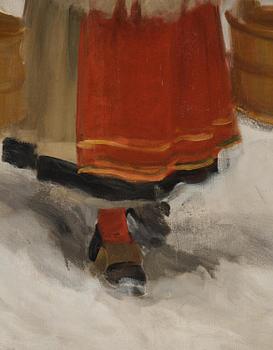
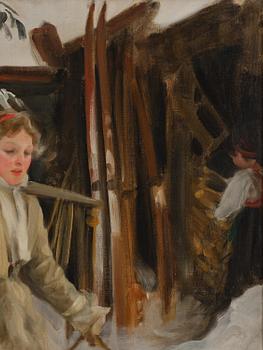
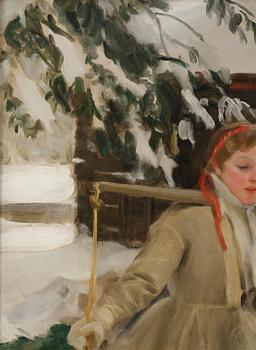
Frans Estenberg, who took care of Gopsmor Cottage for Zorn, wrote in his diary entries in January 1907 that "Zorn is painting Kesti carrying water," referring to the auction's painting "Hämta vatten" ("The Water Pails"). Kesti was none other than Hållams-Kesti, who was among Zorn's favourite models. The beautiful girl Hållams-Kesti also modelled for Zorn in "En flykting", where he initially envisioned two girls skiing in the snowy landscape. However, he changed his mind and removed one girl, and Hållams-Kesti was transformed into none other than king Gustav Vasa, among other things by the addition of the characteristic beard! Among the winter paintings from early 1907, such as "Moraflicka på skidor", "Rättvikskulla i snö" and "En flykting", "Hämta vatten" ranks among the very finest. Hållams-Kesti is depicted in the beautiful winter attire of Mora girls, where the red hairband revealed to those interested that the woman was still unmarried. In the background, the long skis are visible – a necessity for winter travel to Gopsmor and also a popular recreational activity – as well as another industrious girl busy bringing firewood into the cottage. Regarding the painting "Hämta vatten", Tor Hedberg wrote that "the colour scheme here is more melting, with the ivory-yellow skin coat so exquisitely set against the white snow and the brown timber. Zorn's lovingly painted furs could deserve a chapter of their own; one can see how he enjoyed their ancient patina."
With his characteristic virtuosity in brushwork and an outstanding sense of light and movement, Zorn transforms this simple act into a poetic moment, charged with presence and intimacy.
The painting's first owner, consul Erik Brodin, was a good friend of the artist, and in his extensive art collection were some of the artist's very finest works in private hands, such as "Kaikroddare," "Väninnor," "Reflexer," "Söndagsmorgon," to name just a few, as well as the exquisite "Hämta vatten" from the auction.
More about Anders Zorn
Anders Zorn, born in Mora in 1860, showed artistic talent from a young age. In 1875, he traveled to Stockholm and became a student at the then Slöjdskolan (now Tekniska högskolan) in Stockholm, and shortly after, he joined the Royal Academy of Fine Arts. Initially, Zorn had aspirations of becoming a sculptor, but soon watercolor painting took over, becoming his primary medium until 1887. At the student exhibition in 1880, Zorn had his breakthrough with the watercolor painting "I sorg." The following year, he gained international acclaim as a portrait painter. His watercolor painting reached its pinnacle during this period, and his most famous work from this time is "Vårt dagliga bröd” from 1886. Shortly thereafter, Zorn transitioned to oil painting, which was met with immediate success. Zorn's reputation mainly rested on his portrait art, and he portrayed many notable figures, including presidents. For instance, he created an etching of Theodore Roosevelt. His etchings significantly contributed to his success. In the late 1880s, Zorn began working in the genre that would increasingly become his trademark: nude figures in outdoor settings. He had long been fascinated by the movement of water and the reflections of light on its surface. Now, he added the complexity of placing a model near or in the water, aiming to depict a synthesis between nature and humanity. In 1896, Zorn and his wife moved back to Sweden and settled in Zorngården in Mora. This move sparked a renewed interest in his homeland, which would be reflected in his future paintings. Among the artist's scenes from the Mora region, portraying its local customs and ancient traditions, "Midsommardansen" holds the highest value according to Zorn himself. Today, the painting can be found at the National Museum.
Read moreFor condition report contact specialist

Others have also viewed