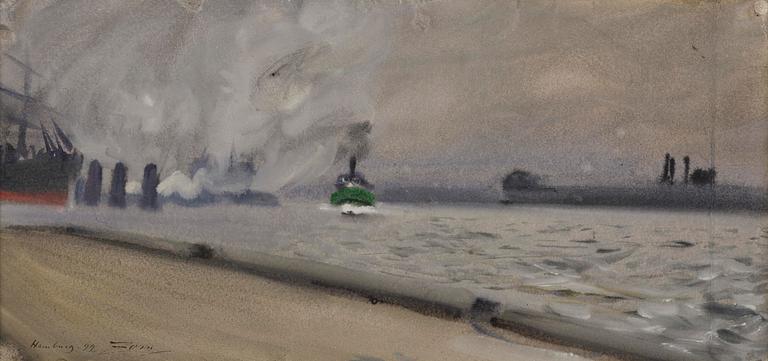
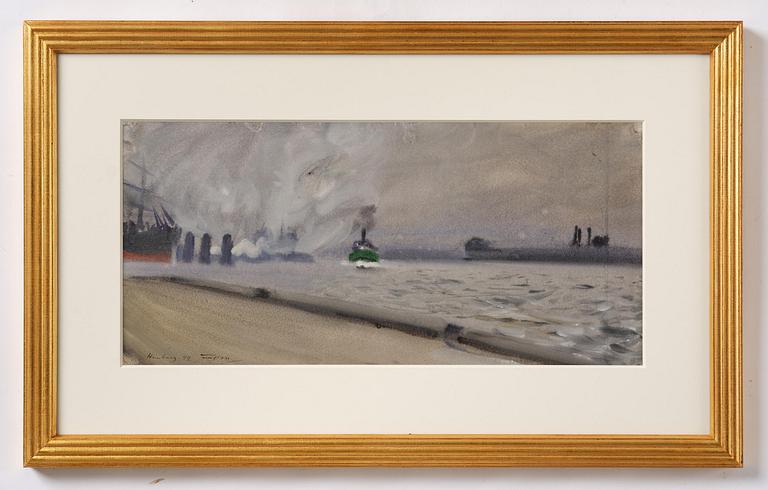
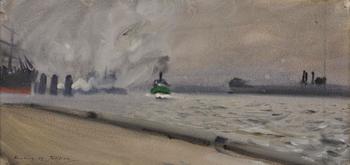
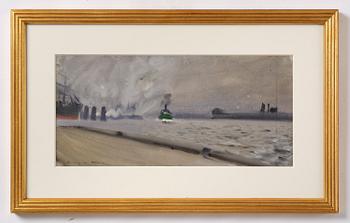
Anders Zorn (Sweden, 1860-1920) In the Port of Hamburg
In the Port of Hamburg
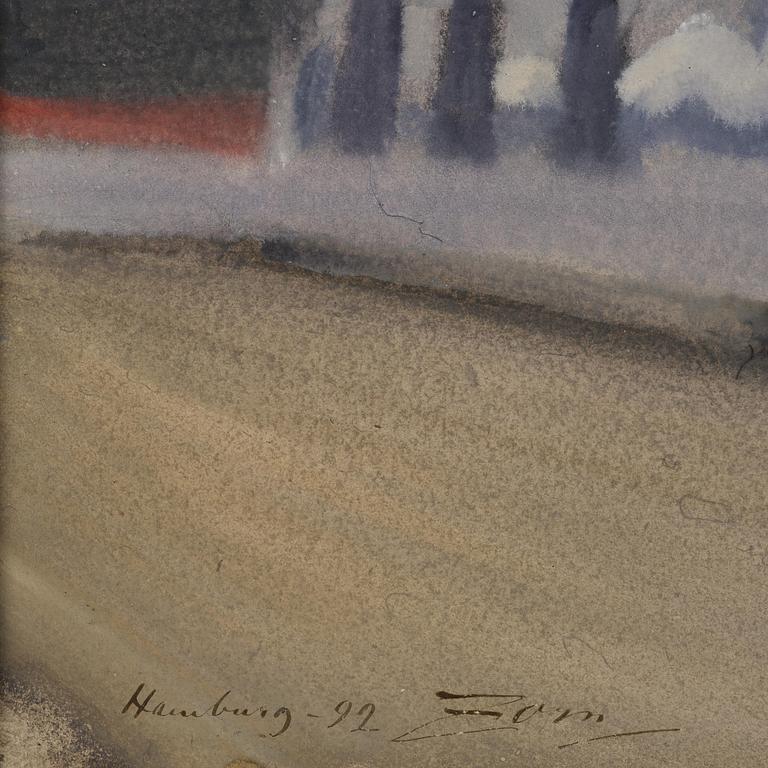
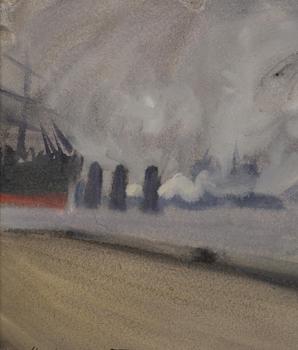
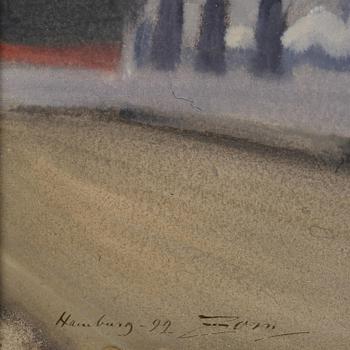
Signed Zorn and dated Hamburg -92. Watercolour heightened with white on paper, 27 x 56 cm.
Exhibitions
Bukowski Auktioner, Stockholm, “Zornutställningen”, August 1994.
More information
Anders and Emma Zorn first visited Hamburg in the autumn of 1885, when they stopped there on their way south during their honeymoon. The newlyweds stayed with Emma’s aunt, Emma Henriques, who was married to the banker Simon Henriques. Over the years, they would return to the German city on several more occasions.
In 1889, Alfred Lichtwark, director of the Hamburger Kunsthalle, established a department devoted to contemporary depictions of the city. He invited a number of artists to visit Hamburg, including Lauritz Tuxen, Frits Thaulow, Pierre Bonnard, Édouard Vuillard and Anders Zorn. This was a testament to Zorn’s success and to his standing as an internationally acclaimed artist. As Hans Henrik Brummer writes in ZORNMCMLXXXIX (1989), Zorn showed less interest in depicting Hamburg’s characteristic landmarks in the watercolours he produced there. Brummer writes:
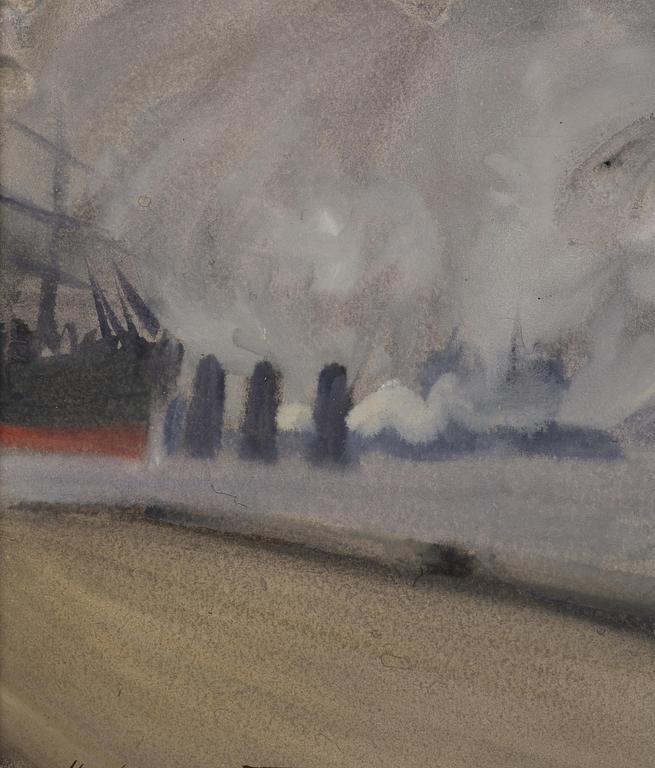
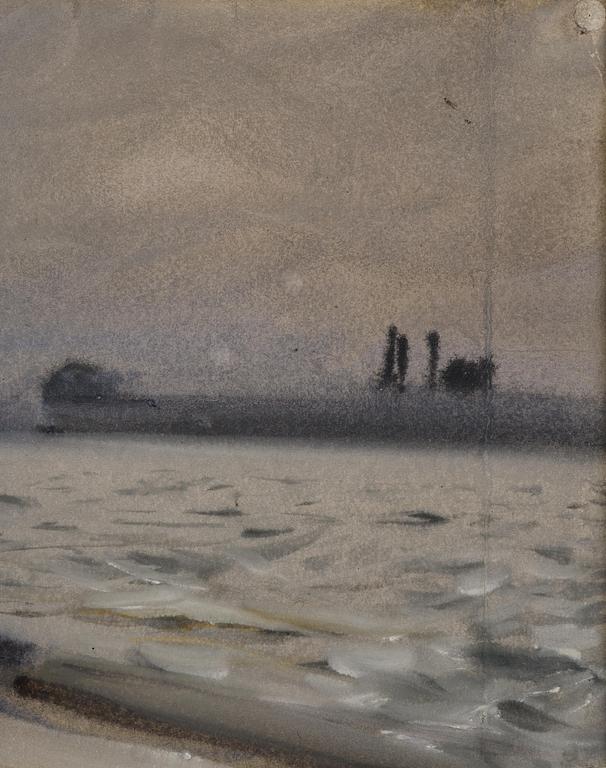
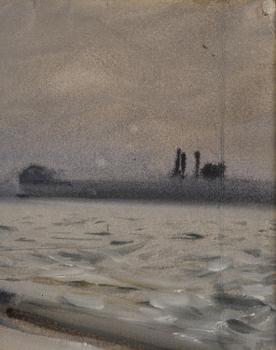
“In his loosely executed sketches, his impressions of the harbour are reduced to brief suggestions of dark hulls reflected in the water, or of a quay running diagonally into the picture with striking effect. [...] Above all, however, the Impressionist Zorn has concentrated his attention on fleeting impressions of natural phenomena: the changing effects of light, the swirling movements of the water, the steam and the atmosphere in Hamburg’s gloomy harbour basin, with its mooring dolphins and ships disappearing into the distance.”
Zorn later recalled his stay in the German city in his "Självbiografiska anteckning":
“It was miserable and bitterly cold out there at Kaiserhöft, but fascinating to paint this muddy expanse of water, the large and small steamers, the steam, the sun and the fog.”
In the present view of Hamburg harbour, offered at auction, Zorn has captured the cold, damp winter atmosphere, where the water, fog and steam hanging in the air are almost palpable. Working wet-in-wet, Zorn creates a gem in the true spirit of Impressionism. He painted most of his harbour scenes of Hamburg in November 1891. On 30 December of the same year, he returned to the city and stayed for a few days. The present work was most likely painted around New Year 1892.
More about Anders Zorn
Anders Zorn, born in Mora in 1860, showed artistic talent from a young age. In 1875, he traveled to Stockholm and became a student at the then Slöjdskolan (now Tekniska högskolan) in Stockholm, and shortly after, he joined the Royal Academy of Fine Arts. Initially, Zorn had aspirations of becoming a sculptor, but soon watercolor painting took over, becoming his primary medium until 1887. At the student exhibition in 1880, Zorn had his breakthrough with the watercolor painting "I sorg." The following year, he gained international acclaim as a portrait painter. His watercolor painting reached its pinnacle during this period, and his most famous work from this time is "Vårt dagliga bröd” from 1886. Shortly thereafter, Zorn transitioned to oil painting, which was met with immediate success. Zorn's reputation mainly rested on his portrait art, and he portrayed many notable figures, including presidents. For instance, he created an etching of Theodore Roosevelt. His etchings significantly contributed to his success. In the late 1880s, Zorn began working in the genre that would increasingly become his trademark: nude figures in outdoor settings. He had long been fascinated by the movement of water and the reflections of light on its surface. Now, he added the complexity of placing a model near or in the water, aiming to depict a synthesis between nature and humanity. In 1896, Zorn and his wife moved back to Sweden and settled in Zorngården in Mora. This move sparked a renewed interest in his homeland, which would be reflected in his future paintings. Among the artist's scenes from the Mora region, portraying its local customs and ancient traditions, "Midsommardansen" holds the highest value according to Zorn himself. Today, the painting can be found at the National Museum.
Read moreFor condition report contact specialist

What will the transport cost?
Shipping can only be arranged by contacting specialdelivery@bukowskis.com.