
Nov 22, 2022
Important Winter Sale: Anders Zorn, ”Modersglädje”
Important Winter Sale presents
Anders Zorn, ”Modersglädje” (Maternal Delight)
After initial stays in Madrid and Seville during November 1881, Zorn set off for Cádiz, tempted by the sea and the city’s women who were reputed to be the most beautiful in all of Spain. Zorn expressed it accordingly in his autobiographical notes: "Yet there was something within me that pulled me towards the ocean – there is always something that pulls me to the ocean. […] Oh, this marvellous island in the Atlantic, connected by a strip of land to the mainland! This wonderful sea air fills one’s lungs, these friendly and hospitable people and these delightful Caditanas! The rule was that the most beautiful girls came from Cadiz.” The painting in the auction, "Modersglädje", is, along with the watercolour "Kusinerna", executed in Cádiz in the same year, one of the absolute central works from Zorn’s first important trip to Spain in 1881-82.
Johan Cederlund has given an account of how "Modersglädje" came about: "Filled with confidence Zorn set about to create what would become two of his central works from his first trip to Spain, "Kusinerna" and "Modersglädje". […] "Kusinerna" became Zorn’s first international success. It was shown at the Salon in 1882, and the newspaper La Presse wrote that Zorn was ‘un aquarelliste de talent’. […] "Kusinerna" is dated January 1882. Immediately after, Zorn tackled his next central work, "Modersglädje", in which a young woman is lovingly playing with her child. The composition, and in particular the child, is reminiscent of Murillo’s famous painting Madonna and Child (1665-66), which is in Museo de Bellas Artes in Seville and which Zorn had acquired a copy of. As with "Kusinerna", "Modersglädje" demonstrates a rich variation between sections of flowing colour and detailed precision work, as seen in the woman’s coral necklace and silver earring”.
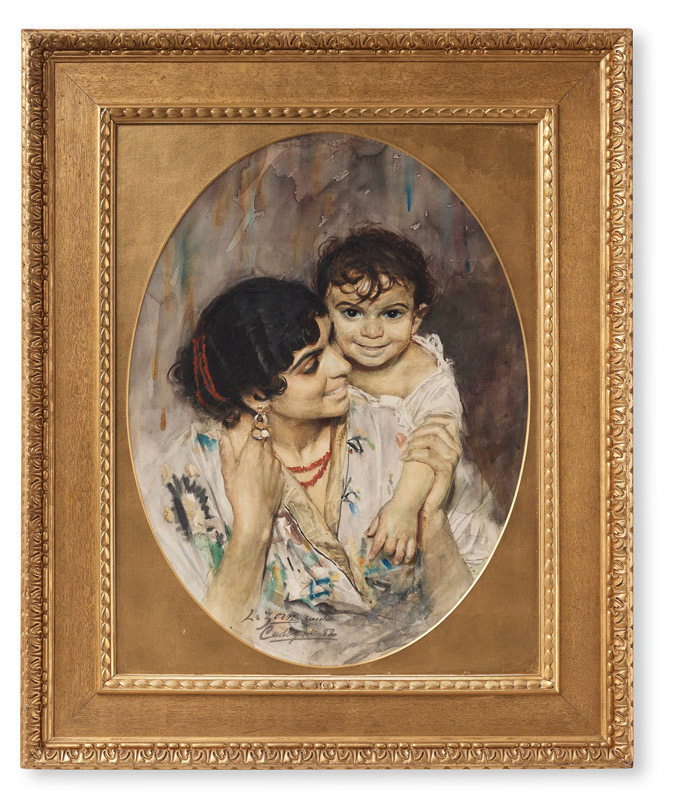
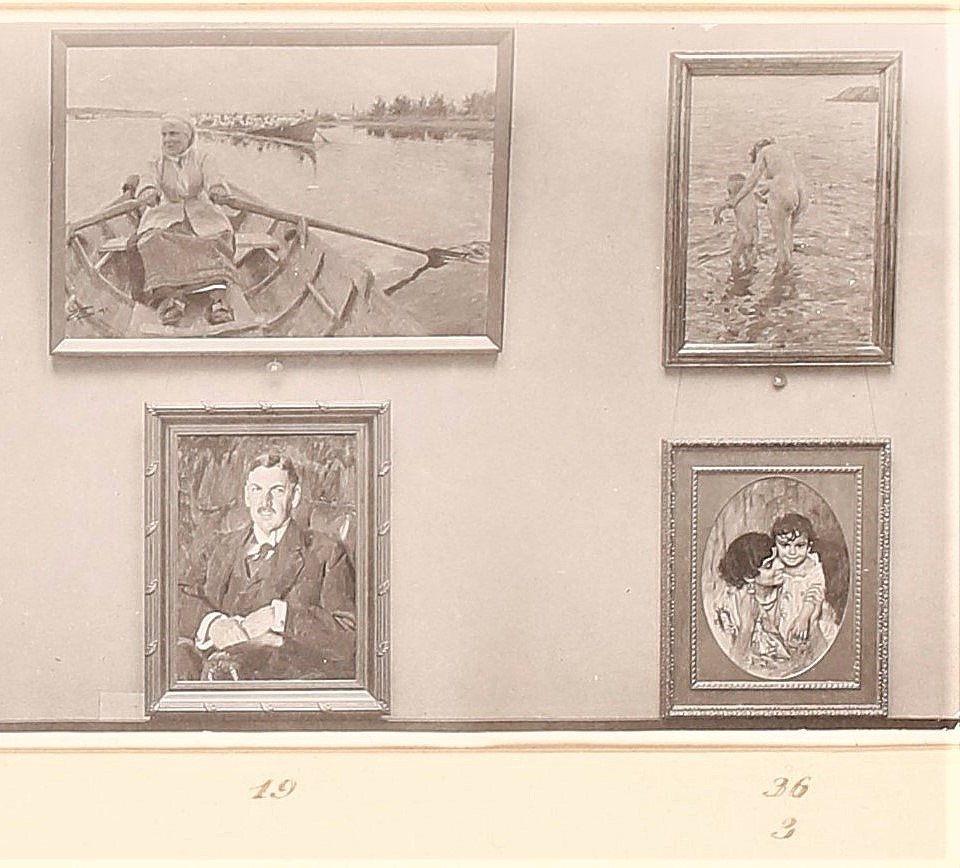
"Modersglädje" was shown in the late autumn of 1882 at Konstföreningen in Stockholm, where it was given an overall favourable reception. In the newspaper Aftonbladet one could read on the 28th of December 1882 how: "Leonard Zorn has for a long while commandeered the visitors’ attention with his "Modersstolthet", a mother with her child – with a particular characteristic expression in her dark, shining eyes, an excellent modelling of the unclothed sections, a lush and soft, very soft, brush and finally such a composition of colours that only this continually forward-moving artist is able to offer us” .
The watercolour was especially appreciated by the artist’s friend Edvard Casparsson who bought the painting for fifty pounds. On the 20th of November 1882 Casparsson wrote to his mother about his successful purchase: "I do not know if you shall like it, but it is undoubtedly Zorn’s most important painting on show in Sweden, or ever" as quoted by Hans Erik Brummer in "Till ögats fröjd och nationens förgyllning – Anders Zorn", 1994.
Hans Henrik Brummer, who referred to the watercolour as "Modersstolthet", has commented on the subject thus: "Even if the image in its overtness may seem banal there is however no reason to underestimate its emotional content". He goes on to write: "Under certain conditions it may even induce feelings of the purest kind. His fiancee, Emma Lamm, wrote in the summer of 1883 to her betrothed that she had had a powerful experience in front of Modersstolthet; ‘When I saw your "Modersstolthet" I felt it to be the greatest I have seen to come from your hand. She was beautiful this painting, in colour and form. I do not know. But one felt in front of her a breeze of the spirit alive, which constitutes the greatness in all creation. It was as if when you painted it you forgot about what was around you and you were captured by a sacred feeling of motherly tenderness’”.
Emma was possibly on to something in her account of the watercolour. Gerda Boëthius connected with this description of the subject when she referred to it as: “a central work that he has put his entire soul into. It is powerfully inspired and the composition is brilliant” (ZORN. Tecknaren, Målaren, Etsaren, Skulptören, 1949).
By the end of February, as "Modersglädje" was finished, Zorn left Cádiz, having spent one of his happiest and most productive periods as an artist there. "I painted”" he would later recall, "with a passion I had never felt before. I was spiritually and physically at my best."
The motif was also executed as an etching the same year (Asplund 4-6, Hjert & Hjert 4-6).
The work is sold at the Important Winter Sale. Estimate 2 000 000 - 2 500 000 SEK.
Viewing: December 1 – 6th, Berzelii Park, Stockholm.
Open: Mon–Fri 11 AM – 18 PM, Sat – Sun 11 AM – 16 PM.
Auction: December 7 – 9th, Arsenalsgatan 2, Stockholm.
To the work
Explore the cataloge
Requests & condition reports Contact specialist


Stockholm
Johan Jinnerot
Specialist Art, Head specialist Old Masters
+46 (0)739 400 801