What does Yixing mean, and what are the origins and history of Yixing teapot production?
Yixing is a city in China, located west of Taihu, the great lake in Jiangsu Province. Ceramics have been produced here since the Neolithic period. The region is rich in clay deposits, and the center of production is located around the small towns of Dingshan and Shushan—today collectively known as Dingshuzhen.
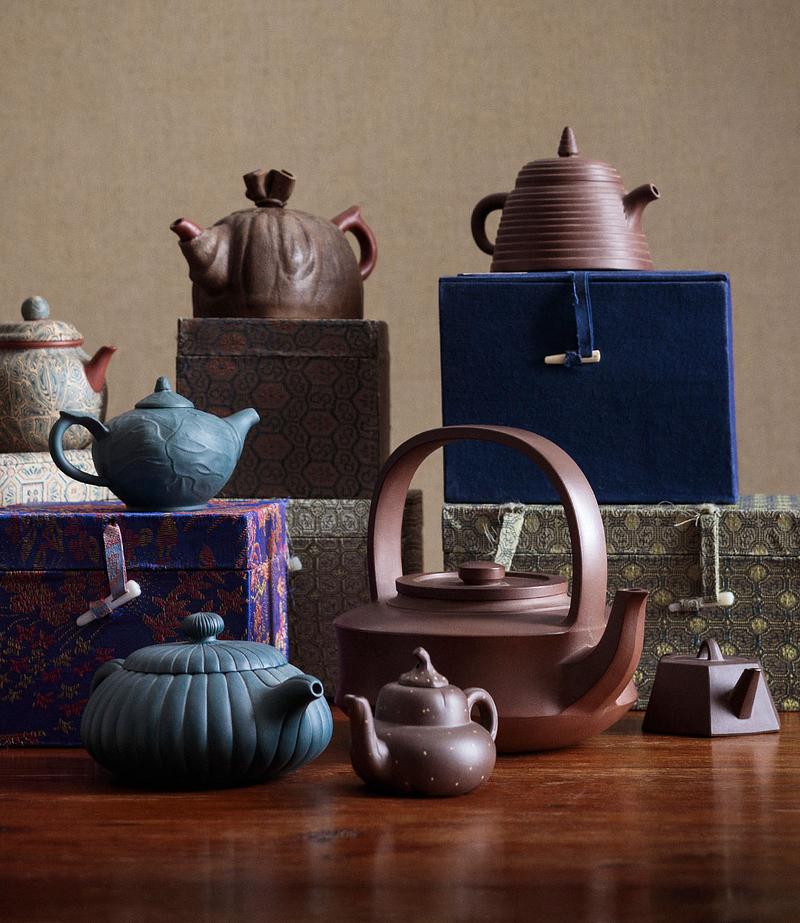
While a wide variety of pottery is produced here—ranging from jars and vessels to roof tiles and porcelain—Yixing is most famous for its zisha, or “purple sand,” teapots and objects for the scholars. The term “Yixing ware” is most commonly associated with teapots, celebrated for their rustic elegance and long prized by tea connoisseurs and scholars in China.
Yixing teapots have been made since the 16th century, with a steady lineage of renowned ceramic artists dating back to the Wanli period (1573–1619).
How are Yixing teapots made?
The dense clay is first pounded with a heavy wooden mallet into slabs. The body of the teapot is then formed using three principal techniques:
– Segmented teapots are press molded.
– Round teapots are shaped by paddling.
– Square teapots are constructed by slabs.
Specialized tools made of wood, bamboo, metal, and horn—developed over centuries—are still used today. A distinctive feature of Yixing craftsmanship is that the same ceramic artist completes every stage of the process, making authorship clear and personal.
Are there different categories of teapots, and are specific styles used for certain teas?
There are four main categories:
– Geometric forms
– Naturalistic forms
– Ribbed or segmented forms
– Miniature teapots (shuiping hu) used for gongfu tea preparation
Different shapes and sizes may be preferred depending on the type of tea being brewed.
What types of clay are used?
Yixing clay is known as zisha (“purple sand”) and consists of three primary types:
– Zisha – purplish-brown clay
– Banshanlu – light sand coloured clay
– Zhusha – cinnabar or deep orange-red clay
By blending these clays, adding mineral pigments, and varying firing temperatures and kiln reduction, potters achieve a rich spectrum of earthy tones—from beige and light brown to cinnabar red, deep brown with a purple hue (hence the name “purple sand”), and even dark green to black.
The latter two colours were introduced in the early 20th century through the addition of cobalt oxide and manganese dioxide. All clay colours may be used across the full range of teapot styles.
Who are some of the most distinguished Yixing ceramic artists?
Gu Jingzhou (1915–1996) was one of the most celebrated masters of zisha teapot craftsmanship. He served as founder and head of research and technology at the Yixing No. 1 Factory. Early in his career, he worked for the antique dealer Lang Yushu, where he had the opportunity to study many classical zisha masterpieces; an influence clearly reflected in his own work.
Zhou Guizhen (born August 1943) is one of China’s most celebrated masters of Yixing Zisha pottery. A native of Yixing, Jiangsu Province, she holds numerous national honors, including Chinese Master of Arts and Crafts, Chinese Ceramic Art Master, and National Representative Inheritor of Yixing Zisha Pottery, recognizing her role in preserving this intangible cultural heritage. Zhou began her career in 1958 at the Yixing Zisha Pottery Factory, training under masters Wang Yinchun and Gu Jingzhou. Her work later evolved through collaborations with leading artists and calligraphers, blending refined craftsmanship with strong artistic expression.
Works by Gu Jingzhou and Zhou Guizhen are highly prized by collectors worldwide, and examples of their work are included in the present auction.
What is the significance of an artist’s seal on a teapot?
Unlike porcelain from Jingdezhen, which passes through many hands during production, a Yixing teapot is typically created from start to finish by a single potter and stamped with their personal seal. When a teapot is a collaborative work, it has more than one seal.
Why are there so many female Yixing potters?
Yixing pottery is fundamentally a craft tradition, and women have long worked across all forms of craftsmanship in China. Unlike many other crafts, Yixing works bear the names of their makers, providing clear documentation of the significant number of women active in the field. In Yixing, many local families possess knowledge of teapot-making; farmers and their families often produce teapots during the winter months. However, their work differs considerably from that of formally trained artistic potters.
What should new collectors look for in a Yixing teapot?
A balance between the body, spout, and handle is essential. The surface should have an appealing finish. If you intend to use the teapot, test it to ensure it does not leak and that the water pours in a smooth, elegant stream. The teapots presented in this auction are crafted by master ceramic artists. Although primarily collectors’ pieces, they remain fully functional for brewing tea.
How should Yixing teapots be displayed and cared for?
Treat a Yixing teapot as a sculpture. When storing it, place a thin piece of soft cloth between the cover and the body. The rim of the cover is the most delicate part of a Yixing teapot and requires special care.