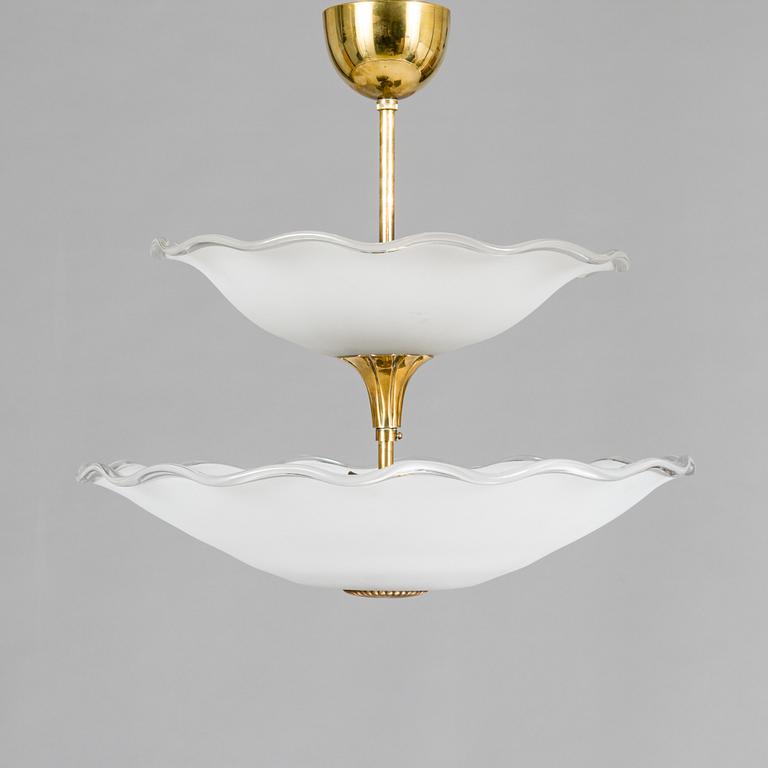
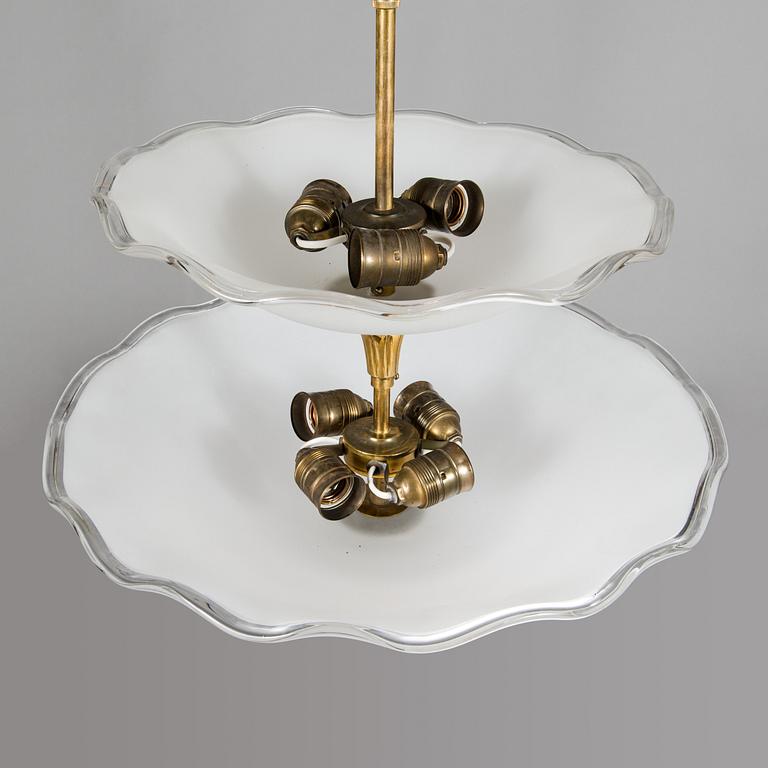
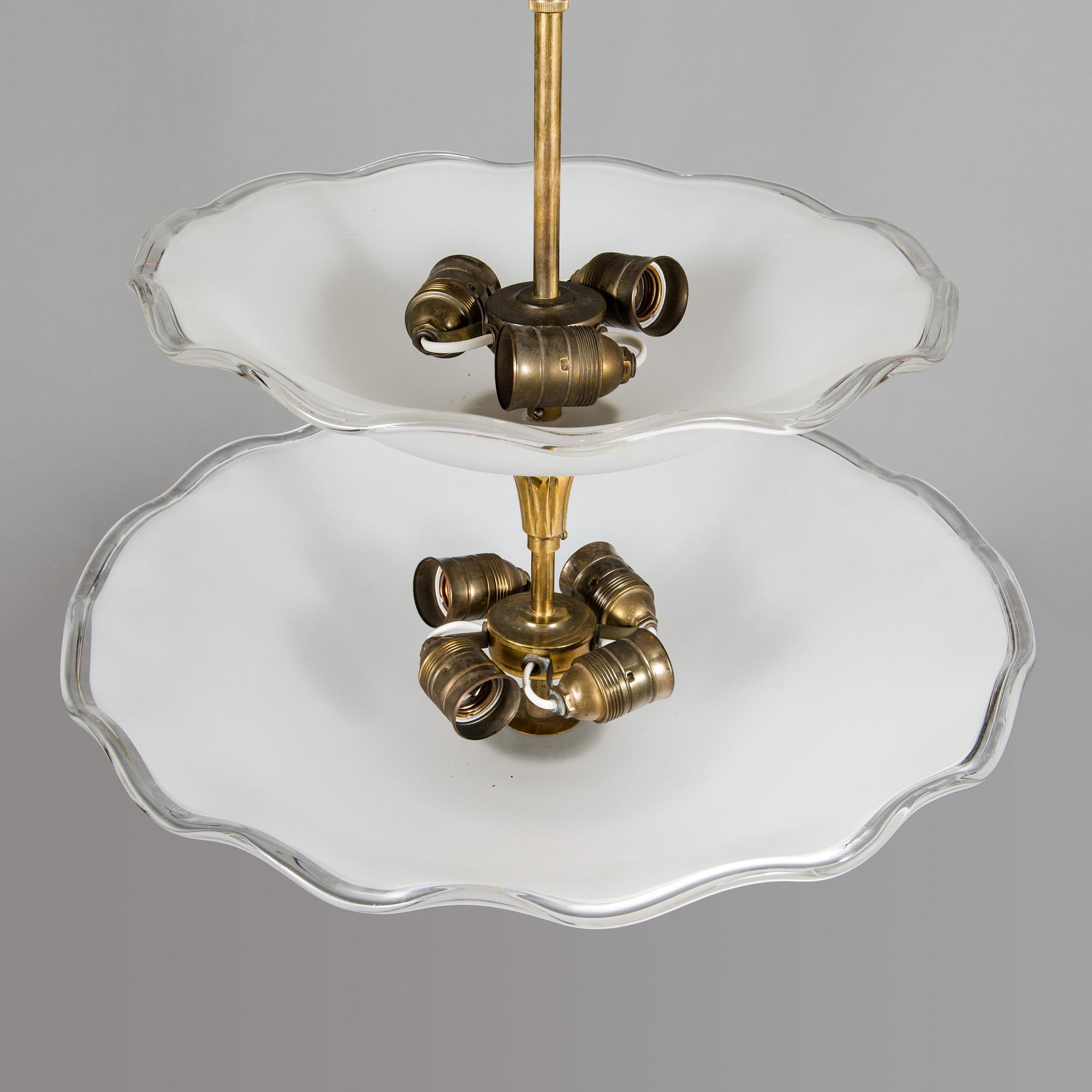
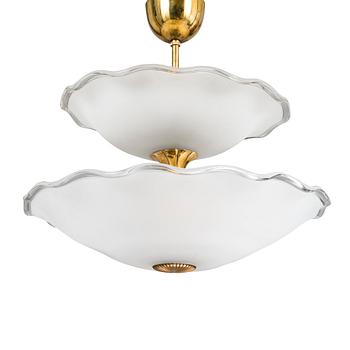
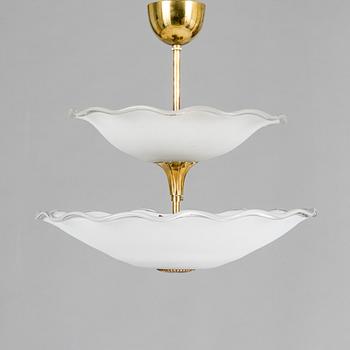
Gunnel Nyman, A 1936 designed pendant lamp for Taito.
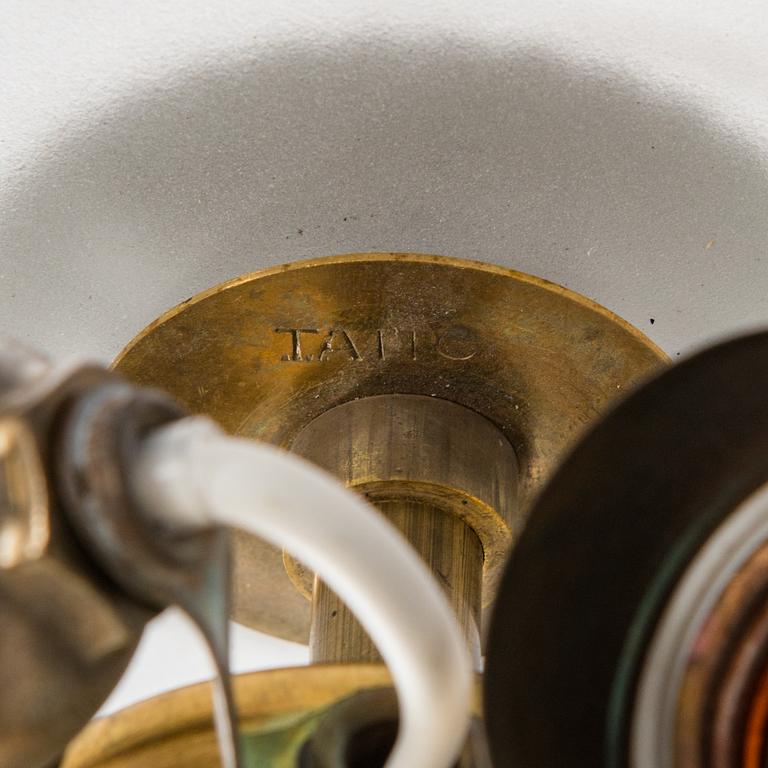
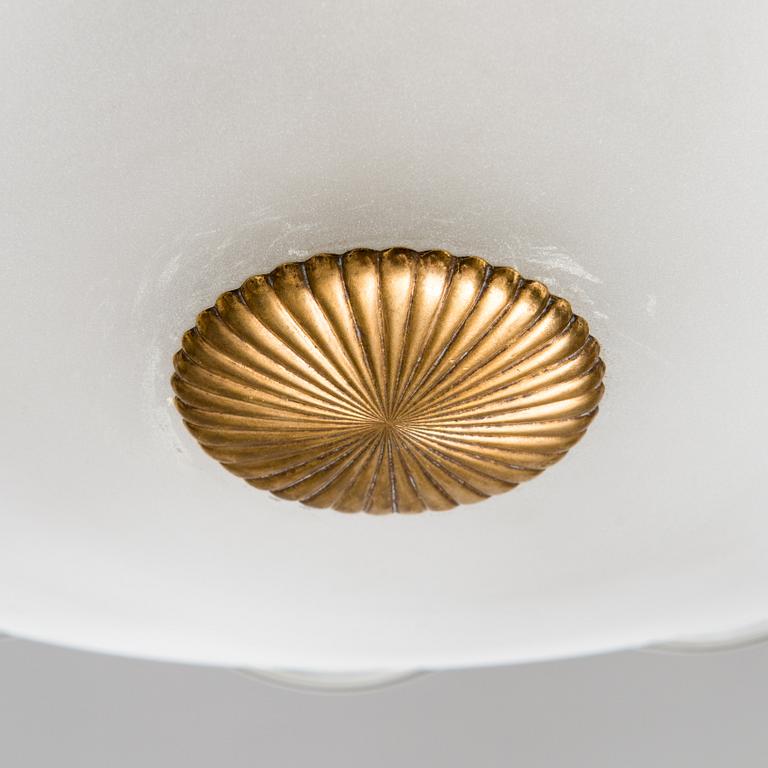
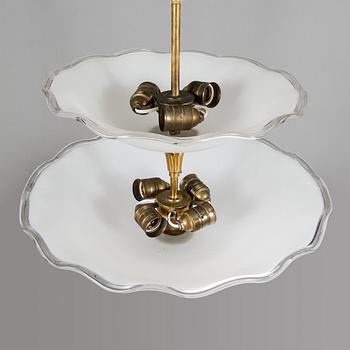
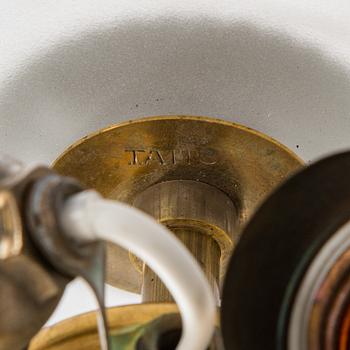
Made to order. Brass frame with two frosted glass shades. Manufacturer's stamp. Total height c. 55 cm. Diameter 52 cm.
Wear due to age and use. Marks. The general impression is good.
Provenance
Pohjoismaiden Yhdyspankki in Parkano.
Exhibitions
This pendant lamp has been exhibited at Finnish Glass museum: The Beauty of the Phenomena Gunnel Nyman & Dora Jung 3.7-25.10 2020.
Literature
The pendant light is illustrated in the book: The Beauty of the Phenomena Gunnel Nyman & Dora Jung. Publisher the Finnish Glass Museum. Page 45.
More information
Gunnel Nyman (1909–1948) started her career as a furniture designer but quickly changed over to glass design. The strongest influence on her career were her teacher Arttu Brummer and a field trip to Stockholm in 1930. During that time the young designer got acquainted with functionalism, and its principles would be visible in her glass artefacts through highlighting the properties of glass and favouring simple, unadorned surfaces.
In the 1930s, designers worked as freelancers, and, in principle, would only get proper recognition through successful competition entry works. Designers wouldn’t just focus on one material but would move between different materials and design targets. In addition to glass artefacts, Gunnel Nyman also designed furniture and luminaires. Although Nyman designed luminaires throughout her career, little information about her production is preserved.
Nyman began designing luminaires in Paavo Tynell’s Oy Taito Ab just after finishing Taideteollisuuskeskuskoulu (Central School of the Industrial Arts) in 1932 and worked there as a drawer and a designer for the next five years. Paavo Tynell was probably in charge of the technical design of the luminaires, while Gunnel Nyman designed the glass parts.
The few known luminaires by Gunnel Nyman feature a combination of her two passions, interior and glass design – the aspiration to highlight the beauty of the material itself and an interest in the reflection and refraction of light on the glass surface are visible in Nyman’s glass artefacts as well as in her luminaires. Her early work in the luminaire industry was a good learning experience that affected her later career in glass arts.
During her short career, Nyman designed furniture, luminaires and glass for leading Finnish furniture and glass factories. Despite her early death, Nyman created a foundation for modern Finnish glass art and served as a vanguard for the next generation of glass artists.
More about Gunnel Nyman
Gunnel Gustafsson-Nyman (1909–1948) was a Finnish glass artist and designer who became a significant pioneer in early modern Finnish glass design. Her work included both functional objects and art glass, and her pieces are represented in international museum collections.
She studied furniture design at the School of Industrial Arts from 1928 to 1932 under the guidance of Arttu Brummer. At the beginning of her career, she worked in a functionalist style, designing furniture for the Stockmann and Boman factories as well as lighting fixtures for Idman’s lighting factory.
Although Nyman was not formally trained as a glass artist, she began designing glass during the 1930s and 1940s and collaborated with several leading Finnish glassworks, including Riihimäki, Karhula, Iittala, and, during the final years of her career, Nuutajärvi.
Nyman received significant international recognition, including a gold medal at the 1937 Paris World Exhibition and medals at the Milan Triennials. Her works are held in the collections of several prestigious museums, including the British Museum and The Metropolitan Museum of Art. Although Nyman passed away at a young age, her influence on glass art extends far into postwar Finnish design.









Others have also viewed